
Chapter 7
Airplane Basic Flight Maneuvers
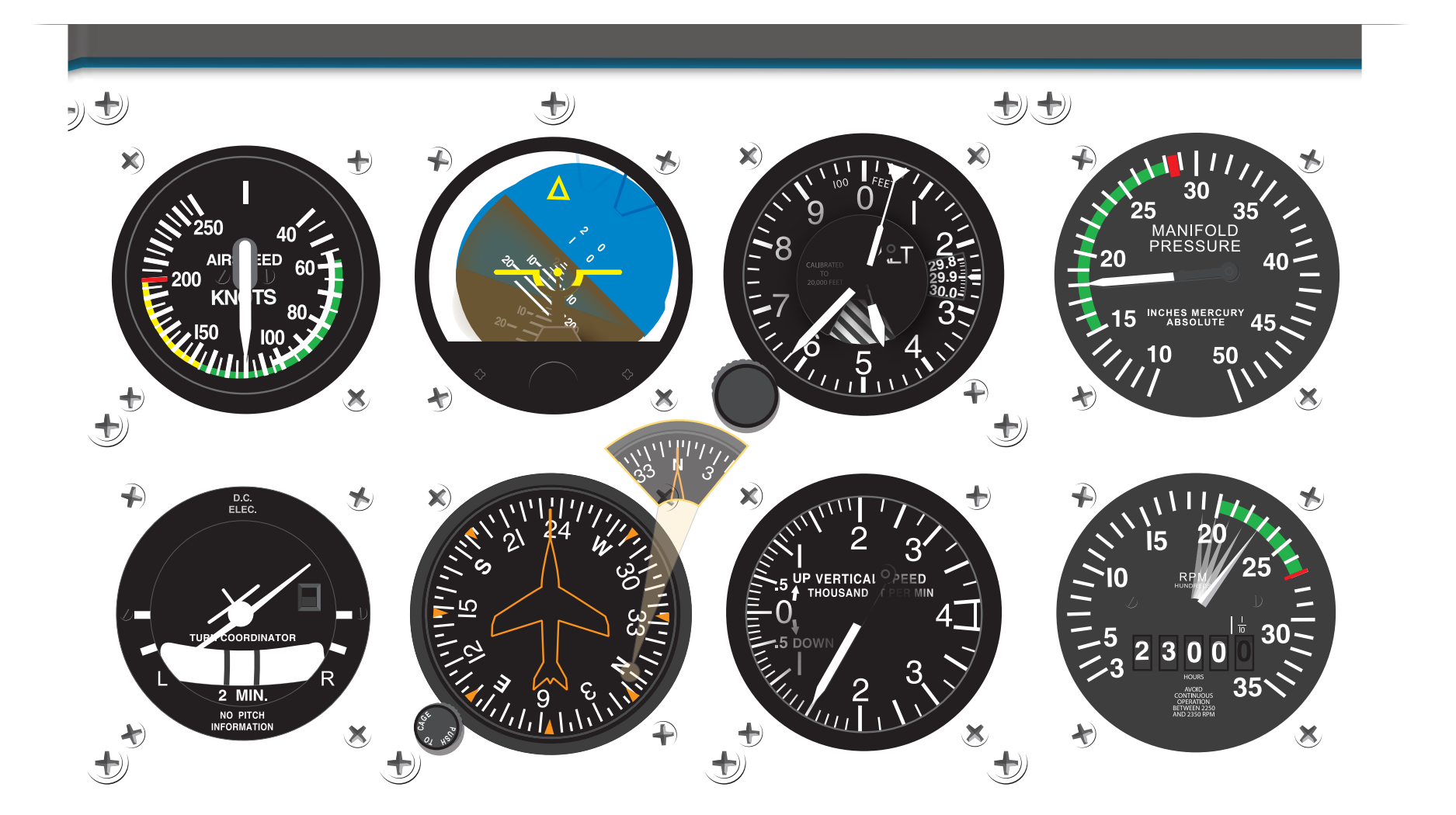
During recovery from steep turns to straight-and-level flight, elevator and power control must be coordinated with bank control in proportion to the changes in aerodynamic forces. Back elevator pressures must be released and power decreased. The common errors associated with steep turns are the same as those discussed later in this section. Remember, errors are more exaggerated, more difficult to correct, and more difficult to analyze unless rates of entry and recovery are consistent with the level of proficiency in the three basic instrument flying skills.
Climbing and Descending Turns
To execute climbing and descending turns, combine the technique used in straight climbs and descents with the various turn techniques. The aerodynamic factors affecting lift and power control must be considered in determining power settings, and the rate of cross-check and interpretation must be increased to enable control of bank as well as pitch changes.
Change of Airspeed During Turns
Changing airspeed during turns is an effective maneuver for increasing proficiency in all three basic instrument skills. Since the maneuver involves simultaneous changes in all components of control, proper execution requires rapid cross-check and interpretation as well as smooth control. Proficiency in the maneuver also contributes to confidence in the instruments during attitude and power changes involved in more complex maneuvers. Pitch and power control techniques are the same as those used during changes in airspeed in straight-and-level flight.
The angle of bank necessary for a given rate of turn is proportional to the true airspeed. Since the turns are executed at a standard rate, the angle of bank must be varied in direct proportion to the airspeed change in order to maintain a constant rate of turn. During a reduction of airspeed, decrease the angle of bank and increase the pitch attitude to maintain altitude and a standard rate turn.
The altimeter and turn coordinator indications should remain constant throughout the turn. The altimeter is primary for pitch control and the miniature aircraft of the turn coordinator is primary for bank control. The manifold pressure gauge (or tachometer) is primary for power control while the airspeed is changing. As the airspeed approaches the new indication, the ASI becomes primary for power control.
Two methods of changing airspeed in turns may be used. In the first method, airspeed is changed after the turn is established. [Figure 7-38] In the second method, the airspeed change is initiated simultaneously with the turn entry. The first method is easier, but regardless of the method used, the rate of cross-check must be increased as power is reduced. As the airplane decelerates, check the altimeter and VSI for necessary pitch changes and the bank instruments for required bank changes.
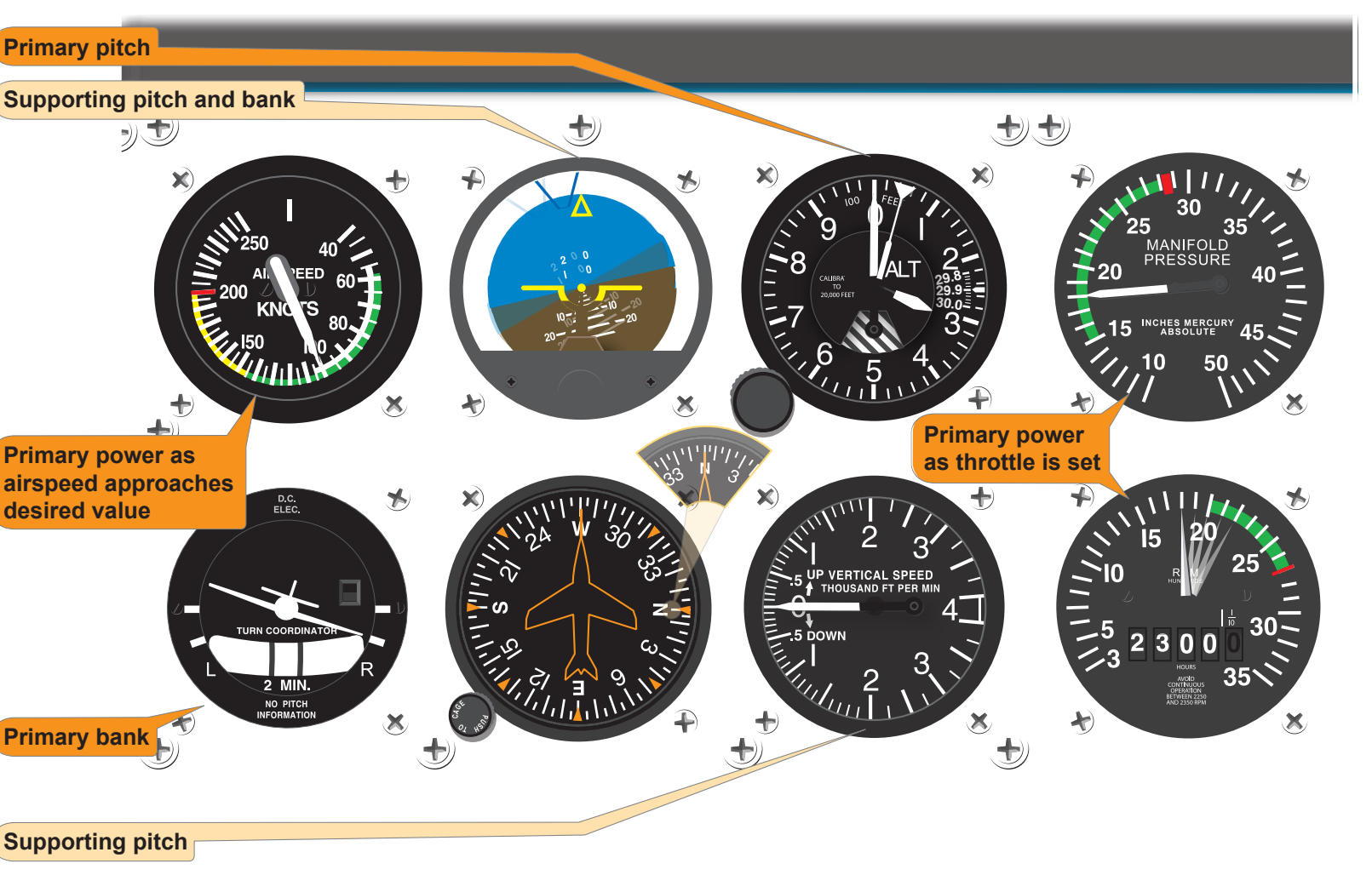
If the miniature aircraft of the turn coordinator indicates a deviation from the desired deflection, adjust the bank. Adjust pitch attitude to maintain altitude. When approaching the desired airspeed, pitch attitude becomes primary for power control and the manifold pressure gauge (or tachometer) is adjusted to maintain the desired airspeed. Trim is important throughout the maneuver to relieve control pressures.
Until control technique is very smooth, frequent cross-check of the attitude indicator is essential to prevent overcontrolling and to provide approximate bank angles appropriate to the changing airspeeds.
Common Errors in Turns
Pitch
Pitch errors result from the following faults:
- Preoccupation with bank control during turn entry and recovery. If 5 seconds are required to roll into a turn, check the pitch instruments as bank pressures are initiated. If bank control pressure and rate of bank change are consistent, a sense of the time required for an attitude change is developed. During the interval, check pitch, power, and trim—as well as bank—controlling the total attitude instead of one factor at a time.
- Failure to understand or remember the need for changing the pitch attitude as the vertical lift component changes, resulting in consistent loss of altitude during entries.
- Changing the pitch attitude before it is necessary. This fault is very likely if a cross-check is slow and rate of entry too rapid. The error occurs during the turn entry due to a mechanical and premature application of back-elevator control pressure.
- Overcontrolling the pitch changes. This fault commonly occurs with the previous error.
- Failure to properly adjust the pitch attitude as the vertical lift component increases during the roll-out, resulting in consistent gain in altitude on recovery to headings.
- Failure to trim during turn entry and following turn recovery (if turn is prolonged).
- Failure to maintain straight-and-level cross-check after roll-out. This error commonly follows a perfectly executed turn.
- Erratic rates of bank change on entry and recovery, resulting from failure to cross-check the pitch instruments with a consistent technique appropriate to the changes in lift.
Bank
Bank and heading errors result from the following faults:
- Overcontrolling, resulting in overbanking upon turn entry, overshooting and undershooting headings, as well as aggravated pitch, airspeed, and trim errors.
- Fixation on a single bank instrument. On a 90° change of heading, for example, leave the heading indicator out of the cross-check for approximately 20 seconds after establishing a standard rate turn, since at 3° per second the turn will not approach the lead point until that time has elapsed. Make the cross-check selective, checking only what needs to be checked at the appropriate time.
- Failure to check for precession of the horizon bar following recovery from a turn. If the heading indicator shows a change in heading when the attitude indicator shows level flight, the airplane is turning. If the ball is centered, the attitude gyro has precessed; if the ball is not centered, the airplane may be in a slipping or skidding turn. Center the ball with rudder pressure, check the attitude indicator and heading indicator, stop the heading change if it continues, and retrim.
- Failure to use the proper degree of bank for the amount of heading change desired. Rolling into a 20° bank for a heading change of 10° will normally overshoot the heading. Use the bank attitude appropriate to the amount of heading change desired.
- Failure to remember the heading to which the aircraft is being turned. This fault is likely when rushing the maneuver.
- Turning in the wrong direction, due to misreading or misinterpreting the heading indicator, or to confusion regarding the location of points on the compass. Turn in the shortest direction to reach a given heading, unless there is a specific reason to turn the long way around. Study the compass rose and visualize at least the positions of the eight major points around the azimuth. A number of methods can be used to make quick computations for heading changes. For example, to turn from a heading of 305° to a heading of 110°, would a pilot turn right or left for the shortest way around? Subtracting 200 from 305 and adding 20, gives 125° as the reciprocal of 305°; therefore, execute the turn to the right. Likewise, to figure the reciprocal of a heading less than 180°, add 200 and subtract 20. Computations are done more quickly using multiples of 100s and 10s than by adding or subtracting 180° from the actual heading; therefore, the method suggested above may save time and confusion.
- Failure to check the ball of the turn coordinator when interpreting the instrument for bank information. If the roll rate is reduced to zero, the miniature aircraft of the turn coordinator indicates only direction and rate of turn. Unless the ball is centered, do not assume the turn is resulting from a banked attitude.