
Chapter 7
Airplane Basic Flight Maneuvers
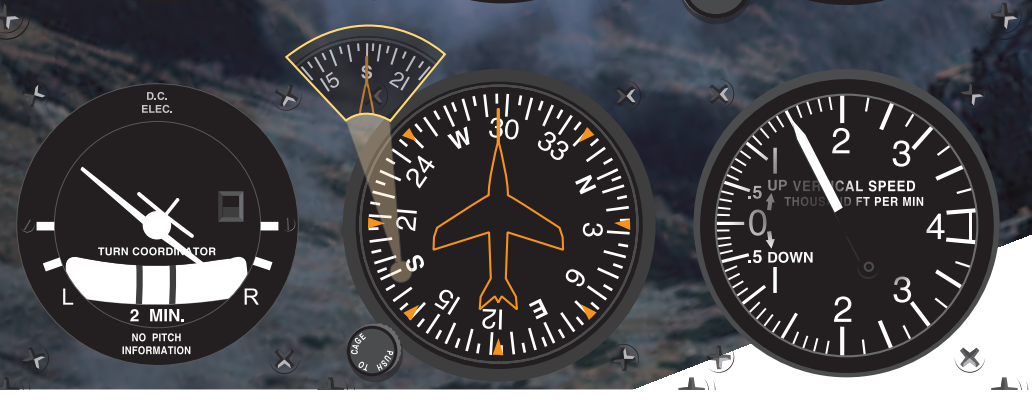
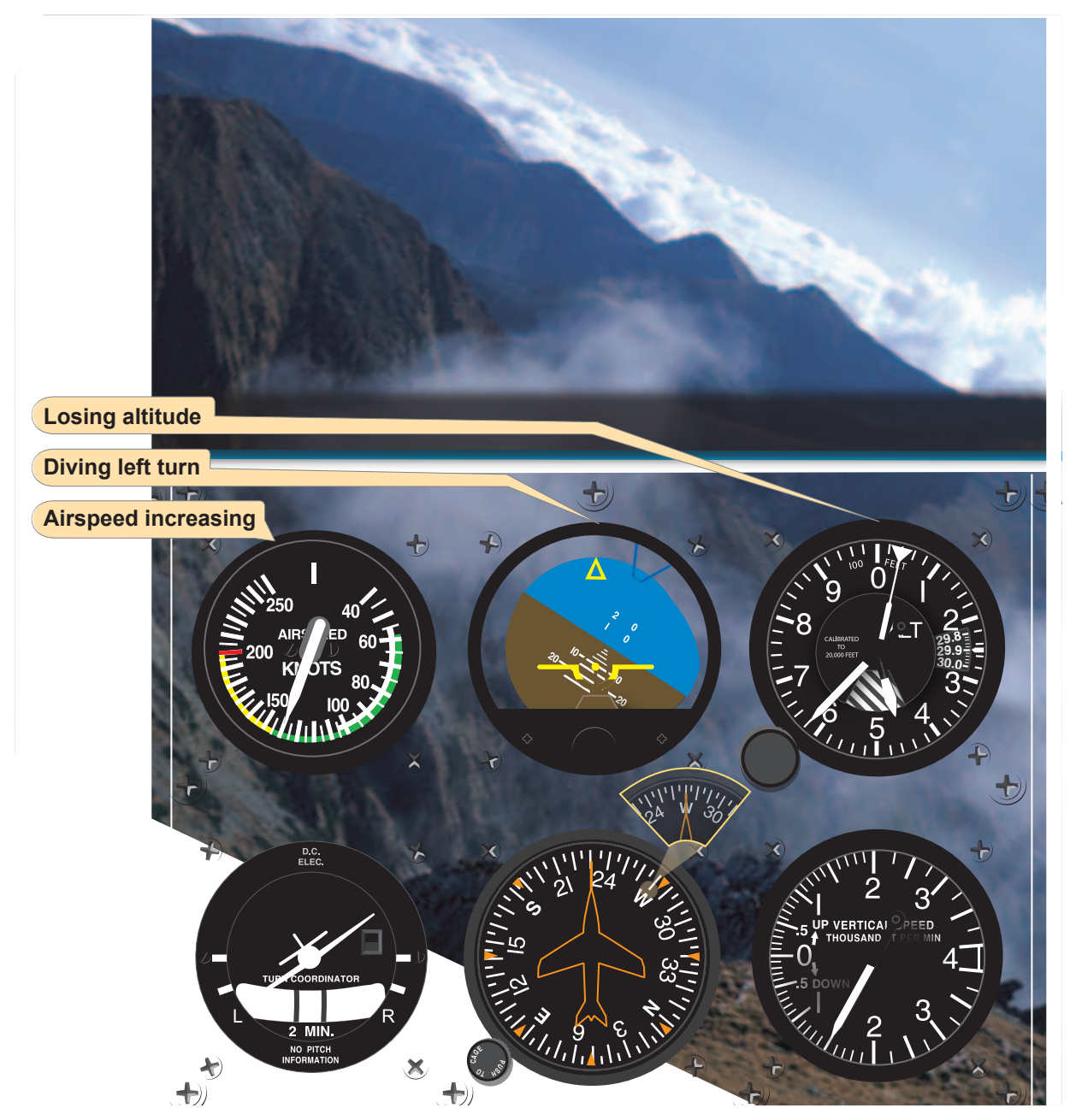
Nose-high attitudes are shown by the rate and direction of movement of the altimeter needle, vertical speed needle, and airspeed needle, as well as the immediately recognizable indication of the attitude indicator (except in extreme attitudes). [Figure 7-39] Nose-low attitudes are shown by the same instruments, but in the opposite direction. [Figure 7-40]
Recovery from Unusual Attitudes
In moderate unusual attitudes, the pilot can normally reorient by establishing a level flight indication on the attitude indicator. However, the pilot should not depend on this instrument if the attitude indicator is the spillable type, because its upset limits may have been exceeded or it may have become inoperative due to mechanical malfunction. If it is the nonspillable-type instrument and is operating properly, errors up to 5 degrees of pitch-and-bank may result and its indications are very difficult to interpret in extreme attitudes. As soon as the unusual attitude is detected, the recommended recovery procedures stated in the POH/AFM should be initiated. If there are no recommended procedures stated in the POH/AFM, the recovery should be initiated by reference to the ASI, altimeter, VSI, and turn coordinator.
Nose-High Attitudes
If the airspeed is decreasing, or below the desired airspeed, increase power (as necessary in proportion to the observed deceleration), apply forward elevator pressure to lower the nose and prevent a stall, and correct the bank by applying coordinated aileron and rudder pressure to level the miniature aircraft and center the ball of the turn coordinator. The corrective control applications are made almost simultaneously, but in the sequence given above. A level pitch attitude is indicated by the reversal and stabilization of the ASI and altimeter needles. Straight coordinated flight is indicated by the level miniature aircraft and centered ball of the turn coordinator.
Nose-Low Attitudes
If the airspeed is increasing, or is above the desired airspeed, reduce power to prevent excessive airspeed and loss of altitude. Correct the bank attitude with coordinated aileron and rudder pressure to straight flight by referring to the turn coordinator. Raise the nose to level flight attitude by applying smooth back elevator pressure. All components of control should be changed simultaneously for a smooth, proficient recovery. However, during initial training a positive, confident recovery should be made by the numbers, in the sequence given above. A very important point to remember is that the instinctive reaction to a nose-down attitude is to pull back on the elevator control.
After initial control has been applied, continue with a fast cross-check for possible overcontrolling, since the necessary initial control pressures may be large. As the rate of movement of altimeter and ASI needles decreases, the attitude is approaching level flight. When the needles stop and reverse direction, the aircraft is passing through level flight. As the indications of the ASI, altimeter, and turn coordinator stabilize, incorporate the attitude indicator into the cross-check.
The attitude indicator and turn coordinator should be checked to determine bank attitude and then corrective aileron and rudder pressures should be applied. The ball should be centered. If it is not, skidding and slipping sensations can easily aggravate disorientation and retard recovery. If entering the unusual attitude from an assigned altitude (either by an instructor or by air traffic control (ATC) if operating under instrument flight rules (IFR)), return to the original altitude after stabilizing in straight-and-level flight.
Common Errors in Unusual Attitudes
Common errors associated with unusual attitudes include the following faults:
- Failure to keep the airplane properly trimmed. A flight deck interruption when holding pressures can easily lead to inadvertent entry into unusual attitudes.
- Disorganized flight deck. Hunting for charts, logs, computers, etc., can seriously distract attention from the instruments.
- Slow cross-check and fixations. The impulse is to stop and stare when noting an instrument discrepancy unless a pilot has trained enough to develop the skill required for immediate recognition.
- Attempting to recover by sensory sensations other than sight. The discussion of disorientation in Chapter 3, Human Factors, indicates the importance of trusting the instruments.
- Failure to practice basic instrument skills. All of the errors noted in connection with basic instrument skills are aggravated during unusual attitude recoveries until the elementary skills have been mastered.
Instrument Takeoff
Competency in instrument takeoffs will provide the proficiency and confidence necessary for use of flight instruments during departures under conditions of low visibility, rain, low ceilings, or disorientation at night. A sudden rapid transition from “visual” to “instrument” flight can result in serious disorientation and control problems.
Instrument takeoff techniques vary with different types of airplanes, but the method described below is applicable whether the airplane is single- or multiengine; tricycle gear or conventional gear.
Align the airplane with the centerline of the runway with the nosewheel or tailwheel straight. Lock the tailwheel, if so equipped, and hold the brakes firmly to avoid creeping while preparing for takeoff. Set the heading indicator with the nose index on the 5 degree mark nearest the published runway heading to allow instant detection of slight changes in heading during the takeoff. Make certain that the instrument is uncaged (if it has a caging feature) by rotating the knob after uncaging and checking for constant heading indication. If using an electric heading indicator with a rotatable needle, rotate the needle so that it points to the nose position, under the top index. Advance the throttle to an rpm that will provide partial rudder control. Release the brakes, advancing the power smoothly to takeoff setting.
During the takeoff roll, hold the heading constant on the heading indicator by using the rudder. In multiengine, propeller-driven airplanes, also use differential throttle to maintain direction. The use of brakes should be avoided, except as a last resort, as it usually results in overcontrolling and extending the takeoff roll. Once the brakes are released, any deviation in heading must be corrected instantly.