
Chapter 7
Airplane Basic Flight Maneuvers
- Overcontrolling pitch on climb entry. Until the pitch attitudes related to specific power settings used in climbs and descents are known, larger than necessary pitch adjustments are made. One of the most difficult habits to acquire during instrument training is to restrain the impulse to disturb a flight attitude until the result is known. Overcome the inclination to make a large control movement for a pitch change, and learn to apply small control pressures smoothly, cross-checking rapidly for the results of the change, and continuing with the pressures as instruments show the desired results. Small pitch changes can be easily controlled, stopped, and corrected; large changes are more difficult to control.
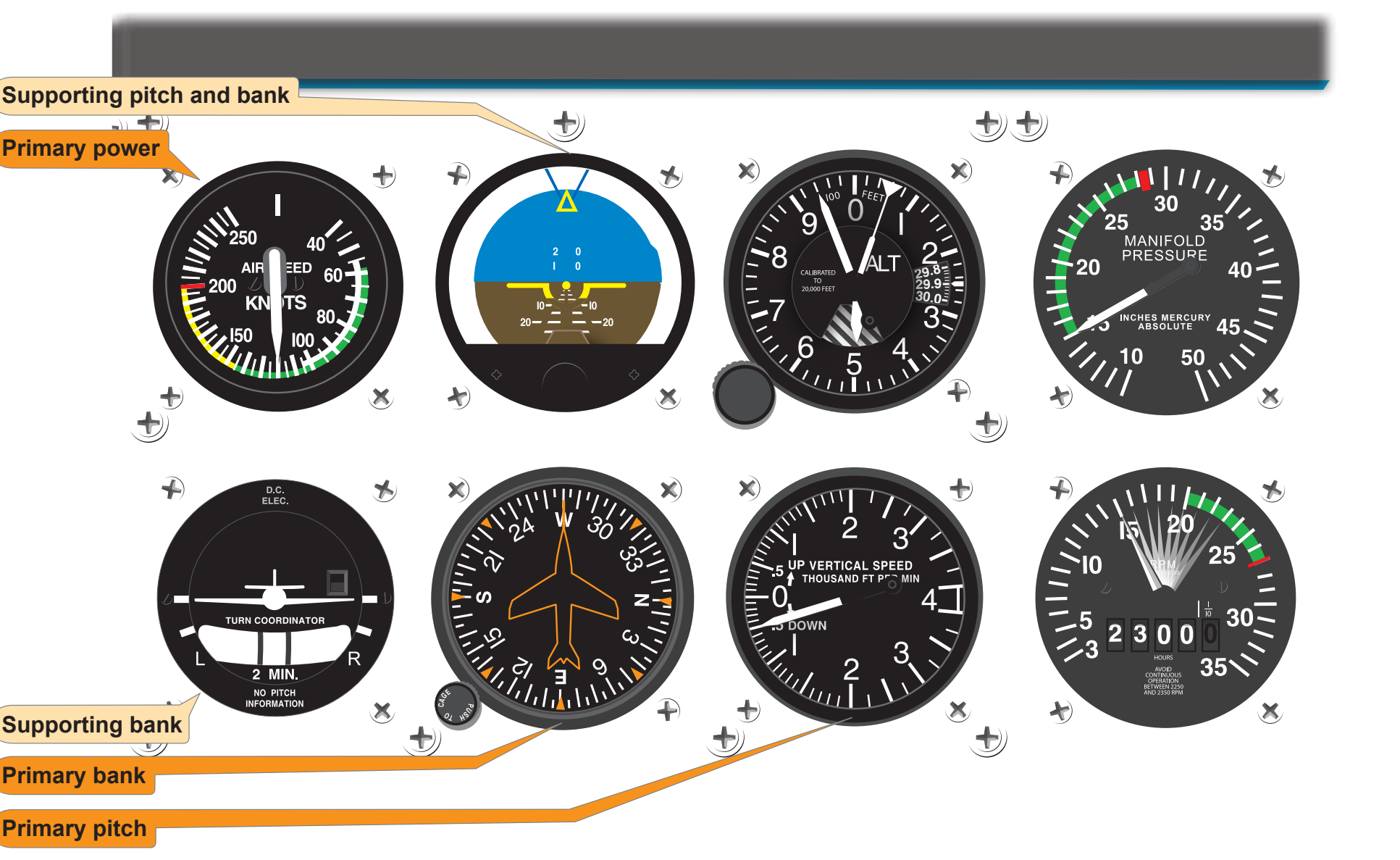
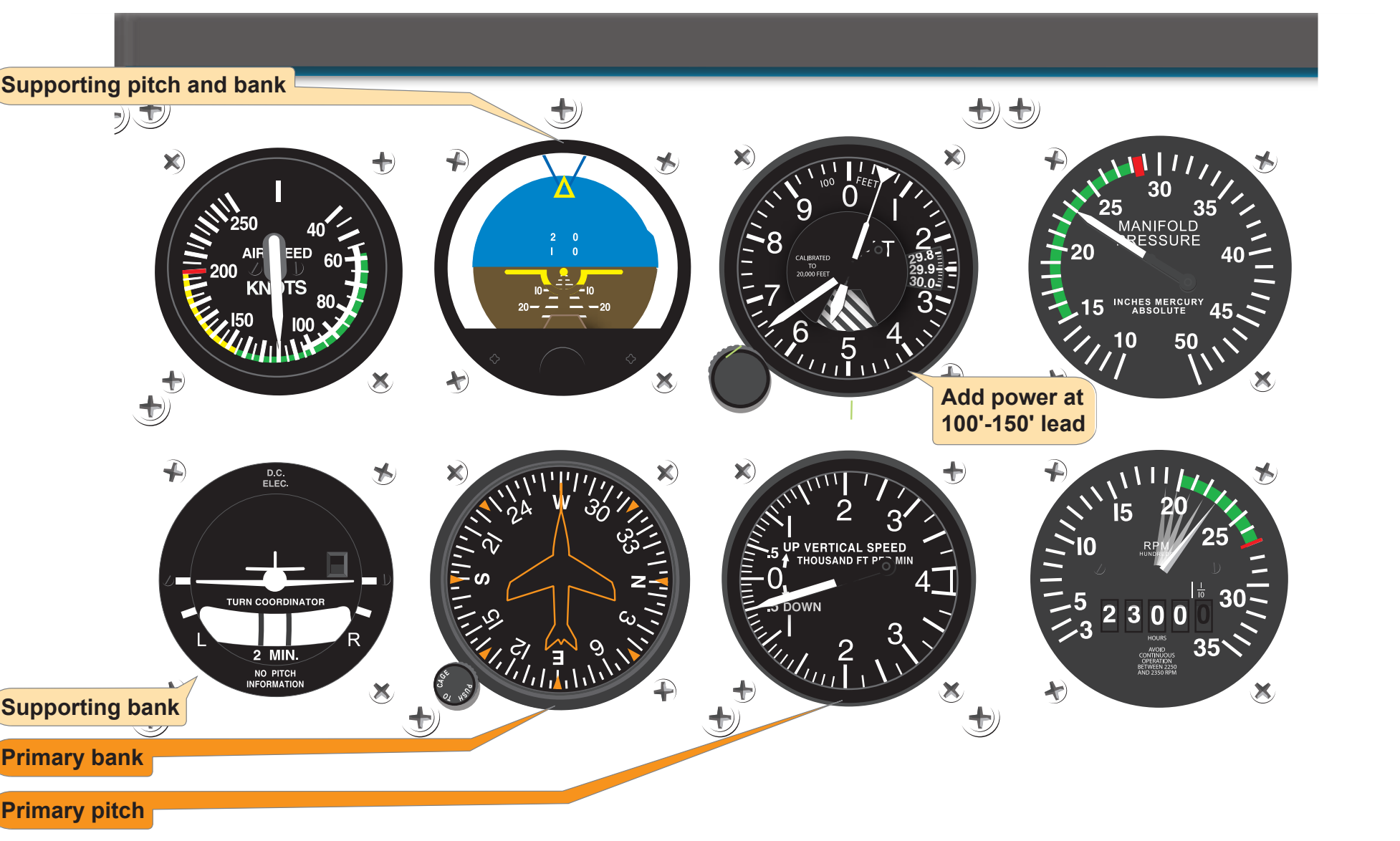
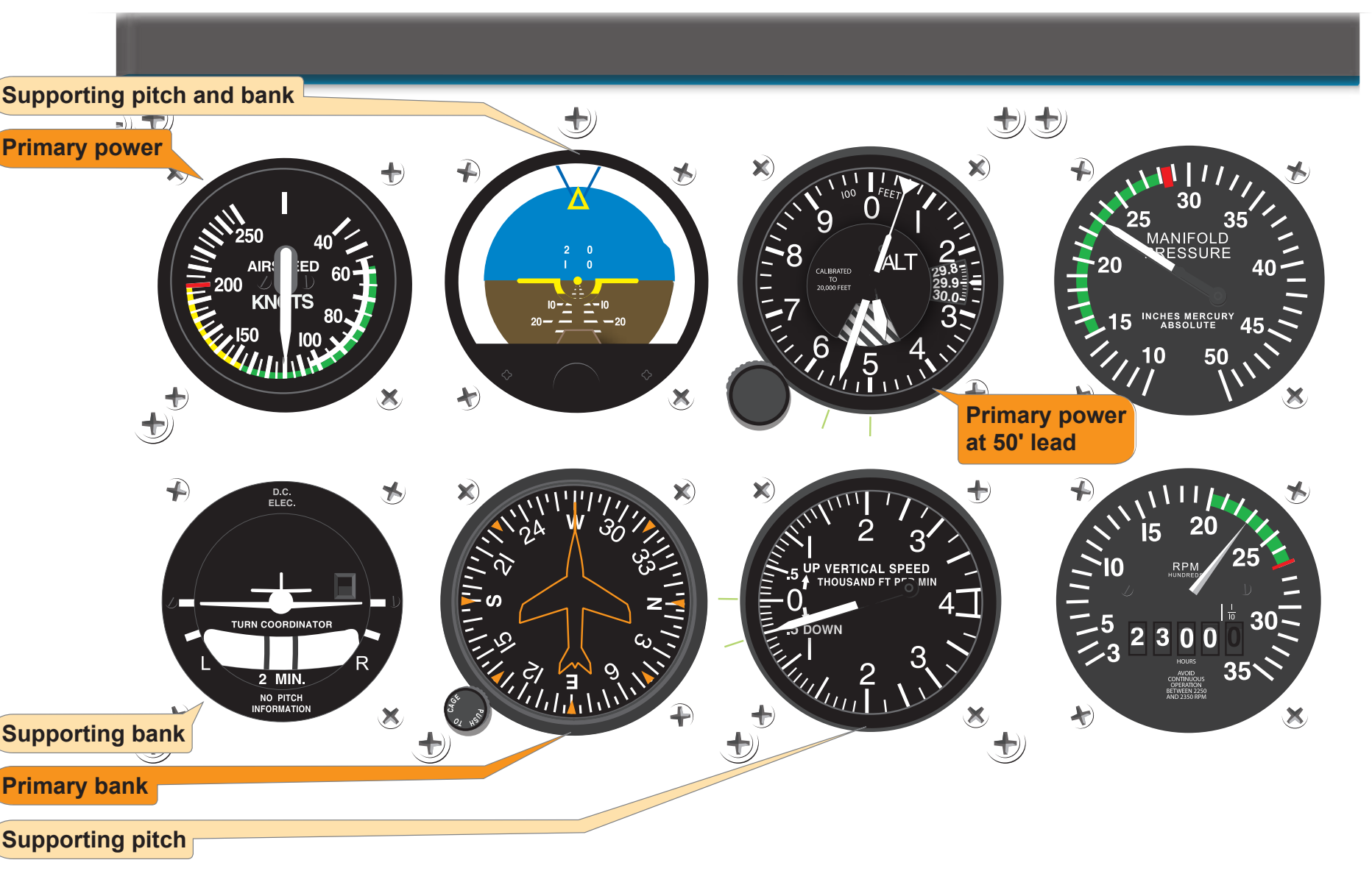
- Failure to vary the rate of cross-check during speed, power, or attitude changes or climb or descent entries.
- Failure to maintain a new pitch attitude. For example, raising the nose to the correct climb attitude, and as the airspeed decreases, either overcontrol and further increase the pitch attitude or allow the nose to lower. As control pressures change with airspeed changes, cross-check must be increased and pressures readjusted.
- Failure to trim off pressures. Unless the airplane is trimmed, there is difficulty in determining whether control pressure changes are induced by aerodynamic changes or by the pilot’s own movements.
- Failure to learn and use proper power settings.
- Failure to cross-check both airspeed and vertical speed before making pitch or power adjustments.
- Improper pitch and power coordination on slow-speed level offs due to slow cross-check of airspeed and altimeter indications.
- Failure to cross-check the VSI against the other pitch control instruments, resulting in chasing the vertical speed.
- Failure to note the rate of climb or descent to determine the lead for level offs, resulting in overshooting or undershooting the desired altitude.
- Ballooning (allowing the nose to pitch up) on level offs from descents, resulting from failure to maintain descending attitude with forward-elevator pressure as power is increased to the level flight cruise setting.
- Failure to recognize the approaching straight-and-level flight indications as level off is completed. Maintain an accelerated cross-check until positively established in straight-and-level flight.
Turns
Standard Rate Turns
A standard rate turn is one in which the pilot will do a complete 360° circle in 2 minutes or 3 degrees per second. A standard rate turn, although always 3 degrees per second, requires higher angles of bank as airspeed increases. To enter a standard rate level turn, apply coordinated aileron and rudder pressures in the desired direction of turn. Pilots commonly roll into turns at a much too rapid rate. During initial training in turns, base control pressures on the rate of cross-check and interpretation. Maneuvering an airplane faster than the capability to keep up with the changes in instrument indications only creates the need to make corrections.
A rule of thumb to determine the approximate angle of bank required for a standard rate turn is to use 15 percent of the true airspeed. A simple way to determine this amount is to divide the airspeed by 10 and add one-half the result. For example, at 100 knots, approximately 15° of bank is required (100 ÷ 10 = 10 + 5 = 15); at 120 knots, approximately 18° of bank is needed for a standard rate turn.
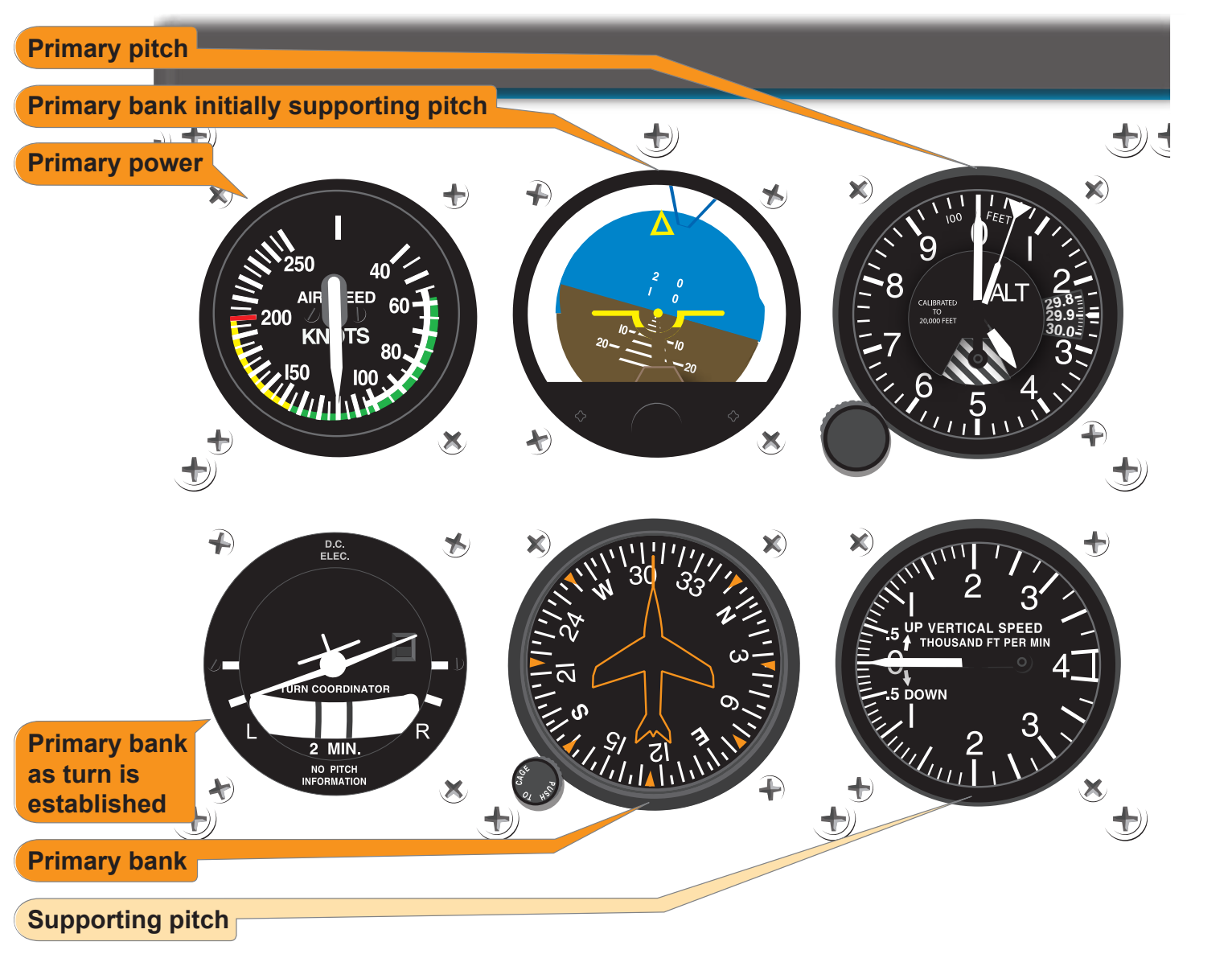
On the roll-in, use the attitude indicator to establish the approximate angle of bank, and then check the turn coordinator’s miniature aircraft for a standard rate turn indication or the aircraft’s turn-and-bank indicator. Maintain the bank for this rate of turn, using the turn coordinator’s miniature aircraft as the primary bank reference and the attitude indicator as the supporting bank instrument. [Figure 7-33] Note the exact angle of bank shown on the banking scale of the attitude indicator when the turn coordinator indicates a standard rate turn.
During the roll-in, check the altimeter, VSI, and attitude indicator for the necessary pitch adjustments as the vertical lift component decreases with an increase in bank. If constant airspeed is to be maintained, the ASI becomes primary for power, and the throttle must be adjusted as drag increases. As the bank is established, trim off the pressures applied during pitch and power changes.
To recover to straight-and-level flight, apply coordinated aileron and rudder pressures opposite to the direction of the turn. Strive for the same rate of roll-out used to roll into the turn; fewer problems are encountered in estimating the lead necessary for roll-out on exact headings, especially on partial panel maneuvers. Upon initiation of the turn recovery, the attitude indicator becomes the primary bank instrument. When the airplane is approximately level, the heading indicator is the primary bank instrument as in straight-and-level flight. Pitch, power, and trim adjustments are made as changes in vertical lift component and airspeed occur. The ball should be checked throughout the turn, especially if control pressures are held rather than trimmed off.
Some airplanes are very stable during turns, requiring only slight trim adjustments that permit hands-off flight while the airplane remains in the established attitude. Other airplanes require constant, rapid cross-check and control during turns to correct overbanking tendencies. Due to the interrelationship of pitch, bank, and airspeed deviations during turns, cross-check must be fast in order to prevent an accumulation of errors.
Turns to Predetermined Headings
As long as an airplane is in a coordinated bank, it continues to turn. Thus, the roll-out to a desired heading must be started before the heading is reached. The amount of lead varies with the relationship between the rate of turn, angle of bank, and rate of recovery. For small heading changes, use a bank angle that does not exceed the number of degrees to be turned. Lead the desired heading by one-half the number of degrees of bank used. For example, if a 10° bank is used during a change in heading, start the roll-out 5 degrees before reaching the desired heading. For larger changes in heading, the amount of lead varies since the angle of bank for a standard rate turn varies with the true airspeed.
Practice with a lead of one-half the angle of bank until the precise lead a given technique requires is determined. If rates of roll-in and roll-out are consistent, the precise amount of lead suitable to a particular roll-out technique can be determined.
Timed Turns
A timed turn is a turn in which the clock and the turn coordinator are used to change heading by a specific number of degrees in a given time. For example, in a standard rate turn (3 degrees per second), an airplane turns 45° in 15 seconds; in a half standard rate turn, the airplane turns 45° in 30 seconds.