
Chapter 7
Airplane Basic Flight Maneuvers
Prior to performing timed turns, the turn coordinator should be calibrated to determine the accuracy of its indications. [Figure 7-34] Establish a standard rate turn as indicated by the turn coordinator, and as the sweep-second hand of the clock passes a cardinal point (12, 3, 6, 9), check the heading on the heading indicator. While holding the indicated rate of turn constant, note the indicated heading changes at 10 second intervals. If the airplane turns more than or less than 30° in that interval, a respectively larger or smaller deflection of the miniature aircraft of the turn coordinator is necessary to produce a standard rate turn. After calibrating the turn coordinator during turns in each direction, note the corrected deflections, if any, and apply them during all timed turns.
The same cross-check and control technique is used in making a timed turn that is used to execute turns to predetermined headings, except the clock is substituted for the heading indicator. The miniature aircraft of the turn coordinator is primary for bank control, the altimeter is primary for pitch control, and the ASI is primary for power control. Start the roll-in when the clock’s second hand passes a cardinal point, hold the turn at the calibrated standard rate indication (or half-standard rate for small heading changes), and begin the roll-out when the computed number of seconds has elapsed. If the rates of roll-in and roll-out are the same, the time taken during entry and recovery does not need to be considered in the time computation.
Practice timed turns with a full instrument panel and check the heading indicator for the accuracy of turns. If the turns are executed without the gyro heading indicator, use the magnetic compass at the completion of the turn to check turn accuracy, taking compass deviation errors into consideration.
Compass Turns
In most small airplanes, the magnetic compass is the only direction-indicating instrument independent of other airplane instruments and power sources. Because of its operating characteristics, called compass errors, pilots are prone to use it only as a reference for setting the heading indicator, but knowledge of magnetic compass characteristics permits full use of the instrument to turn the airplane to correct and maintain headings.
Remember the following points when making turns to magnetic compass headings or when using the magnetic compass as a reference for setting the heading indicator:
- If on a north heading and a turn is started to the east or west, the compass indication lags or indicates a turn in the opposite direction.
- If on a south heading and a turn is started toward the east or west, the compass indication precedes the turn, indicating a greater amount of turn than is actually occurring.
- When on an east or west heading, the compass indicates correctly when starting a turn in either direction.
- If on an east or west heading, acceleration results in a north turn indication; deceleration results in a south turn indication.
- When maintaining a north or south heading, no error results from diving, climbing, or changing airspeed.
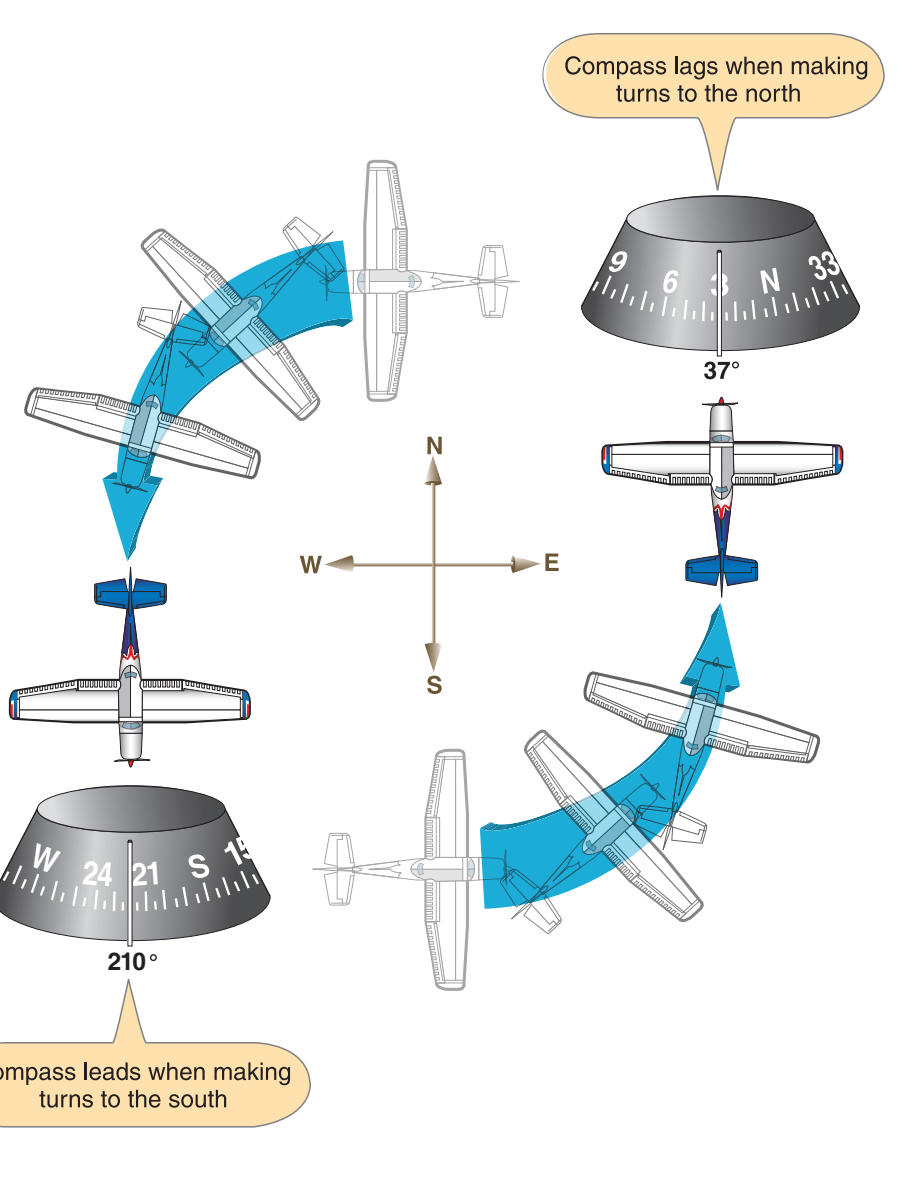
With an angle of bank between 15° and 18°, the amount of lead or lag to be used when turning to northerly or southerly headings varies with, and is approximately equal to, the latitude of the locality over which the turn is being made. When turning to a heading of north, the lead for roll-out must include the number of degrees of change of latitude, plus the lead normally used in recovery from turns. During a turn to a south heading, maintain the turn until the compass passes south the number of degrees of latitude, minus normal roll-out lead. [Figure 7-35]
For example, when turning from an easterly direction to north, where the latitude is 30°, start the roll-out when the compass reads 37° (30° plus one-half the 15° angle of bank, or whatever amount is appropriate for the rate of roll-out). When turning from an easterly direction to south, start the roll-out when the magnetic compass reads 203° (180° plus 30° minus one-half the angle of bank). When making similar turns from a westerly direction, the appropriate points at which to begin the roll-out would be 323° for a turn to north and 157° for a turn to south.
When turning to a heading of east or west from a northerly direction, start the roll-out approximately 10° to 12° before the east or west indication is reached. When turning to an east or west heading from a southerly direction, start the rollout approximately 5 degrees before the east or west indication is reached. When turning to other headings, the lead or lag must be interpolated.
Abrupt changes in attitude or airspeed and the resulting erratic movements of the compass card make accurate interpretations of the instrument very difficult. Proficiency in compass turns depends on knowledge of compass characteristics, smooth control technique, and accurate bank-and-pitch control.
Steep Turns
For purposes of instrument flight training in conventional airplanes, any turn greater than a standard rate is considered steep. [Figure 7-36] The exact angle of bank at which a normal turn becomes steep is unimportant. What is important is learning to control the airplane with bank attitudes in excess of those normally used on instruments. Practicing steep turns will not only increase proficiency in the basic instrument flying skills, but also enable smooth, quick, and confident reactions to unexpected abnormal flight attitudes under instrument flight conditions.
Pronounced changes occur in the effects of aerodynamic forces on aircraft control at progressively greater bank attitudes. Skill in cross-check, interpretation, and control is increasingly necessary in proportion to the amount of these changes, though the techniques for entering, maintaining, and recovering from the turn are the same in principle for steep turns as for shallower turns.
Enter a steep turn in the same way as a shallower turn, but prepare to cross-check rapidly as the turn steepens. Because of the greatly reduced vertical lift component, pitch control is usually the most difficult aspect of this maneuver. Unless immediately noted and corrected with a pitch increase, the loss of vertical lift results in rapid movement of the altimeter, vertical speed, and airspeed needles. The faster the rate of bank change, the more suddenly the lift changes occur. If a cross-check is fast enough to note the immediate need for pitch changes, smooth, steady back-elevator pressure will maintain constant altitude. However, overbanking to excessively steep angles without adjusting pitch as the bank changes occur requires increasingly stronger elevator pressure. The loss of vertical lift and increase in wing loading finally reach a point at which further application of back-elevator pressure tightens the turn without raising the nose.
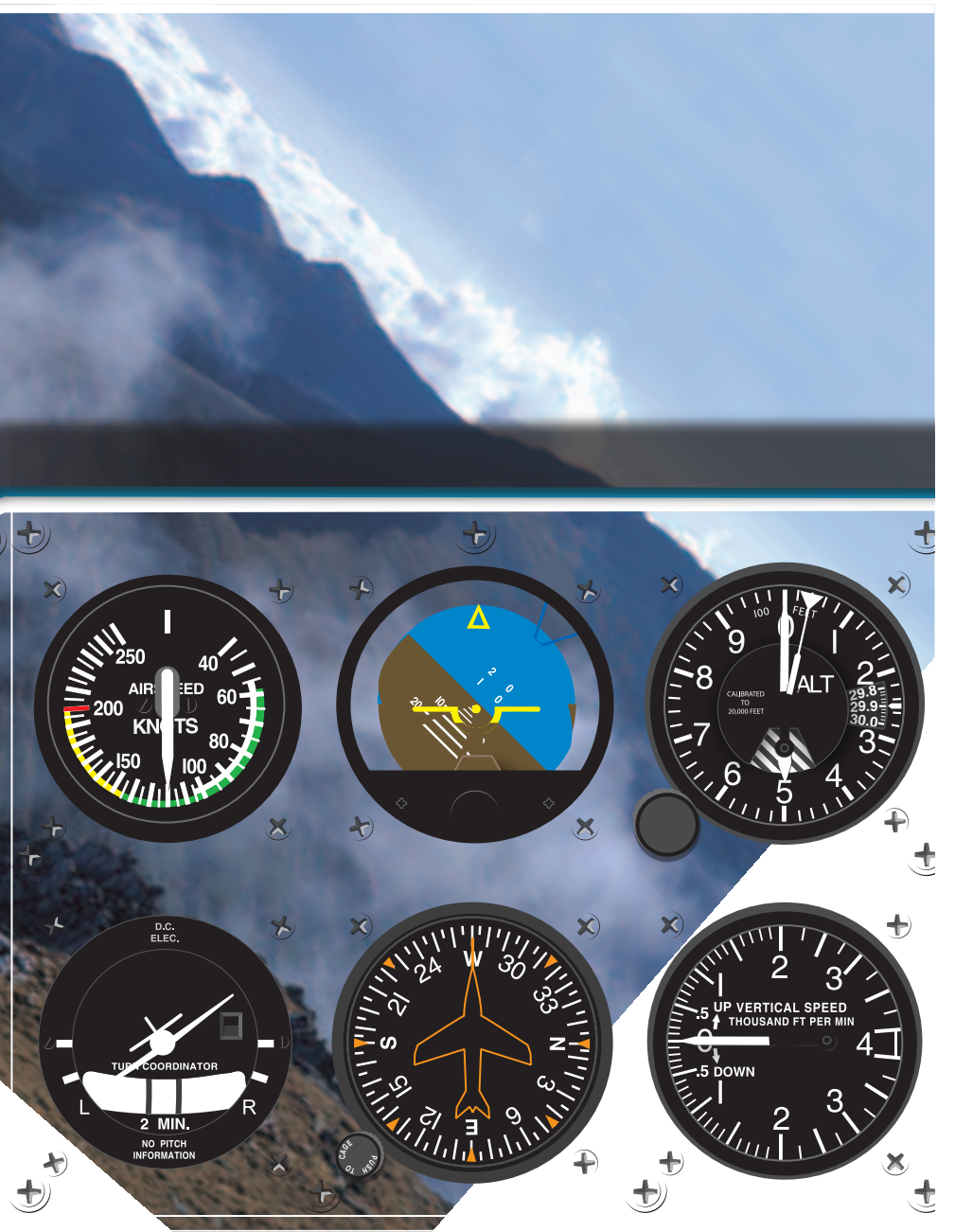
How does a pilot recognize overbanking and low pitch attitude? What should a pilot do to correct them? If a rapid downward movement of the altimeter needle or vertical speed needle, together with an increase in airspeed, is observed despite application of back elevator pressure, the airplane is in a diving spiral. [Figure 7-37] Immediately shallow the bank with smooth and coordinated aileron and rudder pressures, hold or slightly relax elevator pressure, and increase the cross-check of the attitude indicator, altimeter, and VSI. Reduce power if the airspeed increase is rapid. When the vertical speed trends upward, the altimeter needle moves slower as the vertical lift increases. When the elevator is effective in raising the nose, hold the bank attitude shown on the attitude indicator and adjust elevator control pressures smoothly for the nose-high attitude appropriate to the bank maintained. If pitch control is consistently late on entries to steep turns, rollout immediately to straight-and-level flight and analyze possible errors. Practice shallower turns initially and learn the attitude changes and control responses required, then increase the banks as a quicker and more accurate cross-check and control techniques are developed.
The power necessary to maintain constant airspeed increases as the bank and drag increase. With practice, the power settings appropriate to specific bank attitudes are learned, and adjustments can be made without undue attention to airspeed and power instruments. During training in steep turns, as in any other maneuver, attend to the most important tasks first. Keep the pitch attitude relatively constant, and more time can be devoted to cross-check and instrument interpretation.