
Chapter 7
Airplane Basic Flight Maneuvers
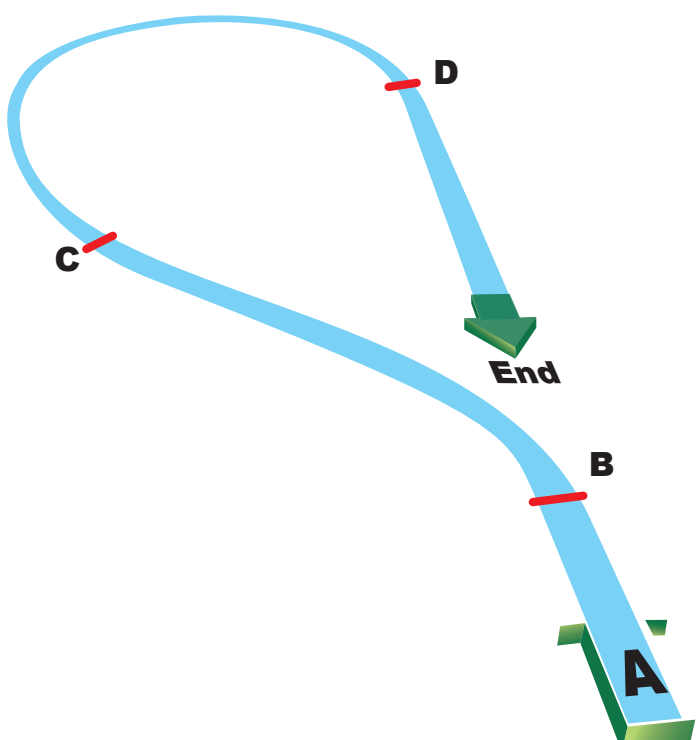
- At point C, turn 225° right (using a standard rate turn) which will provide a heading of 180°. The timing is such that in a no wind environment, the pilot will be aligned with the final approach course of 180° at
- Wind conditions, however must be considered during the execution of the procedure turn. Compensating for wind may result in changes to outbound time, procedure turn heading and/or time and minor changes in the inbound turn.
80/260 Procedure Turn
- Start timing at point A (usually identified on approach procedures by a fix). For example, fly outbound on a heading of 360° for 2 minutes. [Figure 7-43]
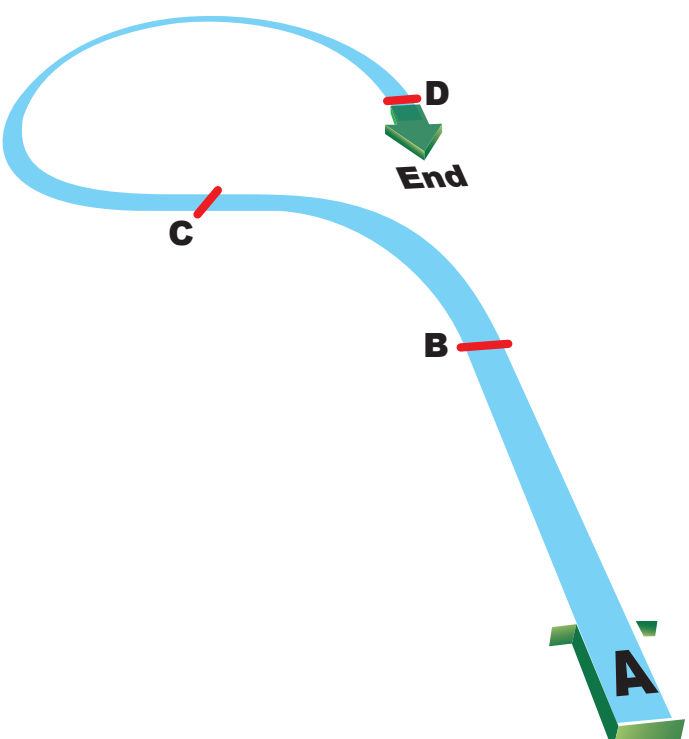
- At B, enter a left standard rate turn of 80° to a heading of 280°.
- At the completion of the 80° turn to 280° (Point C), immediately turn right 260°, rolling-out on a heading of 180° (Point D) and also the reciprocal of the entry heading.
Teardrop Patterns
There are three typical teardrop procedure turns. A 30°, 20°, and a 10° teardrop pattern. The below steps indicate actions for all three starting on a heading of 360°. [Figure 7-44]
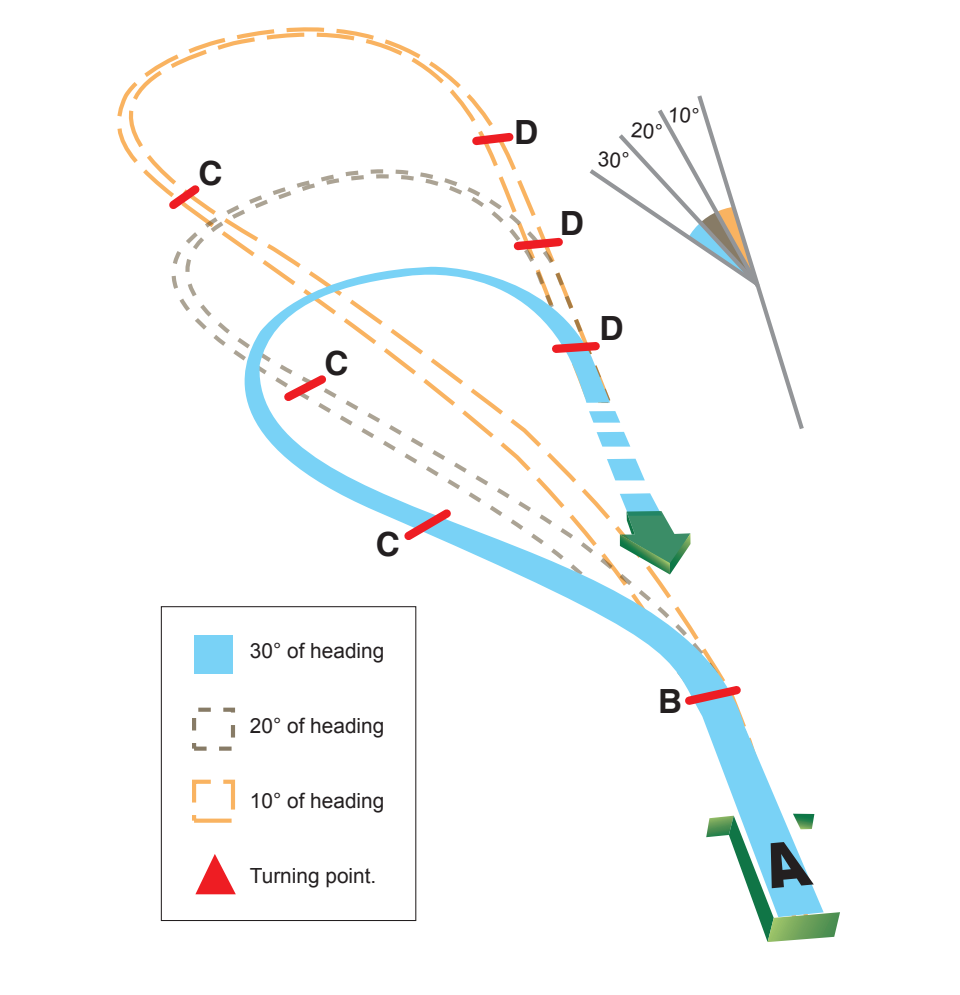
- At point B (after stabilizing on the outbound course) turn left:
- 30° to a heading of 330° and time for 1 minute
- 20° to a heading of 340° and time for 2 minutes
- 10° to a heading of 350° and time for 3 minutes
- After the appropriate time above (Point C), make a standard rate turn to the right for:
- 30° teardrop—210° to the final course heading of 180° (Point D)
- 20° teardrop—200° to the final course heading of 180° (Point D)
- 10° teardrop—190° to the final course heading of 180° (Point D)
By using the different teardrop patterns, a pilot is afforded the ability to manage time more efficiently. For instance, a 10° pattern for 3 minutes provides about three times the distance (and time) than a 30° pattern. Pattern selection should be based upon an individual assessment of the procedure turn requirements to include wind, complexity, the individual preparedness, etc.
Circling Approach Patterns
Pattern I
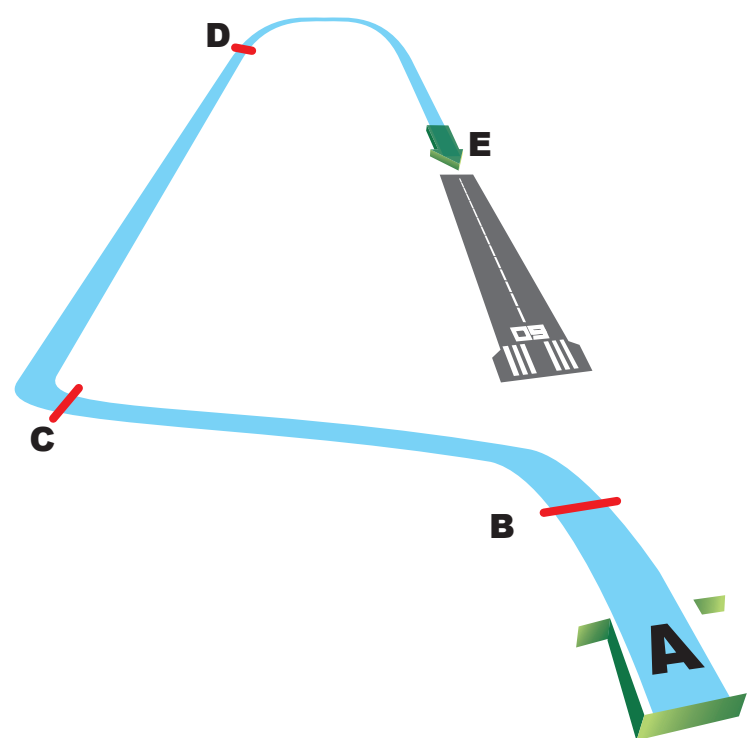
- At A, start timing for 2 minutes from A to B; reduce airspeed to approach speed. [Figure 7-45]
- At B, make a standard rate turn to the left for 45°.
- At the completion of the turn, time for 45 seconds to C.
- At C, turn to the original heading; fly 1 minute to D, lowering the landing gear and flaps.
- At D, turn right 180°, rolling-out at E on the reciprocal of the entry heading.
- At E, enter a 500 fpm rate descent. At the end of a 500 foot descent, enter a straight constant-airspeed climb, retracting gear and flaps.
Pattern II
Steps: