
Chapter 1
Departure Procedures
The term ODP is used to define procedures that simply provide obstacle clearance. ODPs are only used for obstruction clearance and do not include ATC-related climb requirements. In fact, the primary emphasis of ODP design is to use the least restrictive route of flight to the en route structure or to facilitate a climb to an altitude that allows random (diverse) IFR flight, while attempting to accommodate typical departure routes.
An ODP must be developed when obstructions penetrate the 40:1 departure OCS, as described in FAA Order 8260.3. Only one ODP will be established for a particular runway. This is considered the default IFR departure procedure for a given runway and is intended for pilot awareness and use in the absence of ATC radar vectors or SID assignment. Text is not published to allow an option to use a SID or alternate maneuver assigned by ATC (e.g., “Climb heading 330 to 1200 before turning or use Manchester Departure” or “Turn right, climb direct ABC very high frequency (VHF) omnidirectional range (VOR) or as assigned by ATC.”). ODPs are textual in nature. However, due to the complex nature of some procedures, a visual presentation may be necessary for clarification and understanding. If the ODP is charted graphically, the chart itself includes the word “Obstacle” in parentheses in the title. Additionally, all newly-developed RNAV ODPs are issued in graphical form.
All ODPs are listed in the front of the Aeronautical Information Services approach chart booklets under the heading Takeoff Minimums and Obstacle Departure Procedures. Each procedure is listed in alphabetical order by city and state. The ODP listing in the front of the booklet includes a reference to the graphic chart located in the main body of the booklet if one exists. [Figure 1-21]
ODP Flight Planning Considerations
ODPs are not assigned by ATC unless absolutely necessary to achieve aircraft separation. It is the pilot’s responsibility to determine if there is an ODP published for that airport. If a Part 91 pilot is not given a clearance containing an ODP, SID, or radar vectors and an ODP exists, compliance with such a procedure is the pilot’s choice. A graphic ODP may also be filed in an instrument flight plan by using the computer code included in the procedure title. As a technique, the pilot may enter “will depart (airport) (runway) via textual ODP” in the remarks section of the flight plan. Providing this information to the controller clarifies the intentions of the pilot and helps prevent a potential pilot/controller misunderstanding. If the ODP is not included in the pilot’s clearance, the pilot should inform ATC when an ODP is used for departure from a runway so that ATC can ensure appropriate traffic separation.
During planning, pilots need to determine whether or not the departure airport has an ODP. Remember, an ODP can only be established at an airport that has instrument approach procedures (IAPs). An ODP may drastically affect the initial part of the flight plan. Pilots may have to depart at a higher than normal climb rate, or depart in a direction opposite the intended heading and maintain that for a period of time, any of which would require an alteration in the flight plan and initial headings. Considering the forecast weather, departure runways, and existing ODP, plan the flight route, climb performance, and fuel burn accordingly to compensate for the departure procedure.
Additionally, when close-in obstacles are noted in the Takeoff Minimums and (Obstacle) Departure Procedures section, it may require the pilot to take action to avoid these obstacles. Consideration must be given to decreased climb performance from an inoperative engine or to the amount of runway used for takeoff. Aircraft requiring a short takeoff roll on a long runway may have little concern. On the other hand, airplanes that use most of the available runway for takeoff may not have the standard ROC when climbing at the normal 200 ft/NM.
Another factor to consider is the possibility of an engine failure during takeoff and departure. During the preflight planning, use the aircraft performance charts to determine if the aircraft can still maintain the required climb performance. For high performance aircraft, an engine failure may not impact the ability to maintain the prescribed climb gradients. Aircraft that are performance limited may have diminished capability and may be unable to maintain altitude, let alone complete a climb to altitude. Based on the performance expectations for the aircraft, construct an emergency plan of action that includes emergency checklists and the actions to take to ensure safety in this situation.
Standard Instrument Departures (SIDs)
A SID is an ATC-requested and developed departure route, typically used in busy terminal areas. It is designed at the request of ATC in order to increase capacity of terminal airspace, effectively control the flow of traffic with minimal communication, and reduce environmental impact through noise abatement procedures.
While obstacle protection is always considered in SID routing, the primary goal is to reduce ATC/pilot workload while providing seamless transitions to the en route structure. ATC clearance must be received prior to flying a SID. SIDs also provide additional benefits to both the airspace capacity and the airspace users by reducing radio congestion, allowing more efficient airspace use, and simplifying departure clearances. All of the benefits combine to provide effective, efficient terminal operations, thereby increasing the overall capacity of the NAS.
If you cannot comply with a SID, if you do not possess the charted SID procedure, or if you simply do not wish to use SIDs, include the statement “NO SIDs” in the remarks section of your flight plan. Doing so notifies ATC that they cannot issue you a clearance containing a SID, but instead will clear you via your filed route to the extent possible, or via a Preferential Departure Route (PDR). It should be noted that SID usage not only decreases clearance delivery time, but also greatly simplifies your departure, easing you into the IFR structure at a desirable location and decreases your flight management load. While you are not required to depart using a SID, it may be more difficult to receive an “as filed” clearance when departing busy airports that frequently use SID routing.
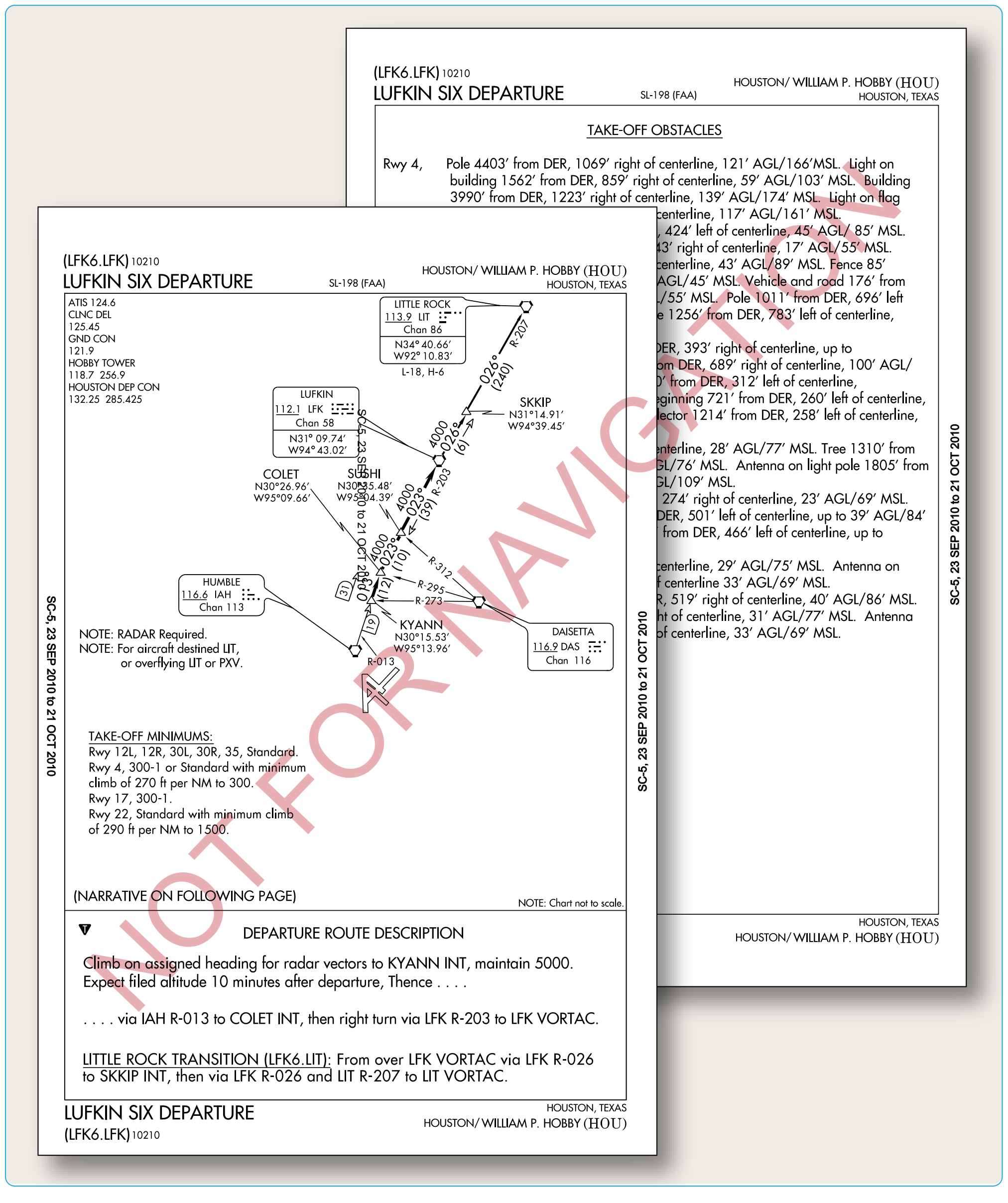
SIDs are always charted graphically and are located in the TPP after the last approach chart for an airport. The SID may be one or two pages in length, depending on the size of the graphic and the amount of space required for the departure description. Each chart depicts the departure route, navigational fixes, transition routes, and required altitudes. The departure description outlines the particular procedure for each runway. [Figure 1-22]
Transition Routes
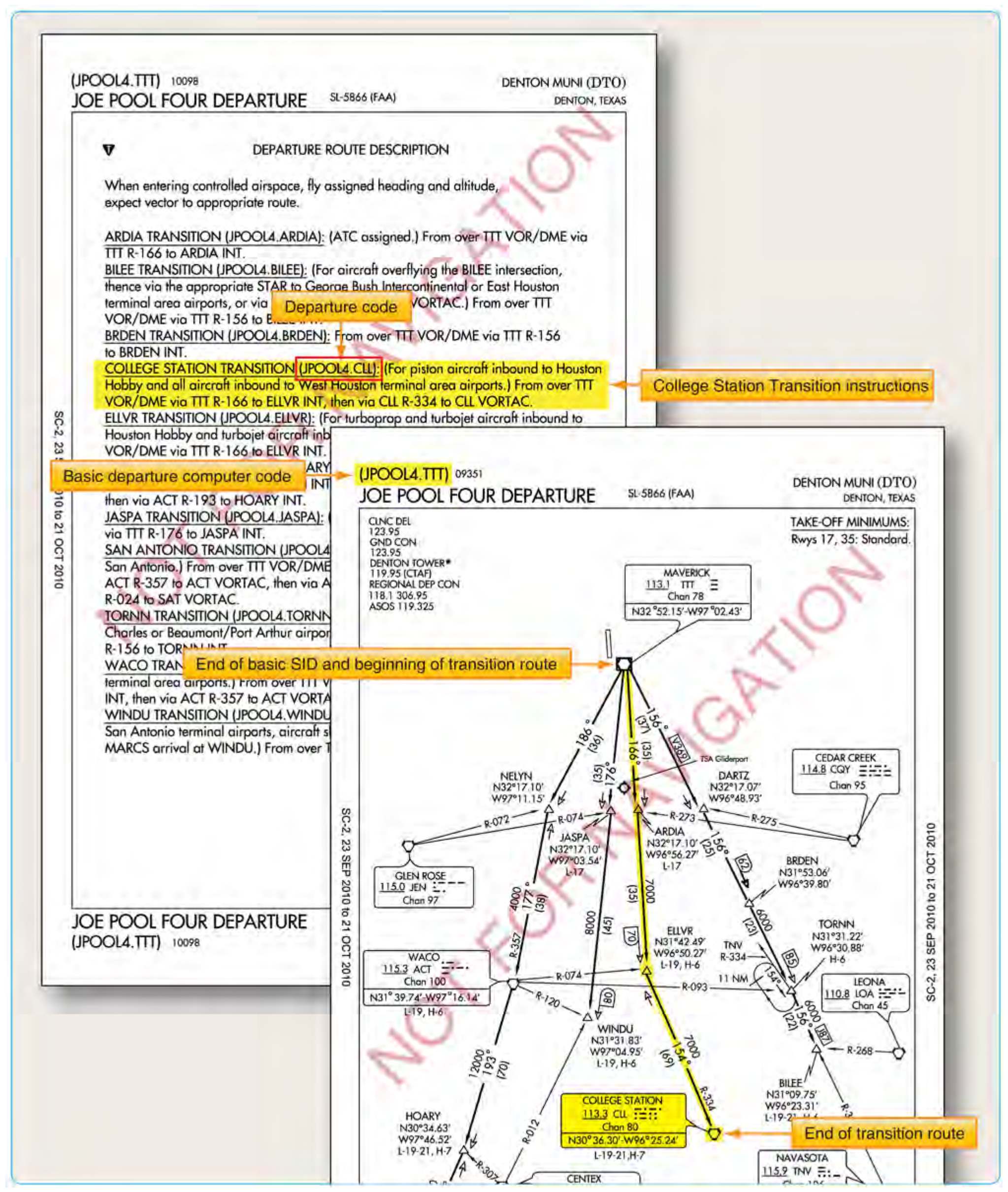
Charted transition routes allow pilots to transition from the end of the basic SID to a location in the en route structure. Typically, transition routes fan out in various directions from the end of the basic SID to allow pilots to choose the transition route that takes them in the direction of intended departure. A transition route includes a course, a minimum altitude, and distances between fixes on the route. When filing a SID for a specific transition route, include the transition in the flight plan, using the correct departure and transition code. ATC also assigns transition routes as a means of putting the flight on course to the destination. In any case, the pilot must receive an ATC clearance for the departure and the associated transition, and the clearance from ATC will include both the departure name and transition (e.g., Joe Pool Nine Departure, College Station Transition). [Figure 1-23]
The SID is designed to allow the pilot to provide his or her own navigation with minimal radio communication. This type of procedure usually contains an initial set of departure instructions followed by one or more transition routes. A SID may include an initial segment requiring radar vectors to help the flight join the procedure, but the majority of the navigation remains the pilot’s responsibility. [Figure 1-24]
A radar SID usually requires ATC to provide radar vectors from just after takeoff (ROC is based on a climb to 400 feet above the DER elevation before making the initial turn) until reaching the assigned route or a fix depicted on the SID chart. Radar SIDs do not include departure routes or transition routes because independent pilot navigation is not involved. The procedure sets forth an initial set of departure instructions that typically include an initial heading and altitude. ATC must have radar contact with the aircraft to be able to provide vectors. ATC expects you to immediately comply with radar vectors, and they expect you to notify them if you are unable to fulfill their request. ATC also expects you to make contact immediately if an instruction causes you to compromise safety due to obstructions or traffic.
It is prudent to review radar SID charts prior to use because this type of procedure often includes nonstandard lost communication procedures. If you were to lose radio contact while being vectored by ATC, you would be expected to comply with the lost communication procedure as outlined on the chart, not necessarily those procedures outlined in the AIM. [Figure 1-25]