
Chapter 1
Departure Procedures
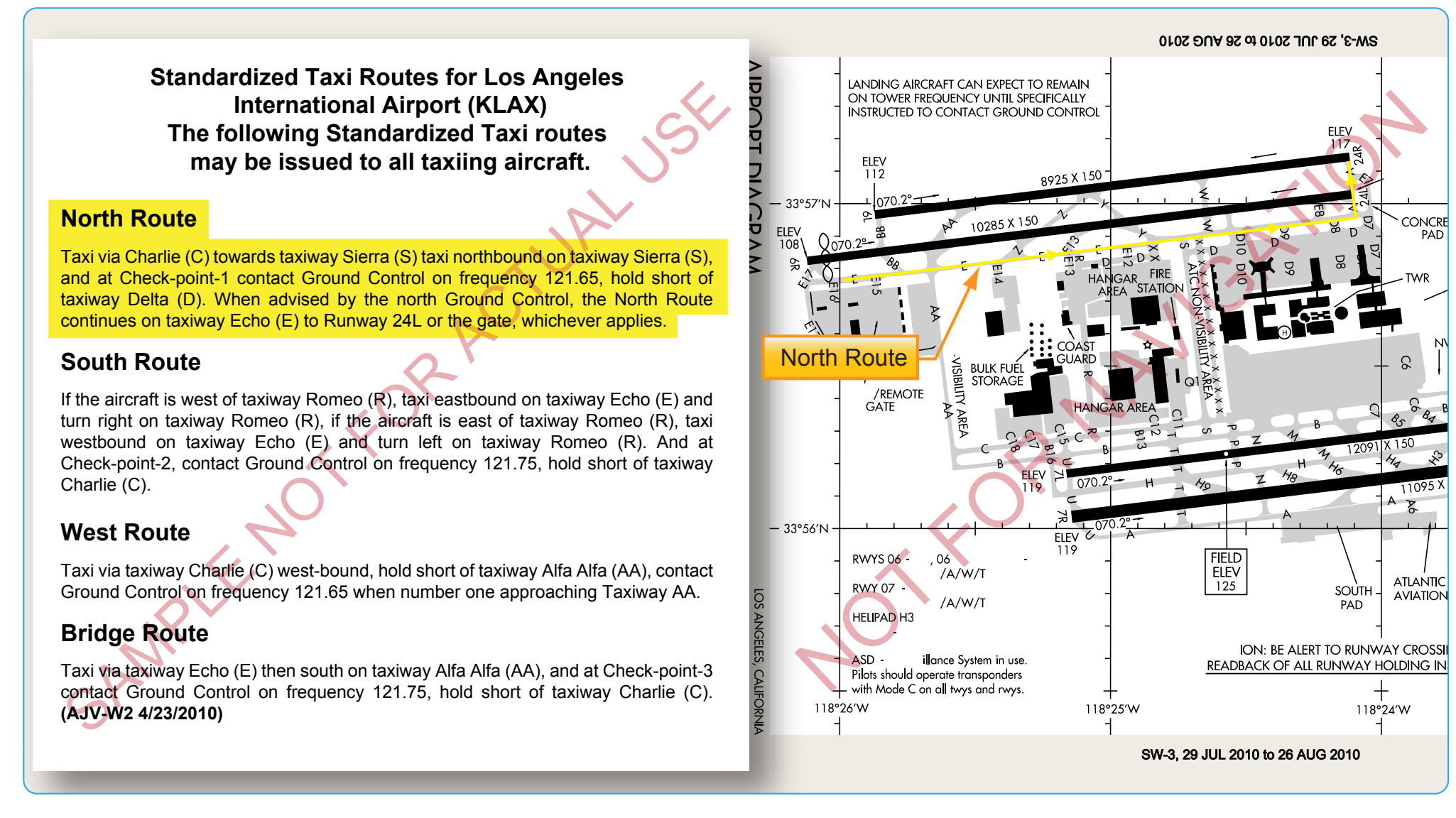
Taxi and Movement Operations Change
As of June 30, 2010, controllers are required to issue explicit instructions to cross or hold short of each runway that intersects a taxi route. Following is a summary of these procedural changes:
- “Taxi to” is no longer used when issuing taxi instructions to an assigned takeoff runway.
- Instructions to cross a runway are issued one at a time. Instructions to cross multiple runways are not issued. An aircraft or vehicle must have crossed the previous runway before another runway crossing is issued. This applies to any runway, including inactive or closed runways.
- Never cross a runway hold marking without explicit ATC instructions. If in doubt, ask!
Reminder: You may not enter a runway unless you have been:
- Instructed to cross or taxi onto that specific runway;
- Cleared to take off from that runway; or
- Instructed to line up and wait on that specific runway.
For more information on the change, refer to FAA Order JO 7110.65, Air Traffic Control, which can be found at www. ([source link](http://www.faa.gov)) [faa.gov](http://www.faa.gov).
Weather and the Departure Environment
Takeoff Minimums
While mechanical failure is potentially hazardous during any phase of flight, a failure during takeoff under instrument conditions is extremely critical. In the event of an emergency, a decision must be made to either return to the departure airport or fly directly to a takeoff alternate. If the departure weather were below the landing minimums for the departure airport, the flight would be unable to return for landing, leaving few options and little time to reach a takeoff alternate.
In the early years of air transportation, landing minimums for commercial operators were usually lower than takeoff minimums. Therefore, it was possible that minimums allowed pilots to land at an airport but not depart from that airport. Additionally, all takeoff minimums once included ceiling, as well as visibility requirements. Today, takeoff minimums are typically lower than published landing minimums, and ceiling requirements are only included if it is necessary to see and avoid obstacles in the departure area.
The FAA establishes takeoff minimums for every airport that has published Standard Instrument Approaches. These minimums are used by commercially operated aircraft, namely Part 121 and Part 135 operators. At airports where minimums are not established, these same carriers are required to use FAA-designated standard minimums: 1 statute mile (SM) visibility for single- and twin-engine aircraft, and 1⁄2 SM for helicopters and aircraft with more than two engines.
Aircraft operating under 14 CFR Part 91 are not required to comply with established takeoff minimums. Legally, a zero/zero departure may be made, but it is never advisable. If commercial pilots who fly passengers on a daily basis must comply with takeoff minimums, then good judgment and common sense would tell all instrument pilots to follow the established minimums as well.
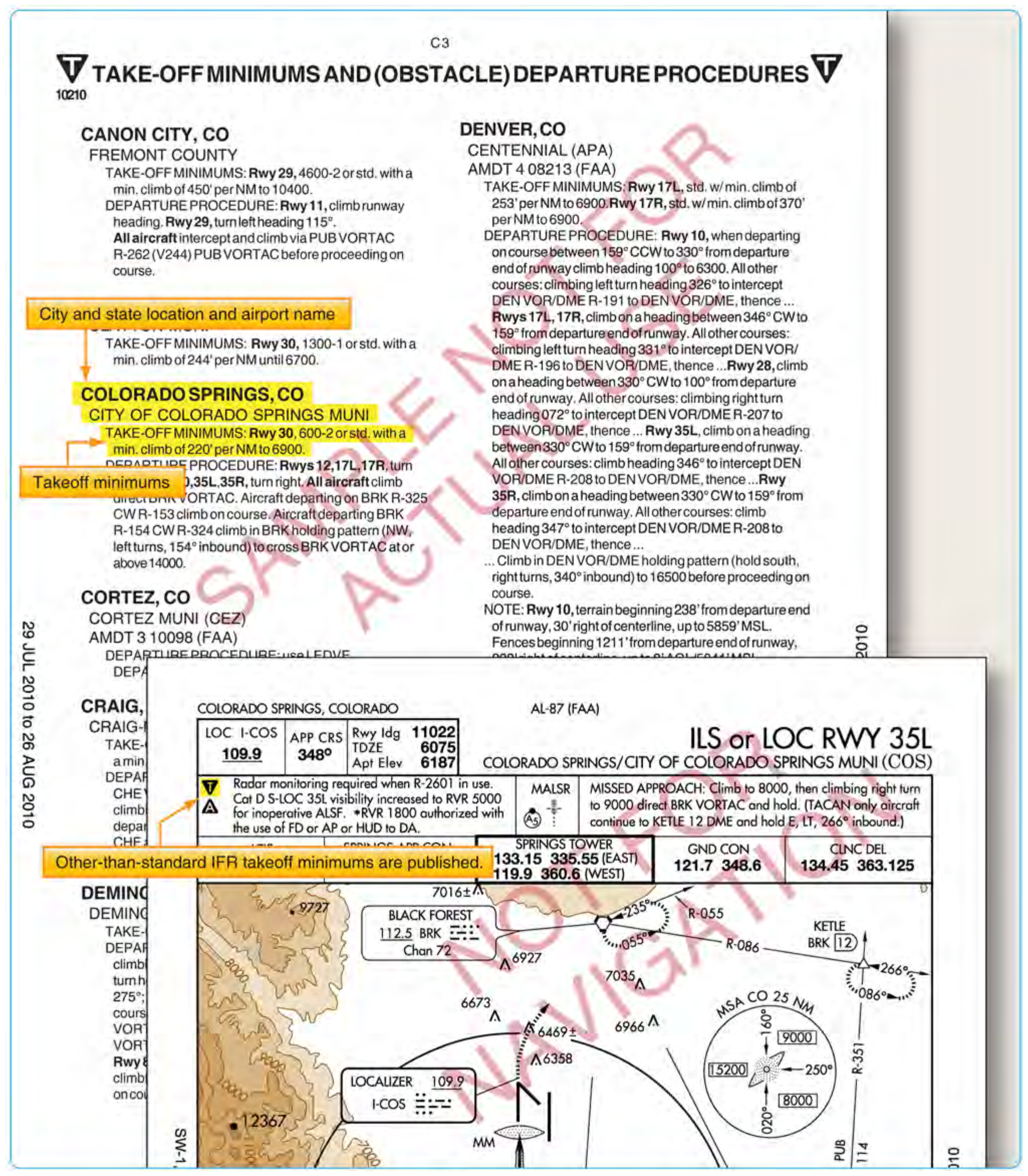
Aeronautical Information Services charts list takeoff minimums only for the runways at airports that have other than standard minimums. These takeoff minimums are listed by airport in alphabetical order in the front of the TPP booklet. If an airport has non-standard takeoff minimums, a T (referred to by some as either the “triangle T” or “trouble T”) is placed in the notes sections of the instrument procedure chart. In the front of the TPP booklet, takeoff minimums are listed before the obstacle departure procedure. Some departure procedures allow a departure with standard minimums provided specific aircraft performance requirements are met. [Figure 1-8]
Takeoff Minimums for Commercial Operators
While Part 121 and Part 135 operators are the primary users of takeoff minimums, they may be able to use alternative takeoff minimums based on their individual OpSpecs. Through these OpSpecs, operators are authorized to depart with lower-than-standard minimums provided they have the necessary equipment and crew training.
Operations Specifications (OpSpecs)
Within the air transportation industry, there is a need to establish and administer safety standards to accommodate many variables. These variables include a wide range of aircraft, varied operator capabilities, the various situations requiring different types of air transportation, and the continual, rapid changes in aviation technology. It is impractical to address these variables through the promulgation of safety regulations for each and every type of air transport situation and the varying degrees of operator capabilities. Also, it is impractical to address the rapidly changing aviation technology and environment through the regulatory process. Safety regulations would be extremely complex and unwieldy if all possible variations and situations were addressed by regulation. Instead, the safety standards established by regulation should usually have a broad application that allows varying acceptable methods of compliance. The OpSpecs provide an effective method for establishing safety standards that address a wide range of variables. In addition, OpSpecs can be adapted to a specific certificate holder or operator’s class and size of aircraft and type and kinds of operations. OpSpecs can be tailored to suit an individual certificate holder or operator’s needs.
Part 121 and Part 135 certificate holders have the ability, through the use of approved OpSpecs, to use lower-than-standard takeoff minimums. Depending on the equipment installed in a specific type of aircraft, the crew training, and the type of equipment installed at a particular airport, these operators can depart from appropriately equipped runways with as little as 300 feet RVR. Additionally, OpSpecs outline provisions for approach minimums, alternate airports, and weather services in Volume 3 of FAA Order 8900.1, Flight Standards Information Management System (FSIMS).