
Chapter 1
Departure Procedures
Not all airports can be used as alternate airports. An airport may not be qualified for alternate use if the airport NAVAID is unmonitored, or if it does not have weather reporting capabilities. For an airport to be used as an alternate, the forecast weather at that airport must meet certain qualifications at the ETA. For aircraft other than helicopters, standard alternate minimums for a precision approach are a 600-foot ceiling and a 2 SM visibility. For a non-precision approach, the minimums are an 800-foot ceiling and a 2 SM visibility. Standard alternate minimums apply unless higher alternate minimums are listed for an airport. For helicopters, alternate weather minimums are a ceiling of 200 feet above the minimum for the approach to be flown, and visibility at least 1 SM but never less than the minimum visibility for the approach to be flown.
Alternate Minimums for Commercial Operators
IFR alternate minimums for Part 121 and Part 135 operators are very specific and have more stringent requirements than Part 91 operators.
Part 121 operators are required by their OpSpecs and 14 CFR Part 121, § 121.617 and 121.625 to have a takeoff alternate airport for their departure airport in addition to their airport of intended landing if the weather at the departure airport is below the landing minimums in the certificate holder’s OpSpecs for that airport. The alternate must be within two hours flying time for an aircraft with three or more engines with an engine out in normal cruise in still air. For two engine aircraft, the alternate must be within one hour. The airport of intended landing may be used in lieu of an alternate provided that it meets all the requirements. Domestic Part 121 operators must also file for alternate airports when the weather at their destination airport, from one hour before to one hour after their ETA, is forecast to be below a 2,000-foot ceiling and/or less than three miles visibility.
For alternate airports with at least one operational navigational facility that provides a straight-in non-precision approach, a straight-in precision approach, or a circling maneuver from an instrument approach procedure determine the ceiling and visibility by:
- Adding 400 feet to the authorized CAT I height above airport (HAA)/height above touchdown elevation (HAT) for ceiling.
- Adding one mile to the authorized CAT I visibility for visibility minimums.
This is one example of the criteria required for Part 121 operators when calculating minimums. Part 135 operators are also subject to their own specific rules regarding the selection and use of alternate minimums as outlined in their OpSpecs and 14 CFR Part 135, § 135.219 through 135.225, which are similar to those used by Part 121 operators with additional considerations.
Commercial operators typically use dispatchers to plan flights, including selecting and filing alternate airports. The dispatcher considers aircraft performance, aircraft equipment and its condition, and route of flight when choosing alternates. In the event changes need to be made to the flight plan en route due to deteriorating weather, the dispatcher maintains contact with the flight crew and reroutes their flight as necessary. Therefore, it is the pilot’s responsibility to execute the flight as planned by the dispatcher. To aid in the planning of alternates, dispatchers have a list of airports that are approved as alternates so they can quickly determine which airports should be used for a particular flight. Dispatchers also use flight planning software that plans routes including alternates for the flight. This type of software is tailored for individual operators and includes their normal flight paths and approved airports. Flight planning software and services are provided through private sources.
Though the pilot is the final authority for the flight and ultimately has full responsibility, the dispatcher is responsible for creating flight plans that are accurate and comply with the CFRs. Alternate minimum criteria are only used as planning tools to ensure the pilot in command and dispatcher are thinking ahead to the approach phase of flight. In the event the flight would actually need to divert to an alternate, the published approach minimums or lower-than-standard minimums must be used as addressed in OpSpecs documents.
Departure Procedures
Instrument departure procedures are preplanned IFR procedures that provide obstruction clearance from the terminal area to the appropriate en route structure. Primarily, these procedures are designed to provide obstacle protection for departing aircraft. There are two types of Departure Procedures (DPs):
- Obstacle Departure Procedures (ODPs) and
- Standard Instrument Departures (SIDs).
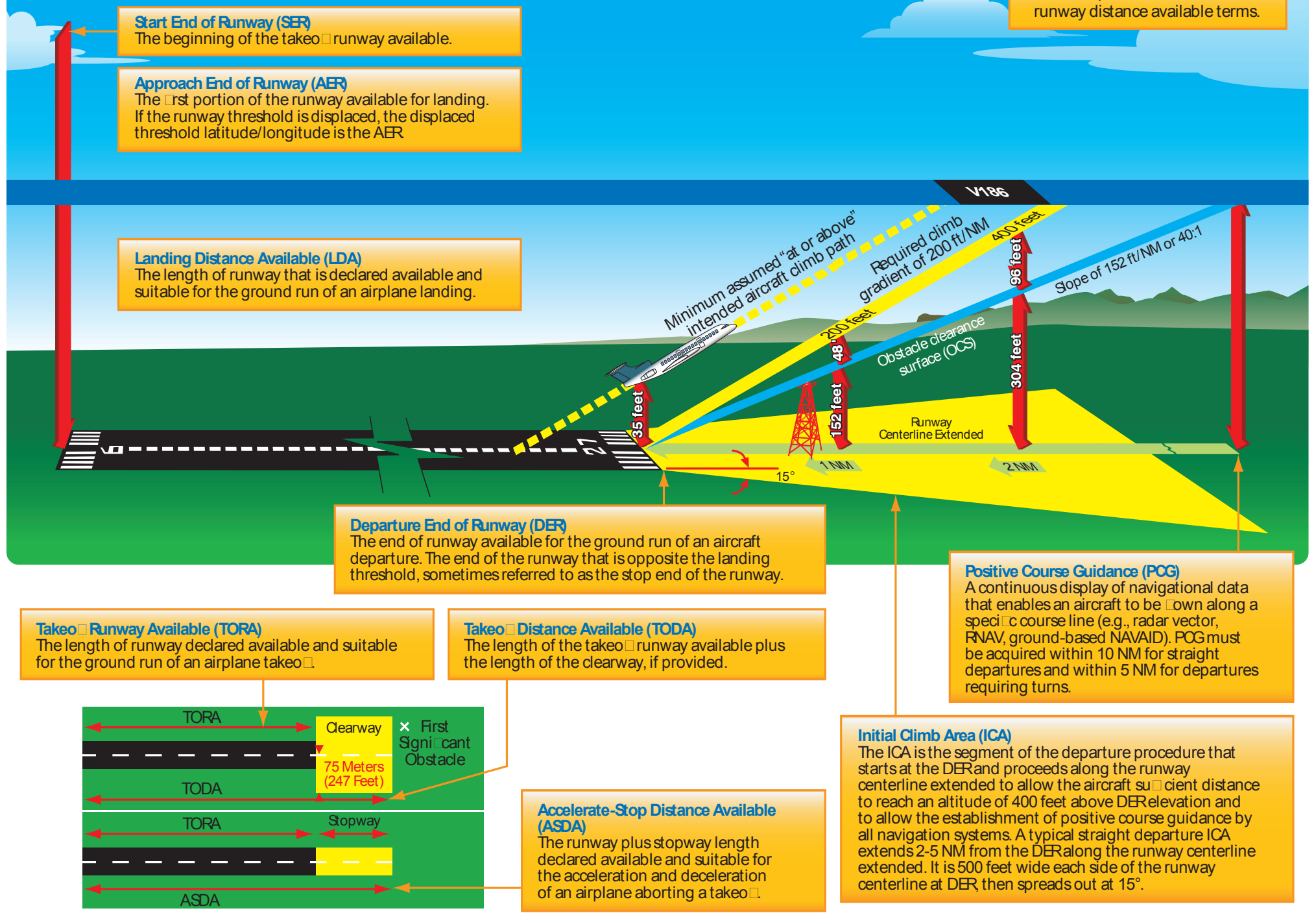
When an instrument approach is initially developed for an airport, the need for an ODP is assessed. If an aircraft may turn in any direction from a runway within the limits of the assessment area and remain clear of obstacles that runway passes what is called a diverse departure assessment, and no ODP is published. A diverse departure assessment ensures that a prescribed, expanding amount of required obstacle clearance (ROC) is achieved during the climb-out until the aircraft can obtain a minimum 1,000 feet ROC in non-mountainous areas or a minimum 2,000 feet ROC in mountainous areas. Unless specified otherwise, required obstacle clearance for all departures, including diverse, is based on the pilot crossing the departure end of the runway (DER) at least 35 feet above the DER elevation, climbing to 400 feet above the DER elevation before making the initial turn, and maintaining a minimum climb gradient of 200 ft/NM, unless required to level off by a crossing restriction, until the minimum IFR altitude is reached. Following ODP assessment, a SID may still be established for the purposes of ATC flow management, system enhancement, or noise abatement.
Design Criteria
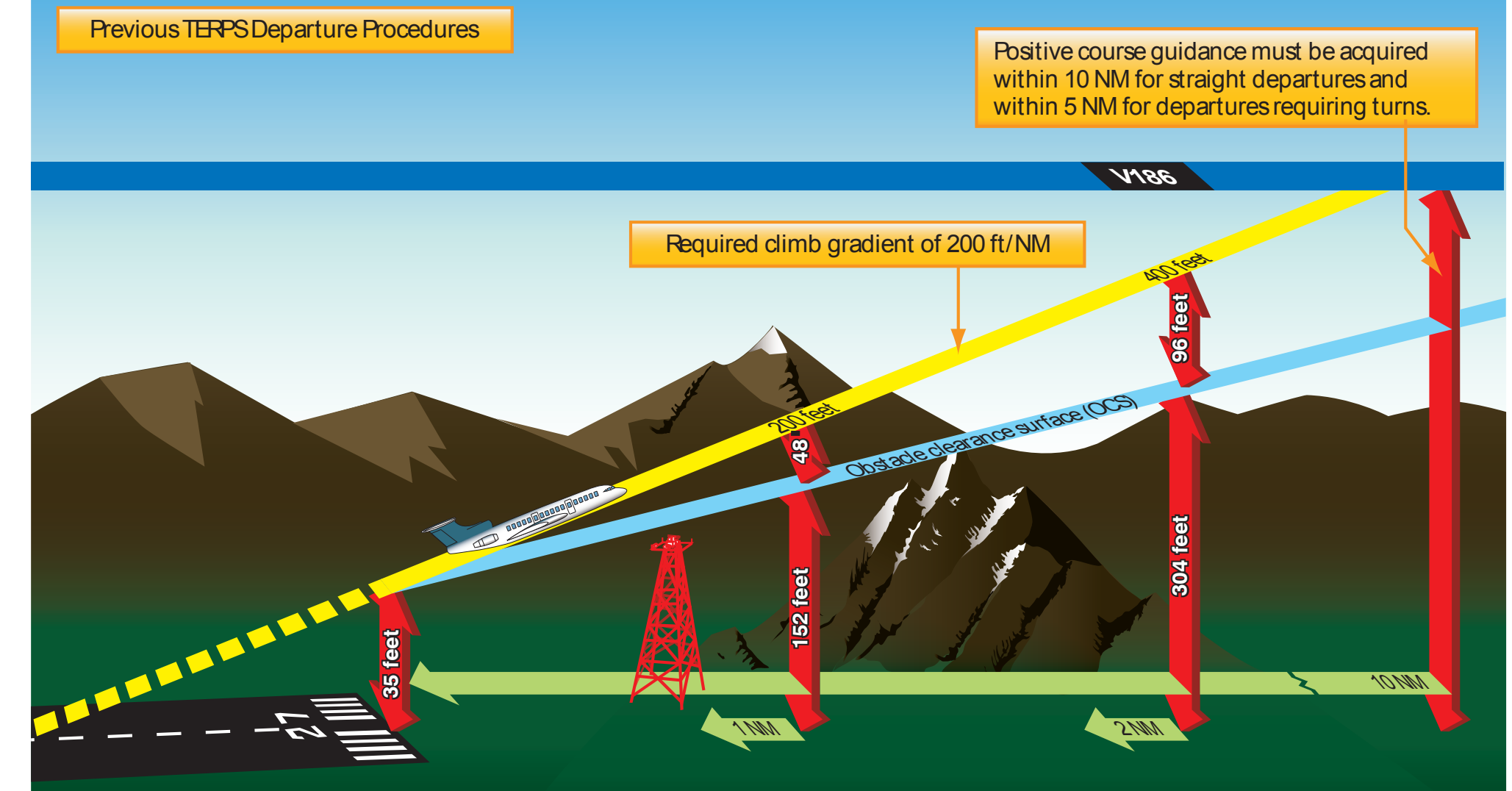
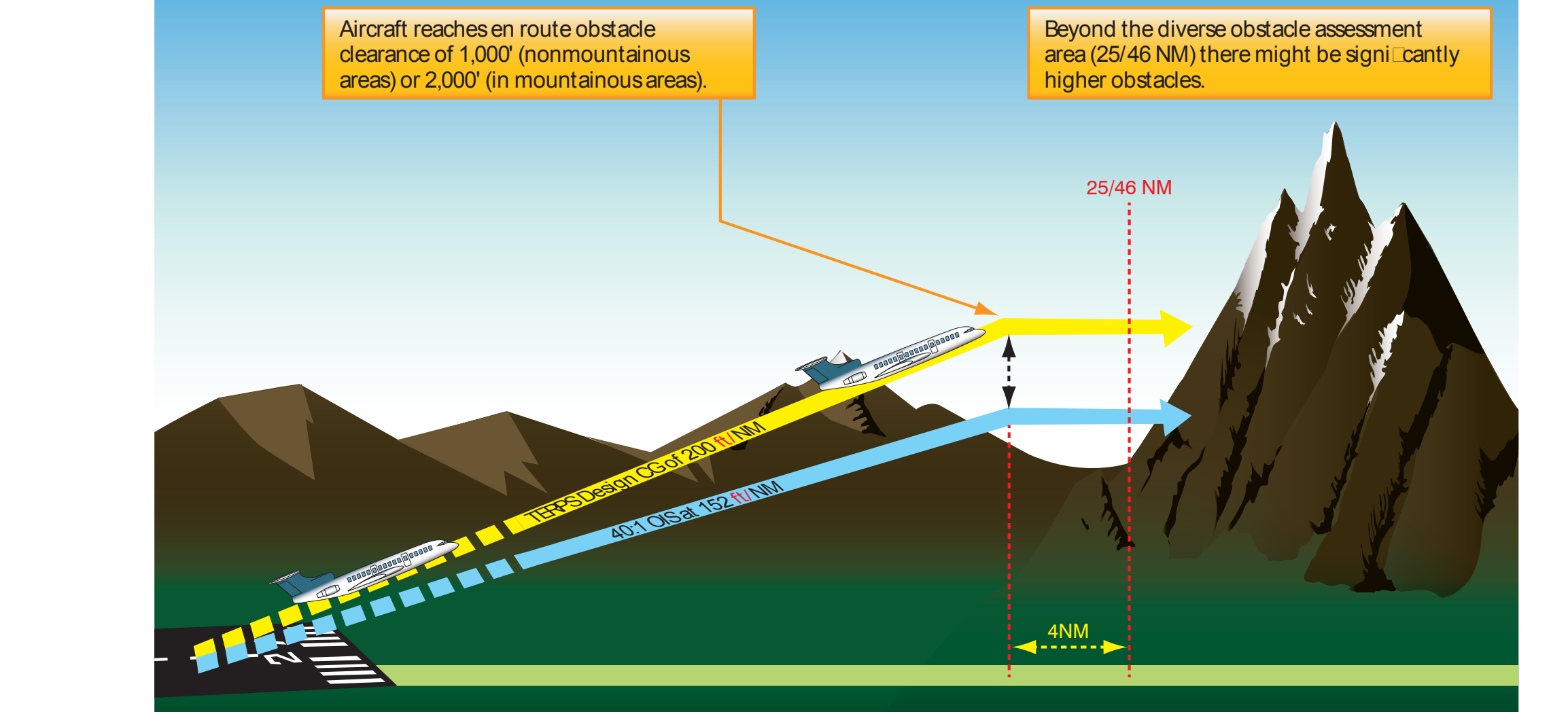
The design of a departure procedure is based on FAA Order 8260.3, United States Standard for Terminal Instrument Procedures (TERPS), which is a living document that is updated frequently. Departure design criterion begins with the assumption of an initial climb of 200 ft/NM after crossing the DER at a height of at least 35 feet. [Figure 1-14] The aircraft climb path assumption provides a minimum of 35 feet of additional obstacle clearance above the required obstacle clearance (ROC), from the DER outward, to absorb variations ranging from the distance of the static source to the landing gear, to differences in establishing the minimum 200 ft/NM climb gradient, etc. The ROC is the planned separation between the obstacle clearance surface (OCS) and the required climb gradient of 200 ft/NM. The ROC value is zero at the DER elevation and increases along the departure route until the ROC value appropriate for en route flight is achieved. The appropriate ROC value for en route operations is typically achieved about 25 NM for 1,000 feet of ROC in non-mountainous areas, and 46 NM for 2,000 feet of ROC in mountainous areas.
If taking off from a runway using a diverse departure (a runway without a published ODP), beyond these distances the pilot is responsible for obstacle clearance if not operating on a published route, and if below the MEA or MOCA of a published route, or below an ATC-assigned altitude. [Figure 1-15]
Recent changes in TERPS criteria make the OCS lower and more restrictive. [Figure 1-16] However, there are many departures today that were evaluated under the old criteria that allowed some obstacle surfaces to be as high as 35 feet at the DER. [Figure 1-14] Since there is no way for the pilot to determine whether the departure was evaluated using the previous or current criteria, and until all departures have been evaluated using the current criteria, pilots need to be very familiar with the departure environment and associated obstacles, especially if crossing the DER at less than 35 feet.