
Chapter 2
En Route Operations
Pilots should keep in mind that they are responsible for adhering to obstruction clearance requirements on those segments of direct routes that are outside of controlled airspace. The MEAs and other altitudes shown on low altitude IFR en route charts pertain to those route segments within controlled airspace, and those altitudes may not meet obstruction clearance criteria when operating off those routes.
Published RNAV Routes
Published RNAV routes are fixed, permanent routes that can be flight planned and flown by aircraft with RNAV capability. These are being expanded worldwide as new RNAV routes are developed, and existing charted, conventional routes are being designated for RNAV use. It is important to be alert to the rapidly changing application of RNAV techniques being applied to conventional en route airways. Published RNAV routes may potentially be found on any en route chart. The published RNAV route designation may be obvious, or, on the other hand, RNAV route designations may be less obvious, as in the case where a published route shares a common flight track with a conventional airway.
Basic designators for air traffic service (ATS) routes and their use in voice communications have been established. One of the main purposes of a system of route designators is to allow both pilots and ATC to make unambiguous reference to RNAV airways and routes. Basic designators for ATS routes consist of a maximum of five, and in no case to exceed six, alpha/numeric characters in order to be usable by both ground and airborne automation systems. The designator indicates the type of the route, such as high/low altitude, specific airborne navigation equipment requirements, such as RNAV, and the aircraft type using the route primarily and exclusively. The basic route designator consists of one or two letter(s) followed by a number from 1 to 999.
Composition of Designators
The prefix letters that pertain specifically to RNAV designations are included in the following list:
- The basic designator consists of one letter of the alphabet followed by a number from 1 to
- The letters may be:
- A, B, G, R—for routes that form part of the regional networks of ATS route and are not RNAV routes;
- L, M, N, P—for RNAV routes that form part of the regional networks of ATS routes;
- H, J, V, W—for routes that do not form part of the regional networks of ATS routes and are not RNAV routes;
- Q, T, Y, Z—for RNAV routes that do not form part of the regional networks of ATS routes.
- Where applicable, one supplementary letter must be added as a prefix to the basic designator as follows:
- K—to indicate a low level route established for use primarily by helicopters;
- U—to indicate that the route or portion thereof is established in the upper airspace;
- S—to indicate a route established exclusively for use by supersonic aircraft during acceleration/deceleration and while in supersonic flight.
- Where applicable, a supplementary letter may be added after the basic designator of the ATS route as a suffix as follows:
- F—to indicate that on the route or portion thereof advisory service only is provided;
- G—to indicate that on the route or portion thereof flight information services only is provided;
- Y—for RNP 1 routes at and above FL 200 to indicate that all turns on the route between 30° and 90° must be made within the tolerance of a tangential arc between the straight leg segments defined with a radius of 22.5 NM;
- Z—for RNP 1 routes at and below FL 190 to indicate that all turns on the route between 30° and 90° should be made within the tolerance of a tangential arc between the straight leg segments defined with a radius of 15 NM.
Use of Designators in Communications
In voice communications, the basic letter of a designator should be spoken in accordance with the International Civil Aviation Organization (ICAO) spelling alphabet. Where the prefixes K, U, or S, previously mentioned, are used in voice communications, they should be pronounced as: K—Kopter U—Upper, as in the English language S—Supersonic
Where suffixes F, G, Y or Z specified in above, are used, the flight crew should not be required to use them in voice communications. Below is an example of how the letters and numbers are spoken.
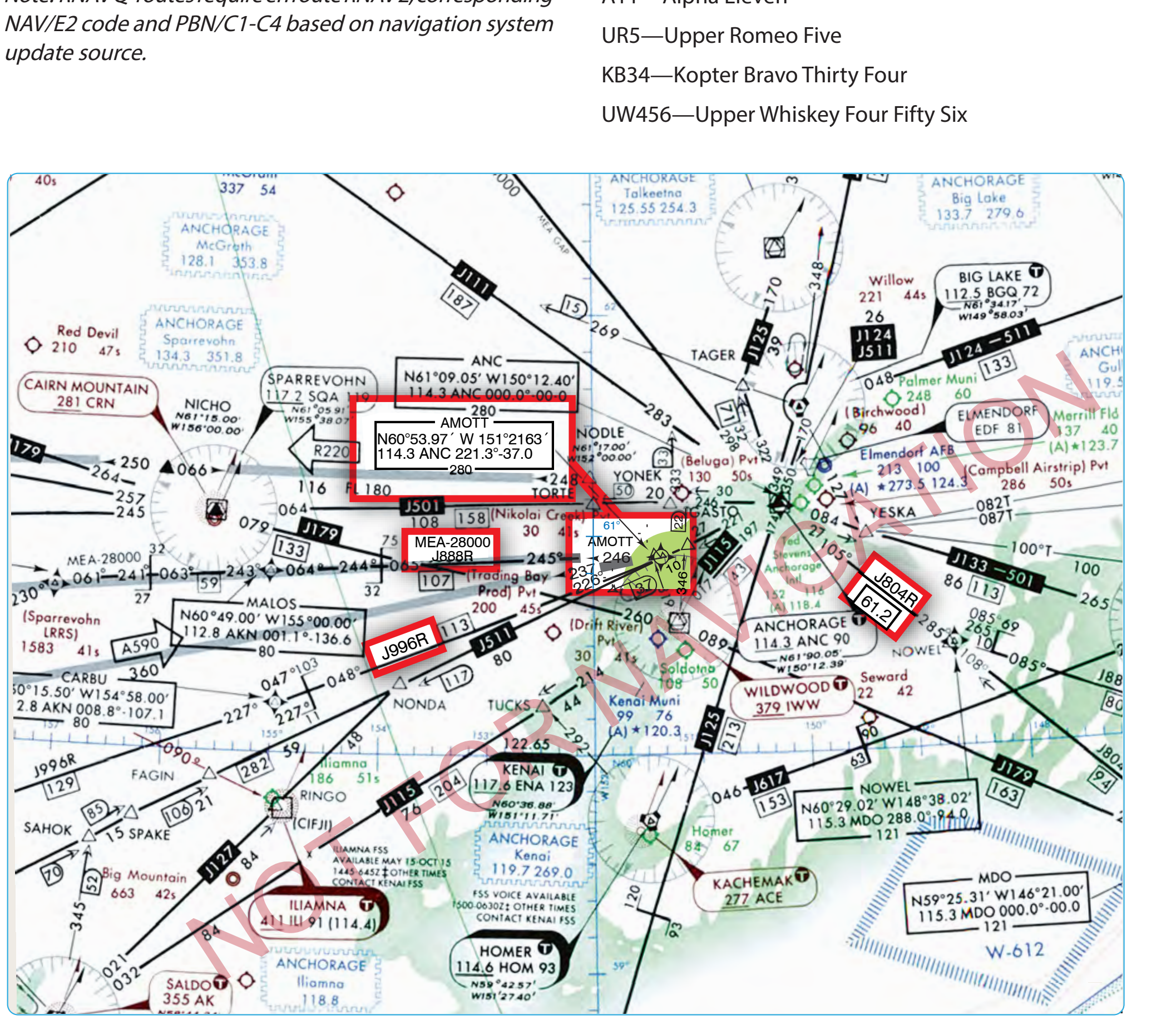
The en route chart excerpt depicts three published RNAV jet routes: J804R, J888R, and J996R. [Figure 2-45] The R suffix is a supplementary route designator denoting an RNAV route. The overlapping symbols for the AMOTT intersection and waypoint indicate that AMOTT can be identified by conventional navigation or by latitude and longitude coordinates. Although coordinates were originally included for aircraft equipped with an inertial navigation system (INS), they are now a good way to cross check between the coordinates on the chart and in the flight management system (FMS) or global positioning system (GPS) databases to ensure you are tracking on your intended en route course. The AMOTT RNAV waypoint includes bearing and distance from the Anchorage VORTAC.