
Chapter 4
Approaches
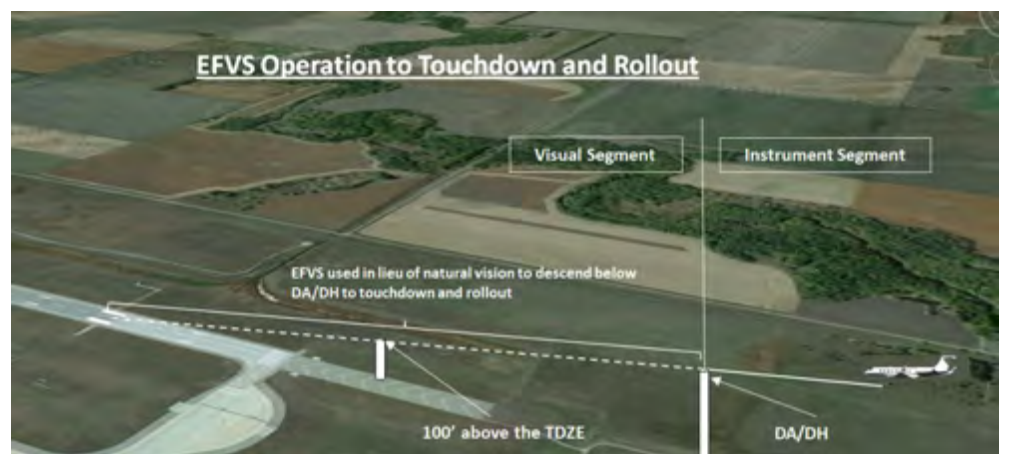
Sections 91.175(c) and 91.176 specify two means of operating visually below DA/DH or MDA in the visual segment of an IAP. One means is by using natural vision under § 91.175(c), and the other is by using enhanced vision provided by an EFVS under § 91.176. When the runway environment cannot be visually acquired using natural vision, a pilot may use an EFVS to continue descending below DA/DH or MDA under § 91.176. An EFVS operation is an operation in which visibility conditions require an EFVS to be used in lieu of natural vision to perform an approach or landing, determine enhanced flight visibility, identify required visual references, or conduct a rollout. There are two types of EFVS operations – EFVS operations to touchdown and rollout and EFVS operations to 100 feet above the touchdown zone elevation (TDZE). An EFVS operation to touchdown and rollout is an operation in which a pilot uses the enhanced vision imagery provided by an EFVS in lieu of natural vision to descend below DA or DH to touchdown and rollout [Figure 4-10B]. These operations may be conducted on standard instrument approach procedures (SIAPs) or special instrument approach procedures (IAPs) that have a DA or DH (e.g., Precision or APV approach).
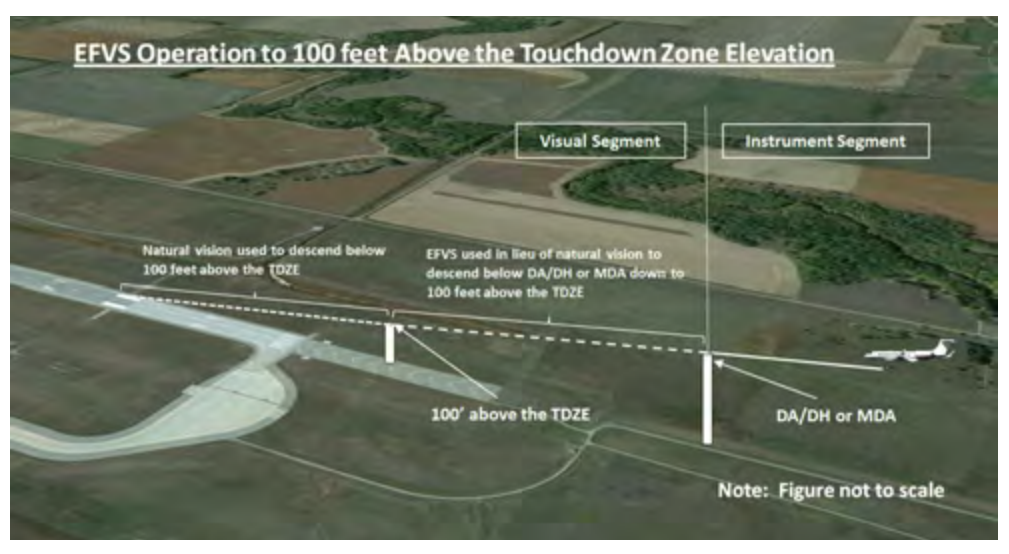
An EFVS operation to 100 feet above the TDZE is an operation in which the pilot uses the EFVS in lieu of natural vision to descend below DA/DH or MDA down to 100 feet above the TDZE [Figure 4-10C]. To descend below 100 feet above the TDZE, however, natural vision must be used. EFVS operations to 100 feet above the TDZE may be conducted on SIAPs or special IAPs that have a DA/DH or MDA.
While the regulations do not prohibit EFVS from being used during any phase of flight for situational awareness, EFVS displays are not designed, installed, certified, or intended as a sufficient visual system to conduct circling maneuvers. EFVS may only be used during a circle-to-land maneuver provided the visual references required throughout the circling maneuver are distinctly visible to the pilot using natural vision throughout the circling maneuver. Therefore, an EFVS cannot be used to satisfy the requirement that an identifiable part of the airport be distinctly visible to the pilot during a circling maneuver at or above MDA or while descending below MDA from a circling maneuver.
The visual information provided by an EFVS serves as independent verification of the position information provided by the aircraft’s displays and systems. An EFVS also enables a pilot to assess the enhanced flight visibility and identify required visual references, helps a pilot align the aircraft with the runway, and provides position, roll, rate of closure, and distance remaining information. Sections 91.176(a) and 91.176(b) permit a pilot to use an EFVS to identify the required visual references and to determine that the enhanced flight visibility provided by the EFVS is not less than the visibility prescribed in the IAP to be flown. Both the visual reference and enhanced flight visibility requirements of the regulations must be met before the pilot can descend below DA/DH during an EFVS operation to touchdown and rollout or below DA/DH or MDA during an EFVS operation to 100 feet above the TDZE. The aircraft also must continuously be in a position from which a descent to landing can be made on the intended runway at a normal rate of descent using normal maneuvers. For EFVS operations to touchdown, § 91.176(a)(2)(vi) requires that the descent rate must allow touchdown to occur within the touchdown zone of the runway of intended landing for all operations. Section 91.176(b)(2)(v), operations conducted to 100 feet above the TDZE, requires the descent rate to allow touchdown to occur within the touchdown zone of the runway of intended landing for operations conducted under 14 CFR Parts 121 and 135.
It is important to understand that using an EFVS does not result in obtaining lower minima with respect to the visibility or the DA/DH or MDA specified in the IAP. For example, a pilot who is using an EFVS on a Category I ILS approach that specifies a DA of 200 feet and a required visibility of RVR 2400 feet must comply with a 200-foot DA and an enhanced flight visibility of 2400 feet, even though the pilot may not have 2400 feet of flight visibility using natural vision or a reported visibility of RVR 2400 feet. The decision altitude is specified by the IAP the pilot is flying, and it does not change whether EFVS is used or not. Accordingly, the visibility specified in the IAP does not change. The difference is whether the pilot assesses the RVR 2400 feet visibility prescribed by the IAP using natural vision or whether he or she assesses it using an EFVS. An EFVS simply provides another means of operating in the visual segment of an IAP. That is, it gives the pilot another means to see the required visual references when they might not be visible using natural vision, and it gives the pilot a means to see forward along the flightpath the distance required by the enhanced flight visibility – when he or she might not be able to do so using natural vision.
During an EFVS operation, a pilot must initiate a go-around at or below DA/DH or MDA whenever the requirements of § 91.176 are not met. The published missed approach procedure provides obstacle clearance only when the missed approach is initiated from or above the DA/DH, or at the MAP. It assumes a climb rate of 200 fT/NM unless a higher climb gradient is identified on the procedure. If a pilot initiates a go-around at a point below DA/DH or after the MAP, obstacle clearance is not necessarily provided by following the published missed approach procedure. Prior planning is recommended and should include contingencies between the published MAP and touchdown with reference to obstacle clearance, aircraft performance, and alternate escape plans. Additionally, pilots should be especially knowledgeable of the approach conditions and approach course alignment when considering whether to rely on EFVS during an instrument approach with an offset final approach course. Depending upon the combination of crosswind correction, approach course offset, and the lateral field of view provided by a particular EFVS, the required visual references may or may not be within the pilot’s view looking through the EFVS upon reaching the MAP. AC 90-106 (current version) contains additional information about visual segment obstacle clearance, missed approach obstacle clearance, and considerations associated with offset approaches.
Operators that have a specific approval from the FAA to conduct special IAPs should evaluate those instrument procedures to determine their compatibility with EFVS operations. Special IAPs are frequently dependent on the ability of the operator to meet certain requirements that may include aircraft performance, equipage, airport facility equipment, crew training, or other requirements. These procedures also may have nonstandard features such as nonstandard final approach course alignment, nonstandard descent gradients, or other features that may or may not be compatible with the conduct of EFVS operations.
Under § 91.176(a), operators who have been issued OpSpec C073, MSpec MC073, or LOA C073, may conduct EFVS operations to touchdown and rollout on certain vertical navigation (VNAV) IAPs that use an MDA as a DA/DH in accordance with C073. Additionally, §§ 91.176 and 91.189 permit an authorized EFVS operation to be conducted during an authorized Category II or Category III operation.
Currently, EFVS operations in rotorcraft can be conducted only on IAPs that are flown to a runway. Instrument approach criteria, procedures, and appropriate visual references have not yet been developed for straight-in landing operations below DA/DH or MDA under IFR to heliports or platforms. EFVS cannot be used in lieu of natural vision to descend below published minimums on copter approaches to a point-in-space (PinS) followed by a “proceed visual flight rules (VFR)” visual segment, or on approaches designed to a specific landing site using a “proceed visually” visual segment.
Vertical Navigation
One of the advantages of some GPS and multi-sensor FMS RNAV avionics is the advisory VNAV capability. Traditionally, the only way to get vertical path information during an approach was to use a ground-based precision NAVAID. Modern RNAV avionics can display an electronic vertical path that provides a constant-rate descent to minimums.
Since these systems are advisory and not primary guidance, the pilot must continuously ensure the aircraft remains at or above any published altitude constraint, including step-down fix altitudes, using the primary barometric altimeter. The pilots, aircraft, and operator must be approved to use advisory VNAV inside the FAF on an instrument approach.
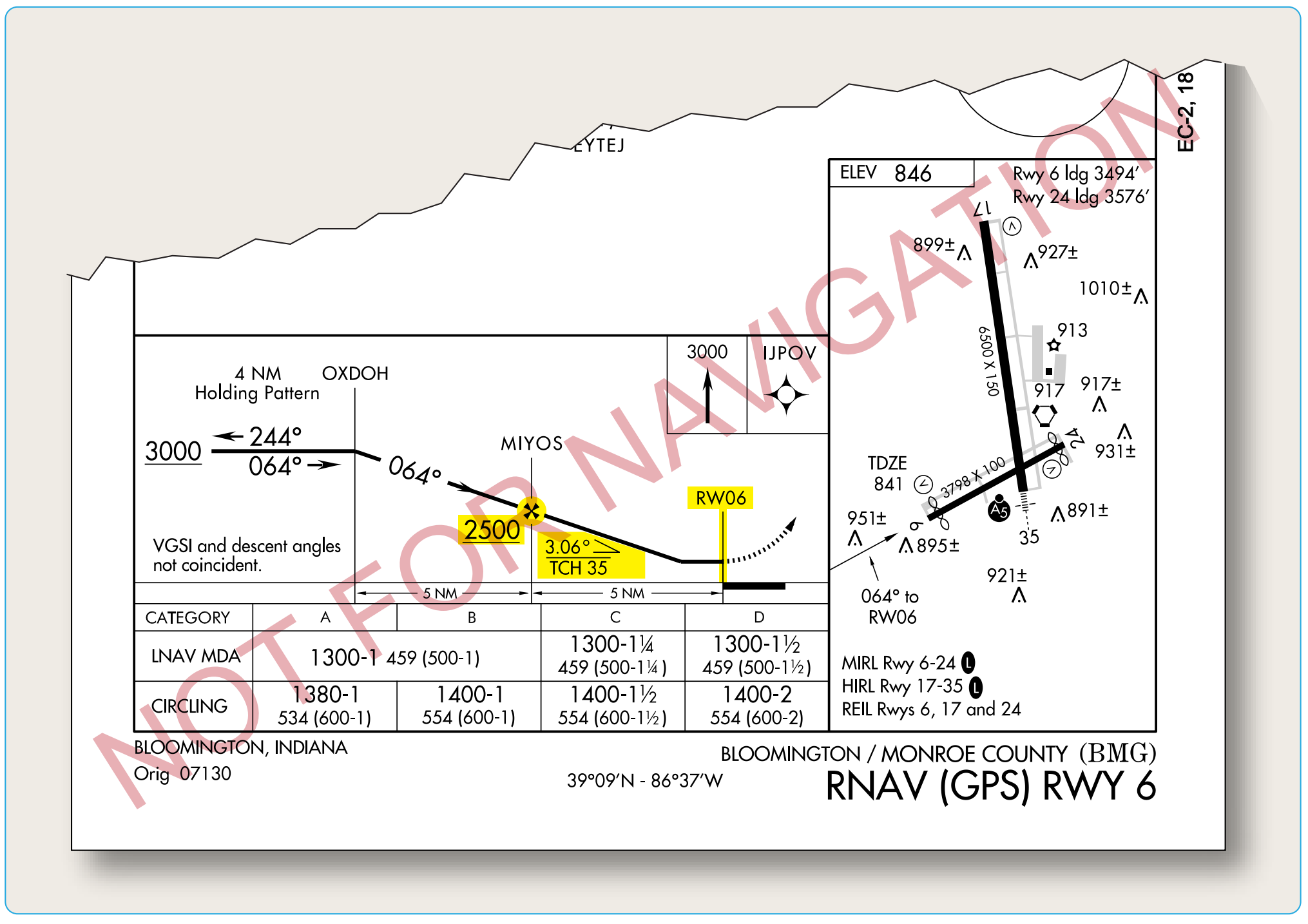
VNAV information appears on selected conventional nonprecision, GPS, and RNAV approaches (see “Types of Approaches” later in this chapter). It normally consists of two fixes (the FAF and the landing runway threshold), a FAF crossing altitude, a vertical descent angle (VDA), and may provide a visual descent point (VDP) [Figure 4-11A].
The VDA provides the pilot with advisory information not previously available on nonprecision approaches. It provides a means for the pilot to establish a stabilized descent from the FAF or step-down fix to the MDA. Stabilized descent is a key factor in the reduction of controlled flight into terrain (CFIT) incidents. However, pilots should be aware that the published angle is for information only − it is strictly advisory in nature. There is no implicit additional obstacle protection below the MDA. Pilots must still respect any published stepdown fixes and the published MDA unless the visual cues stated 14 CFR § 91.175 are present, and they can visually acquire and avoid both lit and unlit obstacles once below the MDA. The presence of a VDA does not guarantee obstacle protection in the visual segment and does not change any of the requirements for flying a nonprecision approach.
Pilots may use the published angle and estimated/actual groundspeed to find a target rate of descent from the rate of descent table published in the back of the U.S. Terminal Procedures Publication. This rate of descent can be flown with the Vertical Velocity Indicator (VVI) in order to use the VDA as an aid to flying a stabilized descent. No special equipment is required.
In rare cases, the LNAV minima may have a lower HAT than minima with a glide path, due to the location of the obstacles and the nonprecision MAP. This should serve as a clear indication to the pilot that obstacles exist below the MDA, which must be seen in order to ensure adequate clearance. In those cases, the glide path may be treated as a VDA and used to descend to the LNAV MDA, as long as all of the rules for a nonprecision approach are applied at the MDA.
When there are obstacles in the visual area that could cause an aircraft to destabilize the approach between the MDA and touchdown, the IAP will not show a vertical descent angle in the profile view. The charts currently include the following statement: “Descent Angle NA” or “Descent Angle NA-Obstacles” [Figure 4-11B ].