
Chapter 5
Inspection and Packing
Introduction
There are a dozen or more commonly seen harness container systems being actively used in the field today. The differences between them can be subtle or, in some cases, polar opposite. Most packing manuals can be found on-line or can be purchased from the container manufacturer. Canopy folding methods are fairly universal from rig to rig. It is the closing of the container that is proprietary. The single-pin rig shown in the following illustrations is somewhat representative of other single-pin reserves. Reserve Static Line (RSL) and Main Activated Reserve Deployment (MARD) configurations differ from rig to rig, and so individual manuals should be consulted for exact routing and setup. Rigs that use a pop-top or externally-mounted reserve pilot chute differ significantly from the single-pin rigs. There are sport and pilot emergency rigs that utilize this design.
For most people, parachute rigging is all about packing parachutes. Rigging and packing may be synonymous, but there is a distinct difference. In its truest form, parachute rigging is the practice of assembling a parachute system with its various components into an operative assembly. Packing is the practice of folding the parachute canopy in an organized manner such that it fits into the container system and allows the canopy to open when the user activates the system.
There are five distinct stages involved in packing the parachute. They are:
- Identification
- Inspection
- Rigging and/or repairs
- Packing
- Documentation
Identification
The first thing the rigger should do when a customer brings a parachute in for packing or repair is to confirm that the owner’s information is correct on the packing data card.
This ensures that the rigger’s logbook entry is accurate. In a commercial loft, a work order is filled out with all the correct information about the customer and the parachute. Many lofts that do a high volume of business input this information into a computer database for tracking their customers. This data is then used to send automatic repack notices to customers.
This ensures that the reserve or emergency parachute is legal to use when the customer needs it.
Inspection
The owner should bring the parachute to the rigger in its packed condition. This practice should be encouraged for several reasons. The canopy is a fragile item and is subject to damage or contamination if left exposed to the elements, and the container is designed to protect the canopy from damage. The parachute should be opened only in the controlled environment of the parachute loft. This is so the entire system can be examined externally for signs of damage or contamination before it is opened. Next, the owner should don the parachute and pull the ripcord as in a real life scenario to understand how to activate the system properly and experience what it feels like to actually pull the reserve ripcord. This gives the owner a great degree of confidence that the parachute will work when needed. It is something that jumpers rarely get to do, and their reaction is generally one of curiosity and satisfaction. Doing so also lets the owner see what is in there. It is surprising how many jumpers do not even know what color their reserve parachute is.
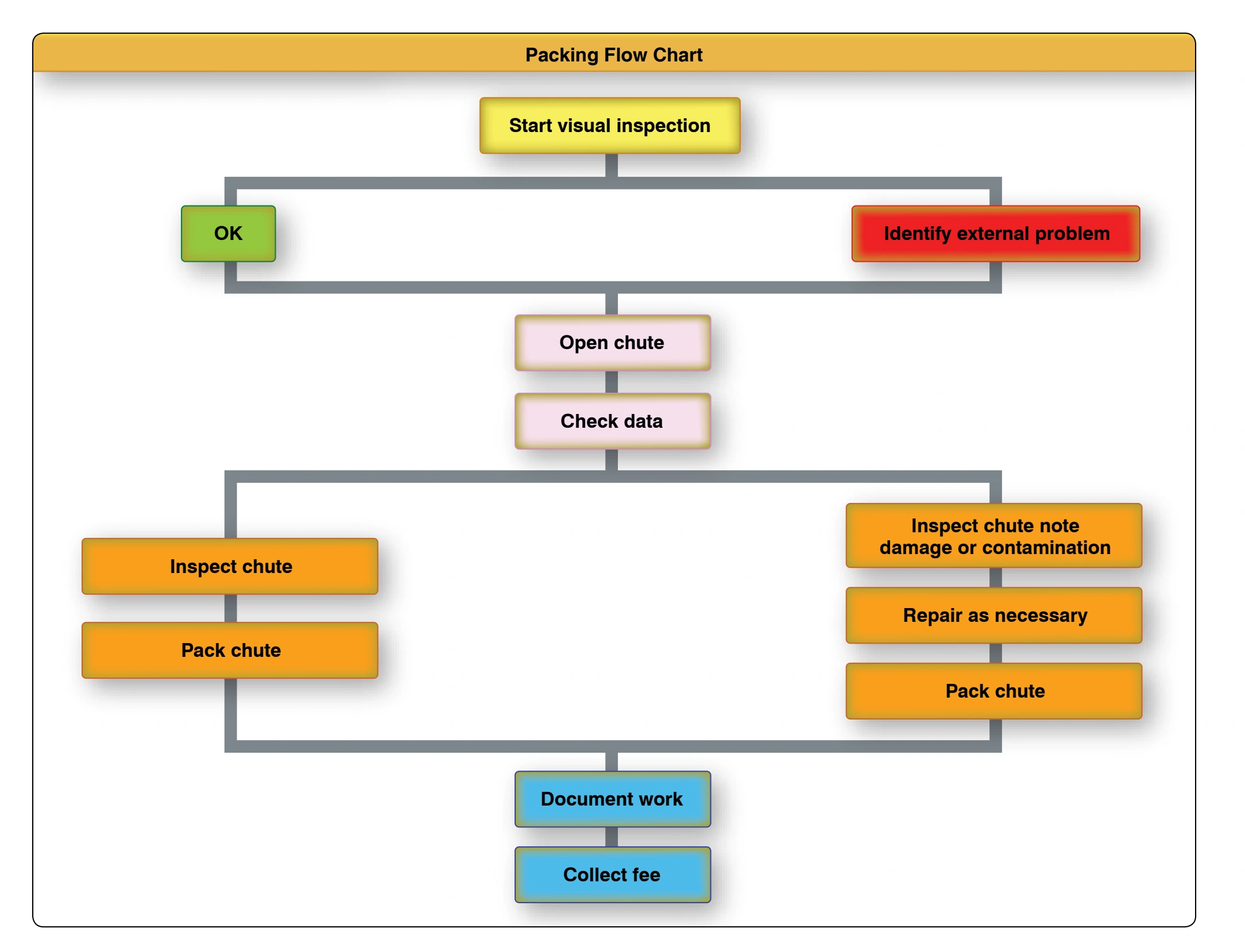
Generally, customers leave the parachute to be repacked; however, riggers should invite their customers to stay and observe the repack. Many riggers encourage this behavior since it results in a more educated individual. In a busy loft environment, however, a scheduled appointment might be needed to allow for the increased time necessary to explain the process. If the customer decides to watch the inspection and repack, the rigger should allow at least twice the usual time for the project so the customer can ask questions. Another benefit of this is that the customer gets to see the effort it takes to service a parachute. Figure 5-1 shows a packing flow chart that details the sequence of events the rigger should follow from receiving the parachute to collecting the money from the customer.
Upon completion of the visual inspection, there are two options for continuing. If there are no visual indications of damage or contamination, move on to the next step of opening the parachute. If something suspicious is found, or if there is a hole in the container or discoloration to the container fabric, the rigger needs to see if the damage penetrated into the canopy. To do so, note the location and check internally after opening the parachute.
If the owner is participating in the inspection, it is a good idea to have them backed against the packing table or similar surface when they pull the ripcord so the canopy does not fall out on the floor. This keeps the canopy clean, but it also lets the rigger control the extraction of the canopy from the container. It is good practice to hold the canopy in the container while the owner takes off the pack. In the case of a bagged square reserve, the bag extraction force should be measured to ensure that it is not excessive. Place the rig on the table or clean floor and measure using a fish scale or by simply lifting the bag by its bridle. Bag extraction forces vary between brands of containers. The manufacturer of the given container should be able to provide a maximum acceptable extraction force in terms of pounds. The rigger can then proceed to thoroughly examine the previous pack job and to check those areas previously identified as damaged or contaminated.
During the examination of the parachute for damage or contamination, the rigger should also look at how the previous rigger packed the canopy. Particularly in regard to pilot emergency parachutes, riggers sometimes exercise great latitude in interpreting the packing instructions in order to make the parachute as comfortable as possible for the pilot. Each rigger makes the determination as to what is the correct packing method. If the present rigger finds that the last pack job was in error, the individual responsible needs to be notified of the findings.
The rigger should then verify the make, model, and serial number of the parachute. Sometimes the canopy may have been changed in an assembly, particularly in a sport rig. For sport rigs and some emergency rigs, be sure to check the Automatic Activation Device (AAD). The newest data cards provide space for information on the AAD to include service cycle and date of last battery replacement. With the recent widespread acceptance of AADs, this is one area the rigger cannot overlook.
The battery life cycle, the unit service life cycle, and how they interface with the inspection and repack cycle of the parachute are very important things to consider. The major question the rigger must ask is: If the battery or unit service life expires during the upcoming inspection cycle, should the rigger pack the parachute and seal it, thereby certifying it for the next 180-day inspection cycle? A comparable situation would be if an airframe and powerplant mechanic signs off an annual inspection on an aircraft. The mechanic is saying that the aircraft is airworthy at that time. However, the mechanic is not responsible for the future status of the aircraft if the emergency locator transmitter (ELT) is due for battery service during the next year that the annual is valid; that responsibility lies with the aircraft owner. This scenario can be reasonably extended to the AAD and parachute. Generally, however, most riggers refuse to pack the parachute if the battery or unit life cycle expires during the 180-day inspection cycle.
Some AAD manufacturers have specific rules regarding battery and repack expiration dates. For example, the manufacturer might mandate that if the battery life expires during the 180-day inspection cycle, then the rigger is not to pack it unless the batteries are replaced or the unit is removed from the assembly. Regarding the 4-year service cycle required for some AADs, there is a 90-day grace period for servicing. If the 180-day inspection cycle expires within that 90-day period, then the rigger may inspect, repack, and recertify the assembly. If the inspection cycle extends past the 90-day period, then the rigger should not pack the assembly with the AAD. In any case, the rigger should follow the directions of the AAD manufacturer for that particular make and model of AAD.