
Chapter 11
Approaches and Landings
The information in this chapter is specific to the powered parachute land class. Refer to the Seaplane, Skiplane, and Float/Ski Equipped Helicopter Operations Handbook (FAA-8083-23) for information regarding operation of a powered parachute category sea class (PPCS) aircraft, as appropriate.
Normal Approach and Landing
A normal approach and landing involves the use of procedures for what is considered a normal situation; that is, when engine power is available, the wind is light or the final approach is made directly into the wind, the final approach path has no obstacles, and the landing surface is firm, level and of ample length to gradually bring the powered parachute to a stop. The selected landing point should be beyond the runway’s approach threshold but within the first one-third portion of the landing area.
So you may better understand the factors that will influence judgment and procedures, the last part of the approach pattern and the actual landing will be divided into five phases: the base leg, the final approach, the roundout, the touchdown, and the after-landing roll.
The manufacturer’s recommended procedures, including powered parachute configuration, center of gravity, and other information relevant to approaches and landings in a specific make and model powered parachute are contained in the Pilot’s Operating Handbook (POH) for that powered parachute. If any of the information in this chapter differs from the powered parachute manufacturer’s recommendations as contained in the POH, the powered parachute manufacturer’s recommendations take precedence.
Base Leg
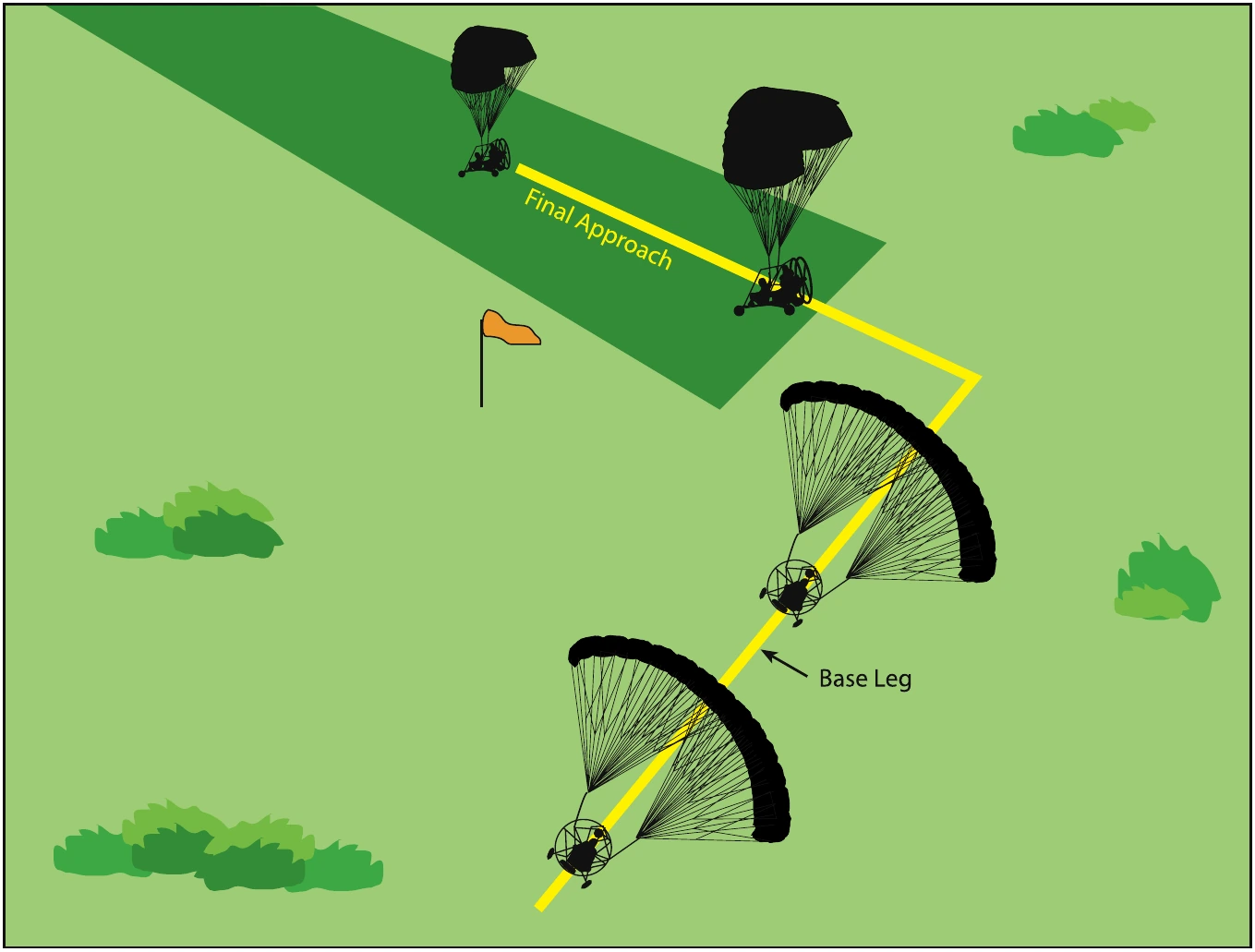
The placement of the base leg is one of the more important judgments made by the pilot in any landing approach. [Figure 11-1] You must accurately judge the altitude and distance from which a gradual descent will result in landing at the desired spot. The distance will depend on the altitude of the base leg and the effect of wind. When there is a strong wind on final approach, the base leg must be positioned closer to the approach end of the runway than would be required with a light wind. You should strive to fly a constant ground track on base leg.
Drift correction should be established and maintained to follow a ground track perpendicular to the extension of the centerline of the runway on which the landing is to be made. Since the final approach and landing will normally be made into the wind, there may be somewhat of a crosswind during the base leg. This requires the powered parachute be angled sufficiently into the wind to prevent drifting farther away from the intended landing spot.
The base leg should be continued to the point where a medium to shallow-banked turn will align the powered parachute’s path directly with the centerline of the landing runway. This descending turn should be completed at a safe altitude that will be dependent upon the height of the terrain and any obstructions along the ground track. The turn to the final approach should also be sufficiently above the airport elevation to permit a final approach long enough for you to accurately estimate the resultant point of touchdown. This will require careful planning as to the starting point and the radius of the turn. Normally, it is recommended that the angle of bank not exceed a medium bank because the steeper the angle of bank, the faster the powered parachute descends. Since the base-to-final turn is often made at a relatively low altitude, it is important not to do radical turns at low altitude. If a significant bank is needed to prevent overshooting the proper final approach path, it is advisable to discontinue the approach, go around, and start the turn earlier on the next approach rather than risk a hazardous situation.
Final Approach
After the base-to-final approach turn is completed, the powered parachute should be aligned with the centerline of the runway or landing surface, so drift (if any) will be recognized immediately. On a normal approach, with no wind drift, keep the longitudinal axis aligned with the runway centerline throughout the approach and landing. (The proper way to correct for a crosswind will be explained under the section, “Crosswind Approach and Landing.” For now, only an approach and landing where the wind is straight down the landing area will be discussed.)
Focus directly down the centerline and steer right or left to remain on that centerline.
While aligning the powered parachute down the runway centerline, or straight down your intended landing area, slight adjustments in power may be necessary to maintain the descent.
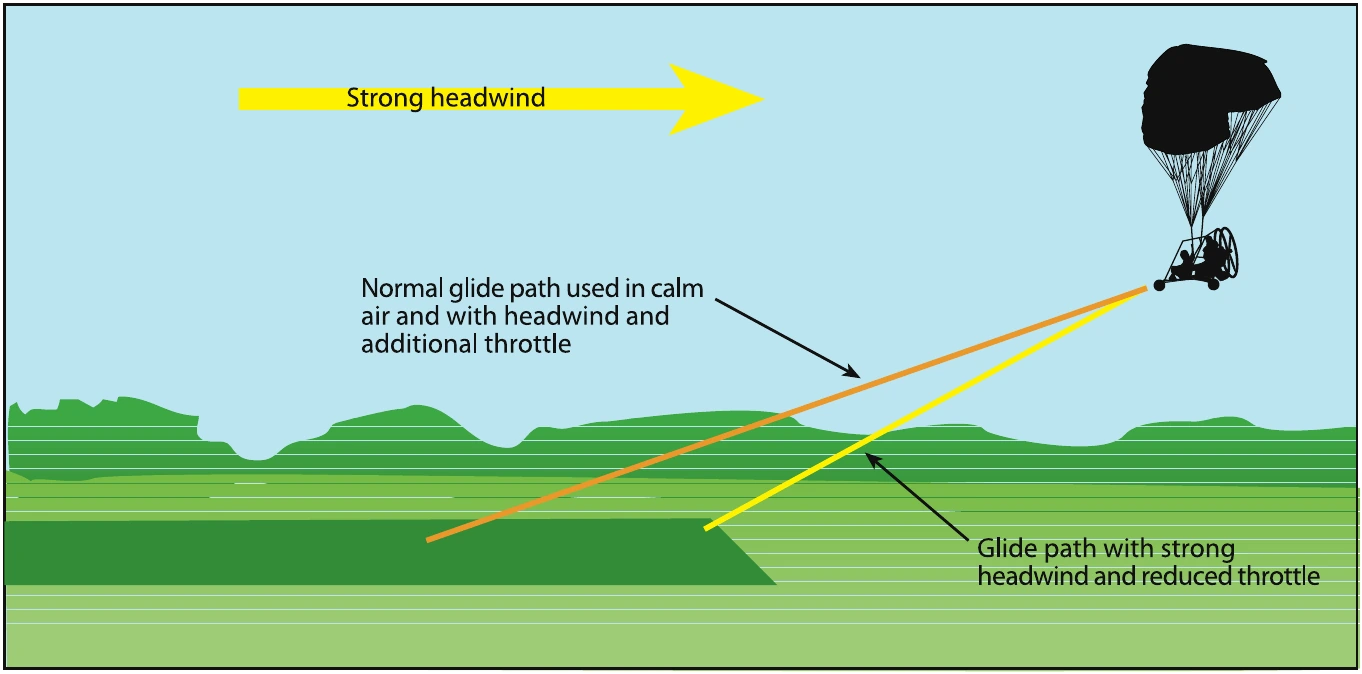
Control the descent angle throughout the approach so the powered parachute will land in the center of the first third of the runway. The descent angle is affected by the throttle. More throttle means lower descent rate, less throttle results in a higher descent rate. The wind also plays a prominent part in the gliding distance over the ground. [Figure 11-2] Naturally, you do not have control over the wind but may correct for its effect on the powered parachute’s descent by appropriate power adjustments: more throttle is required in a headwind and crosswind, less throttle is required with a tailwind.
The objective of a good final approach is to descend at an angle that will permit the powered parachute to reach the desired touchdown point. Since on a normal approach the power setting is not fixed as in a power-off approach, adjust the power as necessary, to control the descent angle, or to attain the desired altitudes along the approach path. This is one reason for performing approaches with partial power; if the approach is too high, merely reduce the power. When the approach is too low, add power.
Estimating Height and Movement
During the approach, roundout, and touchdown, vision is of prime importance. To provide a wide scope of vision and to foster good judgment of height and movement, your head should assume a natural, straight-ahead position. Your visual focus should not be fixed on any one side or any one spot ahead of the powered parachute, but should be changing slowly from a point just over the powered parachute’s nosewheel to the desired touchdown zone and back again, while maintaining a deliberate awareness of distance from either side of the runway within your peripheral field of vision. Accurate estimation of distance is, besides being a matter of practice, dependent upon how clearly objects are seen; it requires that vision be focused properly for the important objects to stand out as clearly as possible.