
Chapter 5
Preflight and Ground Operations
Engine Starting
Prior to starting the engine it is imperative to precisely follow the engine manufacturer’s recommendation for engine warm-up. Follow the before engine starting and engine starting checklist procedures in the POH. Certain precautions apply to all powered parachutes.
Do not start the engine with the back of the cart of the powered parachute pointed toward an open hangar door, parked automobiles, or a group of bystanders. This is not only discourteous, but may result in personal injury and damage to the property of others as propeller blast is surprisingly powerful.
When ready to start the engine, look in all directions to be sure nothing is or will be in the vicinity of the propeller. This includes nearby persons and aircraft that could be struck by the propeller blast or the debris it might pick up from the ground. Turn on the anti-collision strobe prior to engine start (if so equipped), even during daylight operations.
First look around, and then shout “CLEAR PROP.” Wait for a response from persons who may be nearby before activating the starter.
When activating the starter, keep one hand on the throttle. The other hand should be on the ignition in case the engine races immediately after start and the throttle has no effect. This allows prompt response if the engine falters during starting, and allows you to rapidly retard the throttle if revolutions per minute (RPM) are excessive after starting. A low RPM setting is recommended immediately following engine start. Do not allow the RPM to race immediately after start, as there will be insufficient lubrication until the oil pressure rises. In freezing temperatures, the engine will also be exposed to potential mechanical distress until it warms and normal internal operating clearances are assumed.
As soon as the engine is operating smoothly, check the oil pressure, if applicable. If it does not rise to the manufacturer’s specified value, the engine may not be receiving proper lubrication and should be shut down immediately to prevent serious damage. Although quite rare, the starter motor may remain on and engaged after the engine starts. This can be detected by a continuous very high current draw on the ammeter. Some powered parachutes also have a starter engaged warning light specifically for this purpose. The engine should be shut down immediately should this occur.
Starters are small electric motors designed to draw large amounts of current for short periods of cranking. Should the engine fail to start readily, avoid continuous starter operation for periods longer than 30 seconds without a cool down period of at least 30 seconds to a minute (some POHs specify even longer). Their service life is drastically shortened from high heat through overuse.
If the engine fails to start at all, it may be necessary to charge the battery or use the back-up pull starter. Hand propping is not a procedure typically used on powered parachutes. Always follow the manufacturers’ recommendations while troubleshooting and follow those specific procedures.
Engine Warm-Up
Engine warm-up, or run-up, not only brings the engine up to proper operating temperatures but also allows you to determine that the engine and its components are operating properly.
Generally, the engine start-up will follow these steps:
- Walk-around is complete.
- Safety check to include: front wheels properly braced, engine and propeller area clear of loose and foreign objects, area behind the cart is clear of debris, wing lines are away from the propeller.
- Prime the fuel system (as equipped).
- Activate strobe light if switch is independent of magneto switch.
- Shout “CLEAR PROP” and wait for “CLEAR” response from bystanders.
- Turn magnetos on.
- Engine gauge switch on.
- Check throttle – at idle.
- Start engine.
The warm-up procedure should never be skipped, as the result can be costly in engine repairs and detrimental to the physical well-being of the pilot and passenger. Pilots should know their engine temperature parameters from the markings on the panel and the POH limitations. Once the engine has been brought up to normal operating temperatures, check that the engine will produce sufficient RPM. Once again, refer to the engine manufacturer’s manuals for recommended procedures and parameters.
Continually monitor all the engine’s temperature gauges and know the engine operational minimum, normal, and maximum temperature ranges. The engine manual will also specify “difference” temperatures between cylinders. Excessive split differences between cylinders should not be overlooked, even if both temperature readings are within the acceptable ranges for the engine. Do not fly the powered parachute if the temperature readings are not normal! Figure out what the problem is before it results in a dangerous situation or costly engine repair. Finally, test the ignition switches if the engine has dual ignition systems installed. By turning one switch off and checking the RPM and then alternating the check with the other switch, you can assure that both ignition switches are operational. An engine with a dual ignition system is intended to be run with both systems operating.
Taxiing
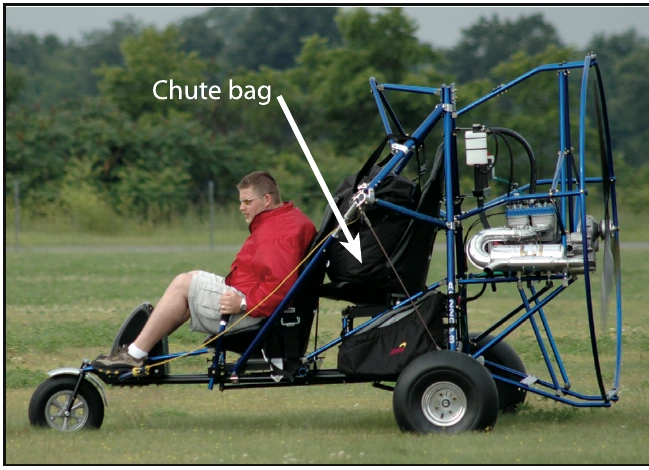
You taxi the aircraft to get the cart from one place to another. The wing bag is typically hung from the cart or placed on the rear seat unless there are extra bars installed specifically to accommodate the wing bag while taxiing; check with your manufacturer for the recommended procedure. [Figure 5-11] You can taxi with the wing packed or with the wing inflated above you; it is called “kiting” if it is inflated. During all ground operations it is important to keep your hand on the throttle and your feet on the steering bars. Do not dangle your feet off of the steering bars as this could result in a broken ankle, foot, or leg. Do not use your feet to stop the PPC, even from low speeds. Wind is not a factor when taxiing with the wing in the bag; follow the procedures for initial takeoff if taxiing with the wing inflated, or “kiting,” in any wind.
Be aware of other aircraft that are taking off, landing or taxiing and provide consideration for the right-of-way of others. Keep a lookout in front of you and on both sides. Be aware of the entire area around the powered parachute to ensure the PPC will clear all obstructions and other aircraft. If at any time there is doubt about the clearance from an object, you should stop the powered parachute and verify clearance.
Even though you may not be using a standard runway, you may need to cross active runways or taxiways to get to the area designated for powered parachute operations. That means understanding radio communications and keeping your eyes and ears open. You probably have better visibility than a pilot in a typical airplane.