
Chapter 3
Identifying Hazards & Associated Risks
Introduction
The words “hazard” and “risk” seem simple, but these words are easily confused. 14 CFR part 5, section 5.5 defines these two terms as follows:
- Hazard – a condition that could foreseeably cause or contribute to an aircraft accident as defined in 49 CFR part 830, section 830.2.
- Risk – the composite of predicted severity and likelihood of the potential effect of a hazard.
Simply put, a hazard is a condition that could cause an accident. The probability and predicted severity of the consequences that may result from any hazard is the risk. Identifying, analyzing, and responding appropriately to hazards decreases the risks and increases the margin of safety.
Hazard Exposure
The example of a person crossing a street helps explain the relationship between hazard and risk. The traffic is always a hazard, but it does not usually create a significant risk for a pedestrian until the actual street crossing takes place.
Some people may lack the experience needed to understand the hazards and risks associated with crossing a busy street and need to learn the procedures used to cross streets safely. In a similar way, pilots need to identify aviation hazards and associated risks and learn to deal with them appropriately. However, when assuming pilot-in-command duties, pilots encounter a variety of hazards, and they may not recognize the potential for an accident in a given situation. Pilots need the ability to perceive relevant hazards, understand and analyze potential consequences, and exercise judgment when responding to any hazard.
Why Hazards Result in Aviation Accidents
Pilots learn to recognize hazards during ground and flight training. While instructors normally include the learner in the decision-making process, training does not teach the learner how to manage every hazard. A saying goes that new pilots have a cup of luck and an empty cup of experience, and they should fill the cup of experience before their cup of luck runs out. However, all pilots should understand that any situation involving a hazard may present a significant risk to their safety. Rather than relying on luck, the correct response to a given hazard often depends on many variables and calls for a disciplined analysis and response. The following case studies illustrate this point.
A pilot with approximately 233 hours of total time rented an unfamiliar airplane for a round-trip VFR cross-country flight. The pilot had about 2.6 hours of time in the specific make and model. The NTSB narrative indicates the following:
According to the operator of the airplane, the pilot had difficulty starting the engine prior to departing for Erie International/Tom Ridge Field (KERI), and requested assistance. The operator proceeded out to the airplane, and showed the pilot how to start the engine. The operator then suggested the pilot leave Erie with enough time to return to Waterbury-Oxford Airport (KOXC) before sunset. Later in the day, the pilot called the operator and informed him that the airplane operated fine on the flight to Erie, and he would be back at Waterbury-Oxford by 19:00.
The pilot actually departed Erie at night. There was a fatal crash and the NTSB probable cause states:
The loss of partial engine power for undetermined reasons, and the pilot’s loss of control after performing an evasive maneuver to avoid trees during a forced landing at night. Factors related to the accident were a rough running engine and the pilot’s inability to see the trees due to the nighttime conditions. The NTSB accident details are available [here](http://www.ntsb.gov/_layouts/ntsb.aviation/brief.aspx?ev_id=20040308X00295&key=1).
While not common, even professionally trained pilots sometimes fail to recognize and respond to hazards and associated risks. An airline accident involving a transport category turbojet taken to its maximum operating altitude resulted in both engines flaming out after an aerodynamic stall. The flight ended in a crash and two fatalities. The NTSB probable cause(s) follows:
The National Transportation Safety Board determines the probable cause(s) of this accident to be: (1) the pilots’ unprofessional behavior, deviation from standard operating procedures, and poor airmanship, which resulted in an in-flight emergency from which they were unable to recover, in part because of the pilots’ inadequate training; (2) the pilots’ failure to prepare for an emergency landing in a timely manner, including communicating with air traffic controllers immediately after the emergency about the loss of both engines and the availability of landing sites; and (3) the pilots’ improper management of the double engine failure checklist, which allowed the engine cores to stop rotating and resulted in the core lock engine condition. Contributing to this accident were (1) the core lock engine condition, which prevented at least one engine from being restarted, and (2) the airplane flight manuals that did not communicate to pilots the importance of maintaining a minimum airspeed to keep the engine cores rotating. The NTSB accident details are available [here](http://app.ntsb.gov/pdfgenerator/ReportGeneratorFile.ashx?EventID=20041015X01633&AKey=1&RType=Summary&IType=MA).
Understanding the Risks Posed by Hazards
A predisposition to respond to persons, situations, or events in a given manner reveals a person’s attitude. Studies have identified five hazardous attitudes that can affect a pilot’s ability to make sound decisions and exercise authority properly. [Figure 3-1]
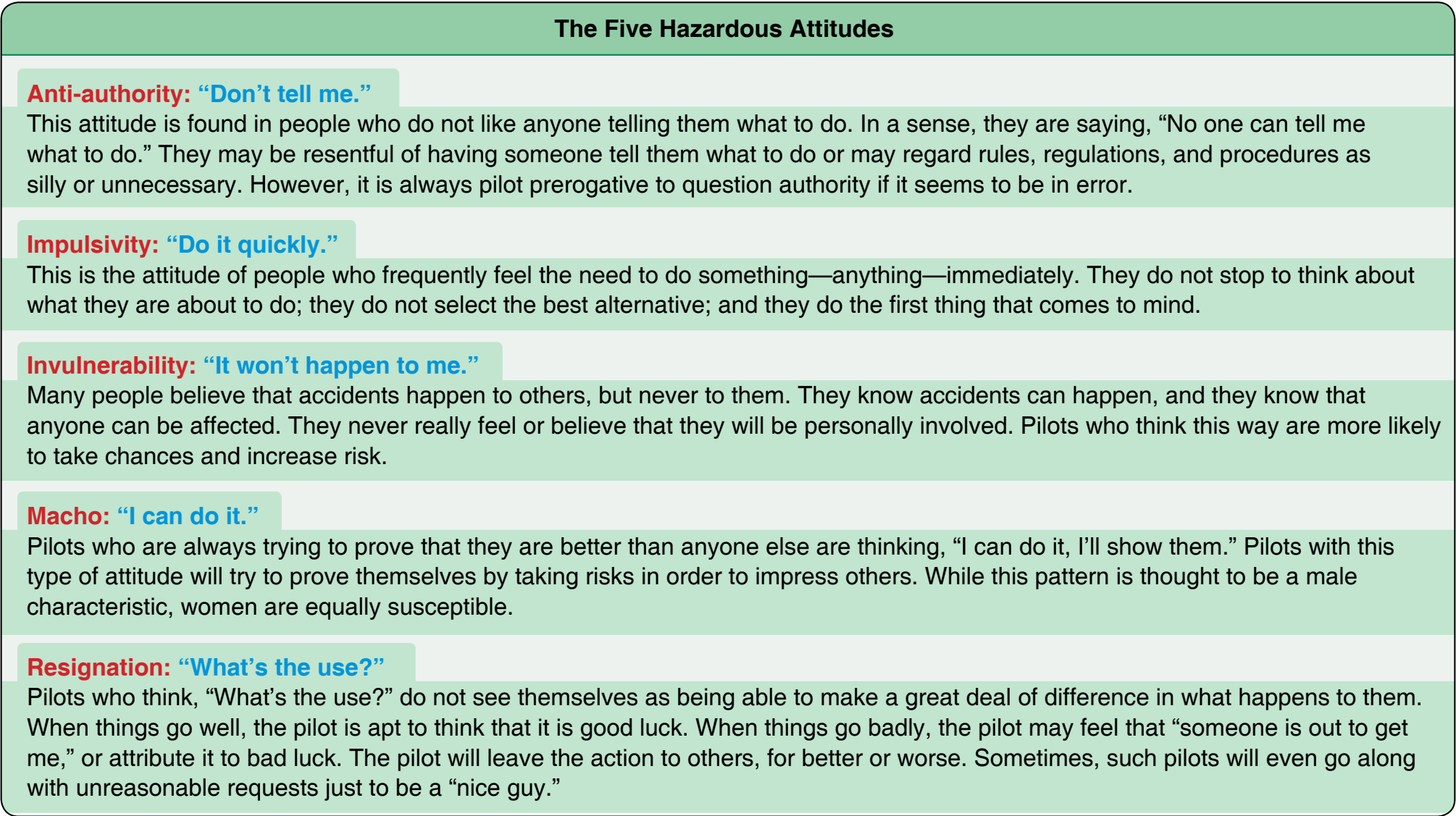
Most pilots sincerely believe that they will respond to hazards appropriately and take actions necessary to avoid accidents. However, a pilot’s attitude affects perception of hazards, the analysis of the potential threat, and performance of an appropriate response.
Since attitude influences behavior, pilots should consider their own attitude and the antidote to any hazardous attitude. [Figure 3-2] The pilots in the two fatal accidents described above exhibited several of these hazardous attitudes. If they had recognized their attitude toward the hazards and associated risks and considered that their behavior could result in an accident, it is very likely that they would have acted differently (invulnerability). If the general aviation pilot had waited and returned the next day, he might be alive today (impulsivity). The commercial pilots wanted to claim they had flown the aircraft at its maximum altitude (macho). Pilot attitudes regarding hazard analysis clearly play a role in decision-making.