Chapter 3
Identifying Hazards & Associated Risks
Leading Accident Causes
The aviation accident record has improved considerably in recent years, but the reduction in accident rates has not been uniform across the aviation community. For example, the accident rate for air carriers operating under 14 CFR part 121 was reduced by nearly 80 percent in the ten-year period beginning in the mid-1990s. In contrast, general aviation aircraft operating under 14 CFR part 91 maintained a static accident rate of about one fatal accident per 100,000 flight hours.
The FAA and the general aviation community collaborate through the General Aviation Joint Steering Committee (GAJSC), to suggest safety enhancements that could reduce accidents. As part of this effort, the GAJSC analyzed hundreds of general aviation accidents and evaluated the causal factors. The FAA Fact Sheet on General Aviation Safety ranks the following ten leading causes of general aviation fatal accidents during the period 2001-2016:
- Loss of control in-flight (LOC-I)
- Controlled flight into terrain (CFIT)
- System component failure–powerplant
- Fuel related
- Unknown or undetermined
- System component failure–non powerplant
- Unintended flight into IMC
- Midair collisions
- Low-altitude operations
- Other
The top four causes of general aviation fatal accidents include loss of control in-flight (LOC-I), controlled flight into terrain (CFIT), system component failure of the powerplant (SCF-PP), and fuel-related issues. These causes often signify the final result of a chain of events. However, an in-depth analysis of these accidents will often reveal inadequate risk management as a common thread. To begin with, pilots should recognize hazards linked to causes of aircraft accidents as presented below:
- Loss of Control In-flight (LOC-I)–Examples of loss of control scenarios include continued VFR into IMC, wake turbulence upsets, thunderstorm encounters, instrument failure, improper aircraft loading, loss of outside references during flight at night or over water, and conditions that exceed the pilot’s capability.
- Controlled Flight into Terrain (CFIT)–CFIT often results from continued VFR flight into areas with a low ceiling or low visibility, flight at night, incorrect interpretation of a chart, flight at high density altitude, flight in mountainous terrain, or intentionally flying too low.
- System Component Failure Powerplant (SCF-PP)–This category includes a variety of hazards, some which the pilot or operator may not easily identify. If a pilot experiences difficulty with an engine run-up or experiences an engine issue after maintenance, a significant hazard may exist.
- Fuel-Related–Pilots still experience fuel starvation or fuel exhaustion. Misunderstanding or mishandling the aircraft's fuel system, a lack of adequate planning, trying to stretch aircraft fuel range, or an unwillingness to take the time or make the effort to stop for fuel contributes to this type of accident.
Identifying Hazards
There are several ways pilots can detect hazards. Pilots should use combinations of methods to detect hazards, including the following:
- Visual Observation–A pilot’s observations provide a primary means to identify hazards. For example, a pilot can visually observe thunderstorms and maintain a safe distance from them. A pilot who can see terrain can maneuver to avoid it.
- Preflight Planning–Many hazards can be detected through preflight planning. Weather briefings identify hazards. Aircraft performance calculations, preflight inspections, and other routine procedures may identify hazards.
- On-board Equipment–The availability of lower-cost modern avionics has improved situational awareness in many general aviation aircraft. Technologies such as GPS-based moving map navigation, datalink weather, traffic displays, terrain displays, and synthetic vision help pilots recognize different hazards.
- Radio Communication–Voice radio provides an effective means to find out about hazards. Communication with air traffic controllers and flight service specialists can provide real-time information on weather, air traffic, airspace activity, and other hazards.
- Postflight Inspections–Inspecting the aircraft following the completion of a flight may identify aircraft hazards before the next person flies the aircraft. Common items include condition of tires and brakes, security of access panels and latches, and leaking operating fluids. Properly securing the aircraft may prevent damage, which could affect the next flight.
Using the PAVE Checklist to Identify Hazards
As described in Chapter 1, the PAVE checklist provides a means to identify hazards using four convenient hazard “buckets.” Using all four checklist categories before a flight captures most hazards normally encountered. This section discusses hazards associated with each category.
Pilot Hazards
“P” hazards can be classified in terms of both capability and aeromedical factors as follows:
- Qualification–Does the pilot possess the appropriate pilot certificate, category, class, and type rating needed to operate a specific aircraft under the given set of conditions? Some accidents have occurred when pilots have attempted to operate under IFR without holding an instrument rating. A few accidents occur every year when the pilot did not possess any airman certificate.
- Currency–Has the pilot logged the minimum number of takeoffs and landings and instrument approaches, flight reviews, or other currency events required by 14 CFR? Are the currency requirements sufficient to guarantee that the pilot will be able to handle the flight requirements?
- Proficiency–Does the pilot have the ability to manage the conditions expected during flight? For example, suppose a pilot plans an IFR flight with forecast of low ceilings. Under 14 CFR part 61, the pilot needs to have logged six instrument approaches, holding, and tracking within the previous six calendar months to be IFR current. However, if these currency events occurred five months ago, the pilot may lack the proficiency to make the flight safely. If a pilot flies an unfamiliar aircraft, does the pilot have the ability to use the avionics and systems efficiently and properly?
Aeromedical
Aeromedical hazards relate to physical and emotional readiness for flight including:
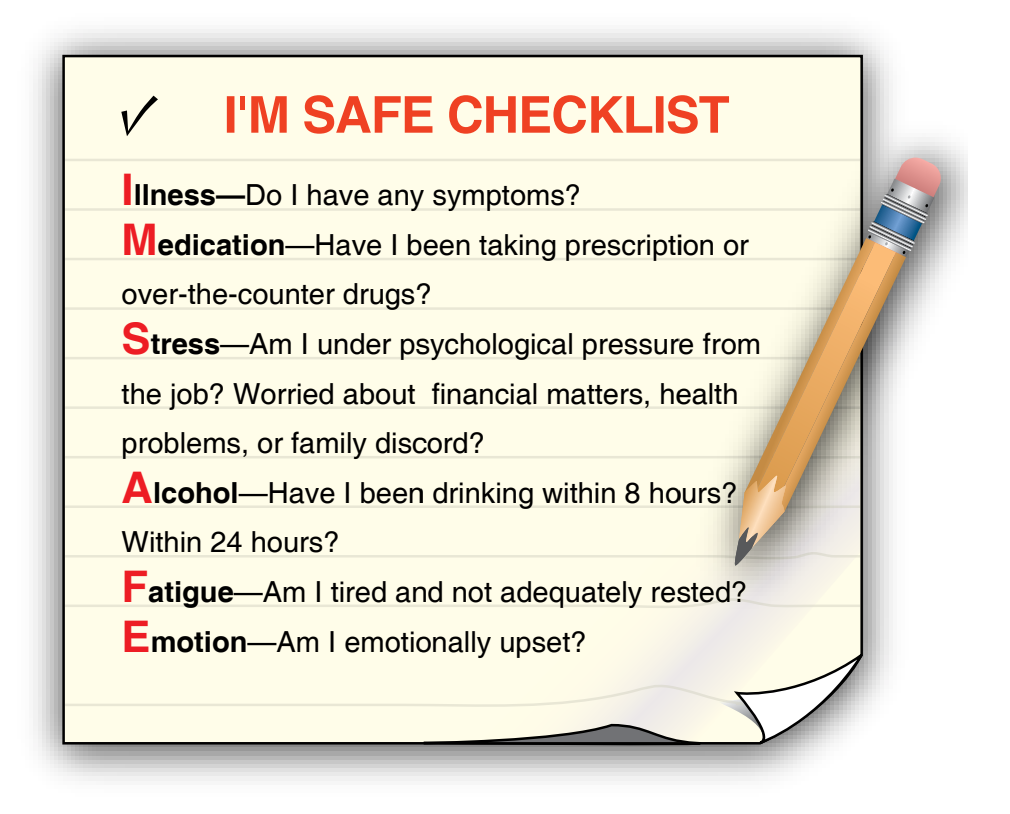
- Illness–Does a pilot suffer from initial symptoms, ongoing illness, or any aftereffects? Even mild symptoms may be sufficiently debilitating to create a “P” hazard.
- Medication–Could any medications the pilot takes affect the flight? Both prescription and non-prescription over-the-counter (OTC) drugs have side effects that can affect a pilot’s physical and mental performance. The FAA provides information regarding OTC drugs [here](http://www.faa.gov/licenses_certificates/medical_certification/media/OTCMedicationsforPilots.pdf).
- Stress–Has a stressful life situation affected the pilot? Many personal or business events and activities can cause stress. Stress has many manifestations and affects thinking, behavior, and health.
- Alcohol–Has the pilot consumed alcohol recently? The CFRs include a time limit (no consumption within eight hours before a flight), a quantity limit (blood alcohol must be below 0.04 percent), and a performance limit (flight duty prohibited while under the influence of alcohol). Aftereffects of alcohol consumption (dehydration, hangover, and headaches, etc.) may trigger a “P” hazard for longer than eight hours after consumption.
- Fatigue–How alert is the pilot? Fatigue may result from insufficient sleep. However, sufficient sleep only corrects acute fatigue. Chronic fatigue may involve multiple factors and requires additional analysis and remedy. Fatigue can be intensified by hypoxia as well as emotional state. While fatigued pilots have fallen asleep while flying, the effects of fatigue may be subtle. For example, fatigue may degrade cognitive skills and decision-making ability.
- Emotion–Has the pilot experienced an event or received information that creates strong feelings? Emotions may affect normal pilot ability to focus.
The IMSAFE checklist, which is an acronym for Illness, Medication, Stress, Alcohol, Fatigue, and Emotion, can help a pilot identify these hazards. [Figure 3-3] Note that some publications combine Emotion with Stress as the “S” in IMSAFE and leave the “E” to remind pilots about “Eating.” Since proper nutrition and hydration affects wellness and safety, a pilot planning a long flight should consider appropriate food and water intake and supply.