
Chapter 12
Attitude Instrument Flying
Entry
To enter a constant airspeed climb from cruise airspeed, when the climb speed is lower than cruise speed, simultaneously increase power to the climb power setting and adjust pitch attitude to the approximate climb attitude. The increase in power causes the helicopter to start climbing and only very slight back cyclic pressure is needed to complete the change from level to climb attitude. The attitude indicator should be used to accomplish the pitch change. If the transition from level flight to a climb is smooth, the vertical speed indicator shows an immediate upward trend and then stops at a rate appropriate to the stabilized airspeed and attitude. Primary and supporting instruments for climb entry are illustrated in figure 12-17.
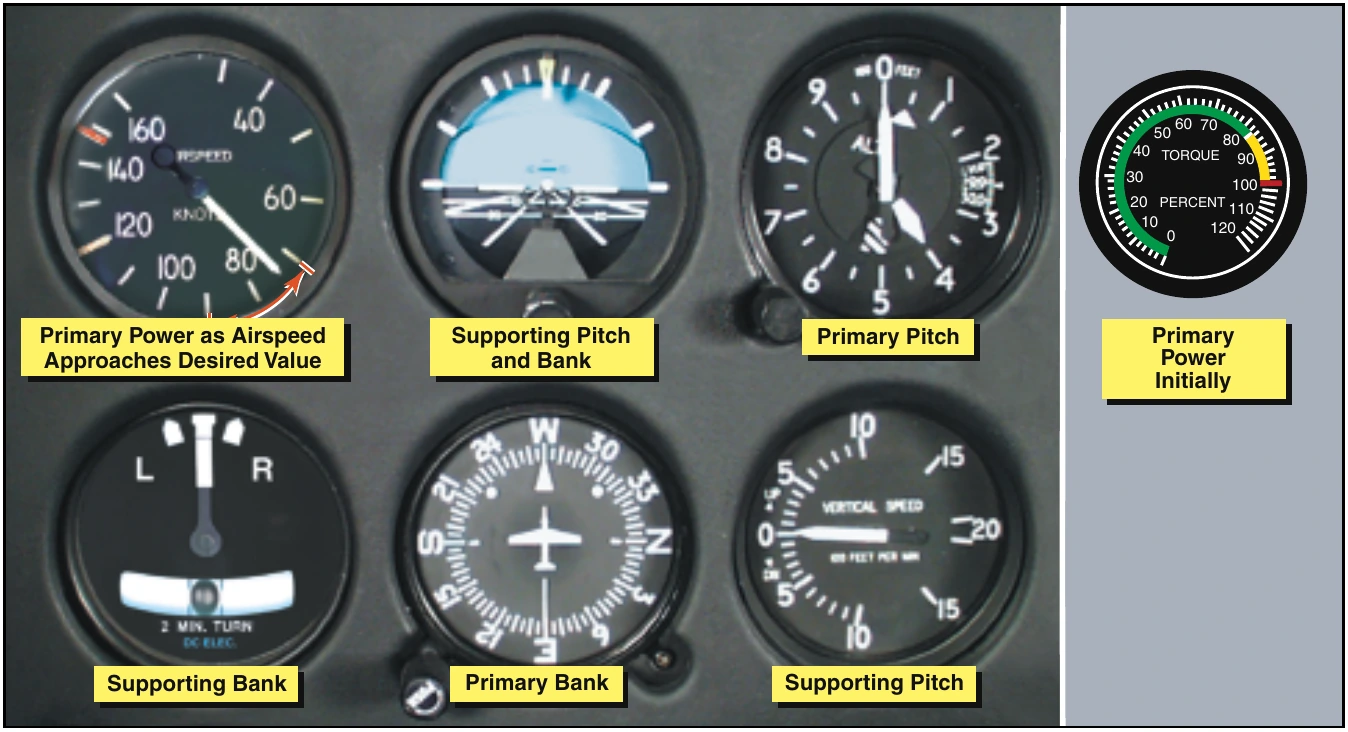
When the helicopter stabilizes on a constant airspeed and attitude, the airspeed indicator becomes primary for pitch. The torque meter continues to be primary for power and should be monitored closely to determine if the proper climb power setting is being maintained.
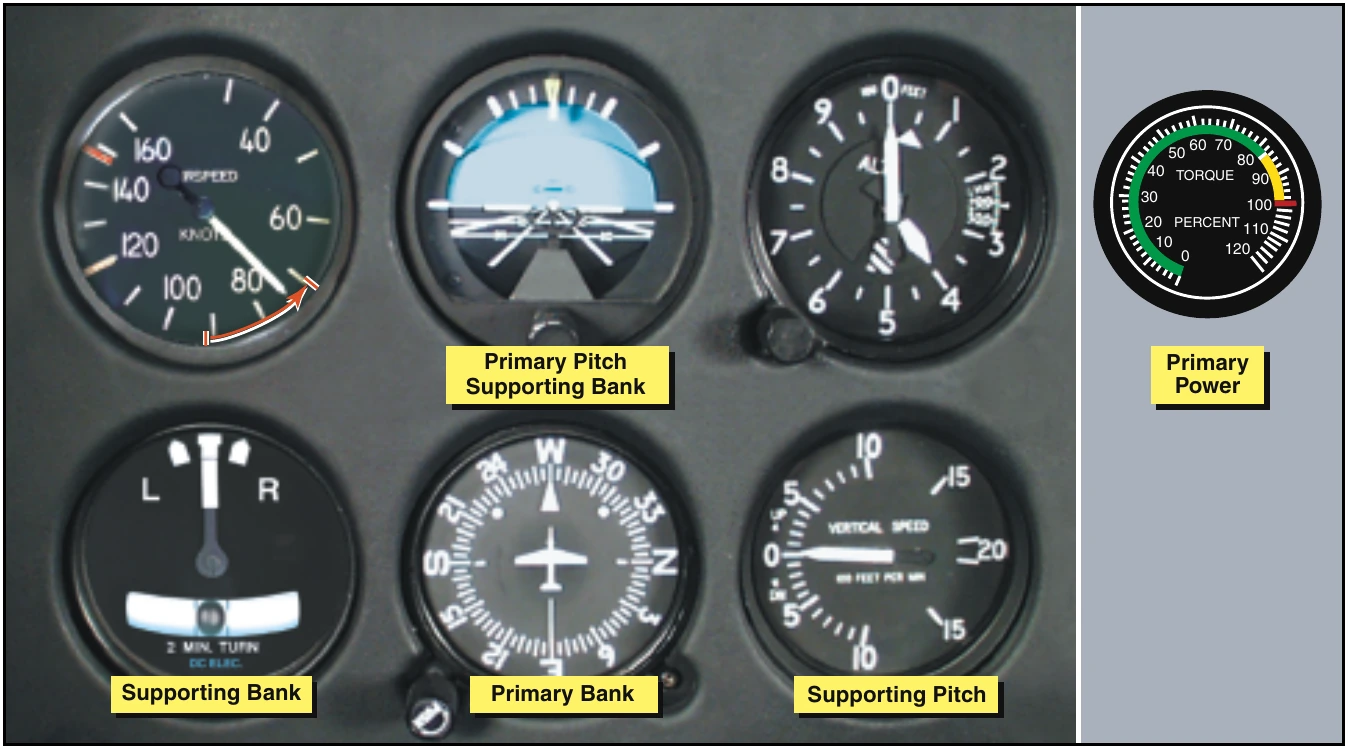
Primary and supporting instruments for a stabilized constant airspeed climb are shown in figure 12-18.
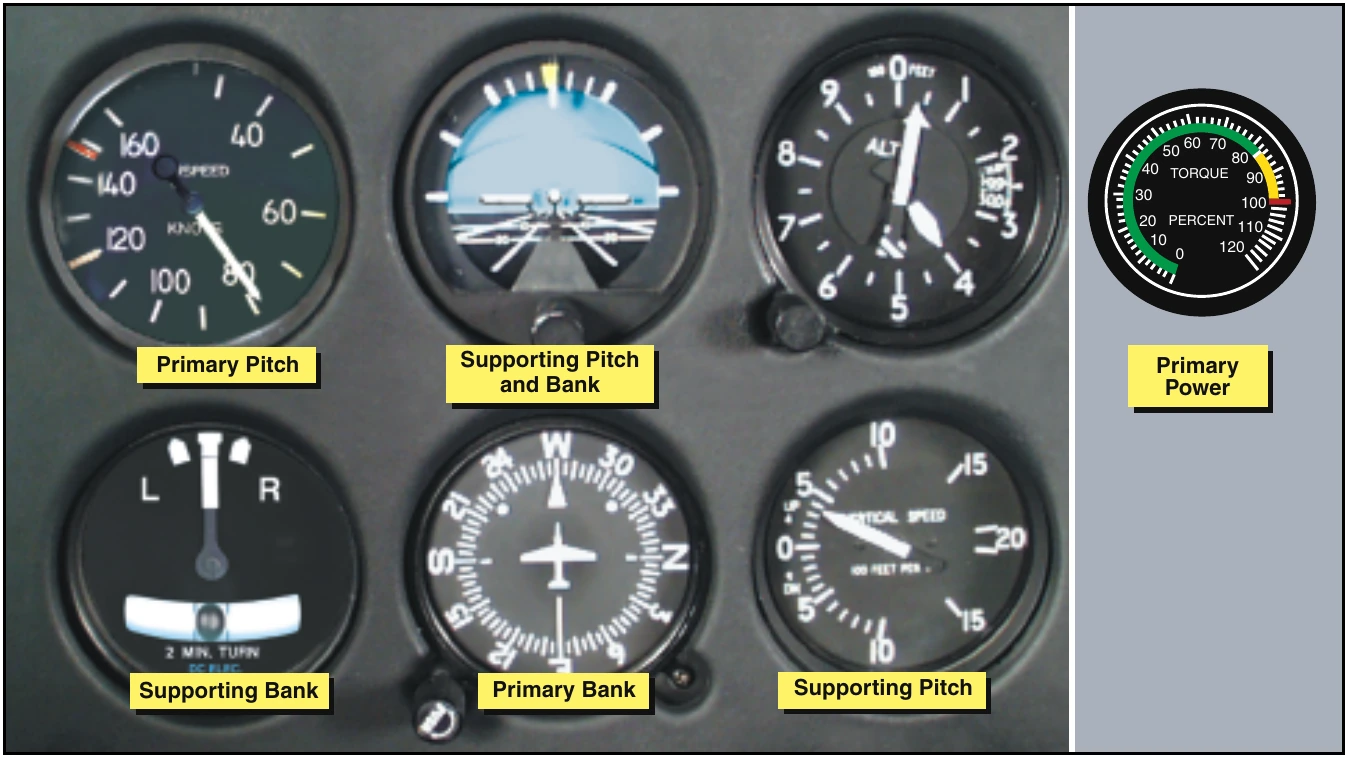
The technique and procedures for entering a constant rate climb are very similar to those previously described for a constant airspeed climb. For training purposes, a constant rate climb is entered from climb airspeed. The rate used is the one that is appropriate for the particular helicopter being flown. Normally, in helicopters with low climb rates, 500 f.p.m. is appropriate, in helicopters capable of high climb rates, use a rate of 1,000 f.p.m.
To enter a constant rate climb, increase power to the approximate setting for the desired rate. As power is applied, the airspeed indicator is primary for pitch until the vertical speed approaches the desired rate. At this time, the vertical speed indicator becomes primary for pitch. Change pitch attitude by reference to the attitude indicator to maintain the desired vertical speed. When the VSI becomes primary for pitch, the airspeed indicator becomes primary for power. Primary and supporting instruments for a stabilized constant rate climb are illustrated in figure 12-19. Adjust power to maintain desired airspeed. Pitch attitude and power corrections should be closely coordinated. To illustrate this, if the vertical speed is correct but the airspeed is low, add power. As power is increased, it may be necessary to lower the pitch attitude slightly to avoid increasing the vertical rate. Adjust the pitch attitude smoothly to avoid overcontrolling. Small power corrections usually will be sufficient to bring the airspeed back to the desired indication.
Leveloff
The leveloff from a constant airspeed climb must be started before reaching the desired altitude. Although the amount of lead varies with the helicopter being flown and your piloting technique, the most important factor is vertical speed. As a rule of thumb, use 10 percent of the vertical velocity as your lead point. For example, if the rate of climb is 500 f.p.m., initiate the leveloff approximately 50 feet before the desired altitude. When the proper lead altitude is reached, the altimeter becomes primary for pitch. Adjust the pitch attitude to the level flight attitude for that airspeed. Cross-check the altimeter and VSI to determine when level flight has been attained at the desired altitude. To level off at cruise airspeed, if this speed is higher than climb airspeed, leave the power at the climb power setting until the airspeed approaches cruise airspeed, then reduce it to the cruise power setting.
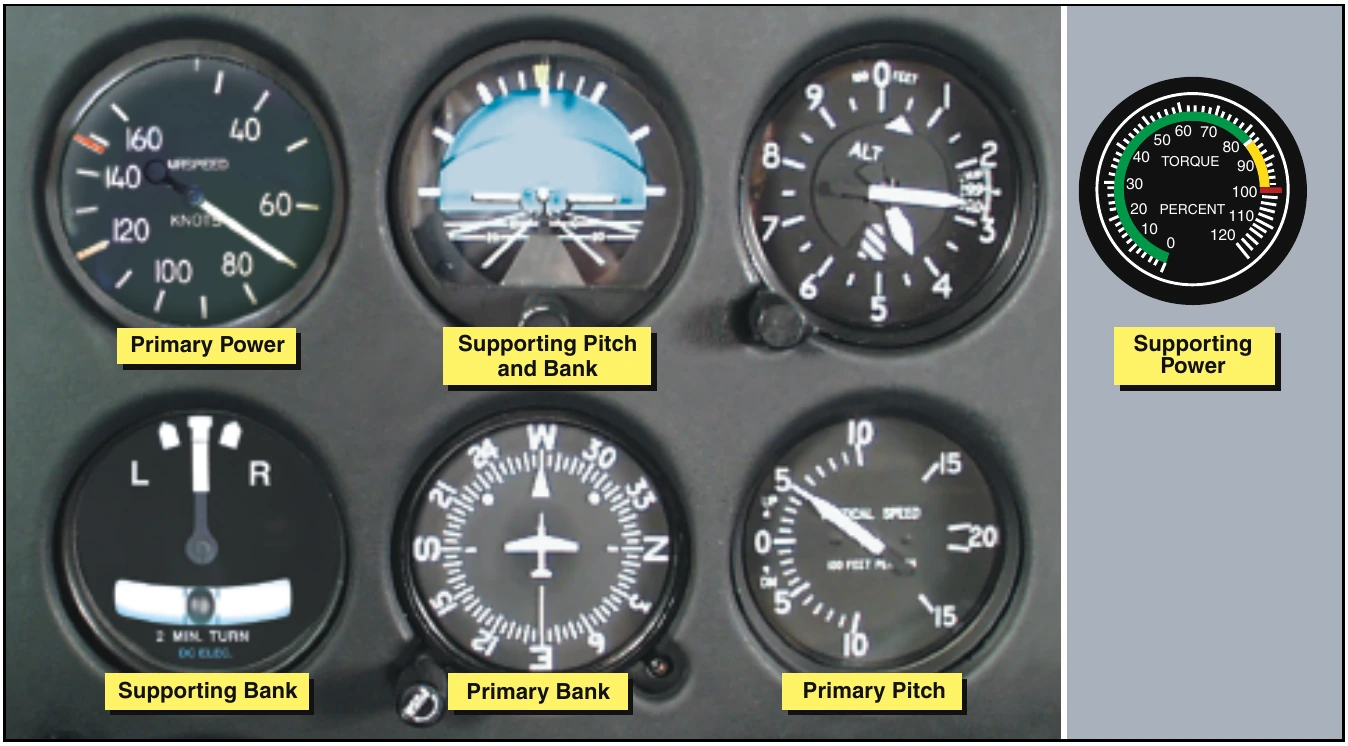
The leveloff from a constant rate climb is accomplished in the same manner as the leveloff from a constant airspeed climb.
Straight Descents (Constant Airspeed and Constant Rate)
A descent may be performed at any normal airspeed the helicopter is capable of, but the airspeed must be determined prior to entry. The technique is determined by whether you want to perform a constant airspeed or a constant rate descent.
Entry
If your airspeed is higher than descending airspeed, and you wish to make a constant airspeed descent at the descending airspeed, reduce power to the descending power setting and maintain a constant altitude using cyclic pitch control. When you approach the descending airspeed, the airspeed indicator becomes primary for pitch, and the torque meter is primary for power. As you hold the airspeed constant, the helicopter begins to descend. For a constant rate descent, reduce the power to the approximate setting for the desired rate. If the descent is started at the descending airspeed, the airspeed indicator is primary for pitch until the VSI approaches the desired rate. At this time, the vertical speed indicator becomes primary for pitch, and the airspeed indicator becomes primary for power.
Coordinate power and pitch attitude control as was described earlier for constant rate climbs.
Leveloff
The leveloff from a constant airspeed descent may be made at descending airspeed or at cruise airspeed, if this is higher than descending airspeed. As in a climb leveloff, the amount of lead depends on the rate of descent and control technique. For a leveloff at descending airspeed, the lead should be approximately 10 percent of the vertical speed. At the lead altitude, simultaneously increase power to the setting necessary to maintain descending airspeed in level flight. At this point, the altimeter becomes primary for pitch, and the airspeed indicator becomes primary for power.