
Chapter 14
Aeronautical Decision Making
Aeronautical decision making (ADM) is a systematic approach to the mental process used by pilots to consistently determine the best course of action in response to a given set of circumstances. The importance of learning effective ADM skills cannot be overemphasized. While progress is continually being made in the advancement of pilot training methods, aircraft equipment and systems, and services for pilots, accidents still occur. Despite all the changes in technology to improve flight safety, one factor remains the same—the human factor. It is estimated that approximately 65 percent of the total rotorcraft accidents are human factors related.
Historically, the term “pilot error” has been used to describe the causes of these accidents. Pilot error means that an action or decision made by the pilot was the cause of, or a contributing factor that lead to, the accident. This definition also includes the pilot’s failure to make a decision or take action. From a broader perspective, the phrase “human factors related” more aptly describes these accidents since it is usually not a single decision that leads to an accident, but a chain of events triggered by a number of factors.
The poor judgment chain, sometimes referred to as the “error chain,” is a term used to describe this concept of contributing factors in a human factors related accident. Breaking one link in the chain normally is all that is necessary to change the outcome of the sequence of events. The following is an example of the type of scenario illustrating the poor judgment chain.
A helicopter pilot, with limited experience flying in adverse weather, wants to be back at his home airport in time to attend an important social affair. He is already 30 minutes late. Therefore, he decides not to refuel his helicopter, since he should get back home with at least 20 minutes of reserve. In addition, in spite of his inexperience, he decides to fly through an area of possible thunderstorms in order to get back just before dark. Arriving in the thunderstorm area, he encounters lightning, turbulence, and heavy clouds. Night is approaching, and the thick cloud cover makes it very dark. With his limited fuel supply, he is not able to circumnavigate the thunderstorms. In the darkness and turbulence, the pilot becomes spatially disoriented while attempting to continue flying with visual reference to the ground instead of using what instruments he has to make a 180° turn. In the ensuing crash, the pilot is seriously injured and the helicopter completely destroyed.
By discussing the events that led to this accident, we can understand how a series of judgmental errors contributed to the final outcome of this flight. For example, one of the first elements that affected the pilot’s flight was a decision regarding the weather. The pilot knew there were going to be thunderstorms in the area, but he had flown near thunderstorms before and never had an accident.
Next, he let his desire to arrive at his destination on time override his concern for a safe flight. For one thing, in order to save time, he did not refuel the helicopter, which might have allowed him the opportunity to circumnavigate the bad weather. Then he overestimated his flying abilities and decided to use a route that took him through a potential area of thunderstorm activity. Next, the pilot pressed on into obviously deteriorating conditions instead of changing course or landing prior to his destination.
On numerous occasions during the flight, the pilot could have made effective decisions that may have prevented this accident. However, as the chain of events unfolded, each poor decision left him with fewer and fewer options. Making sound decisions is the key to preventing accidents. Traditional pilot training has emphasized flying skills, knowledge of the aircraft, and familiarity with regulations. ADM training focuses on the decision-making process and the factors that affect a pilot’s ability to make effective choices.
Human Factors— The study of how people interact with their environments. In the case of general aviation, it is the study of how pilot performance is influenced by such issues as the design of cockpits, the function of the organs of the body, the effects of emotions, and the interaction and communication with the other participants of the aviation community, such as other crew members and air traffic control personnel.
Origins of ADM Training
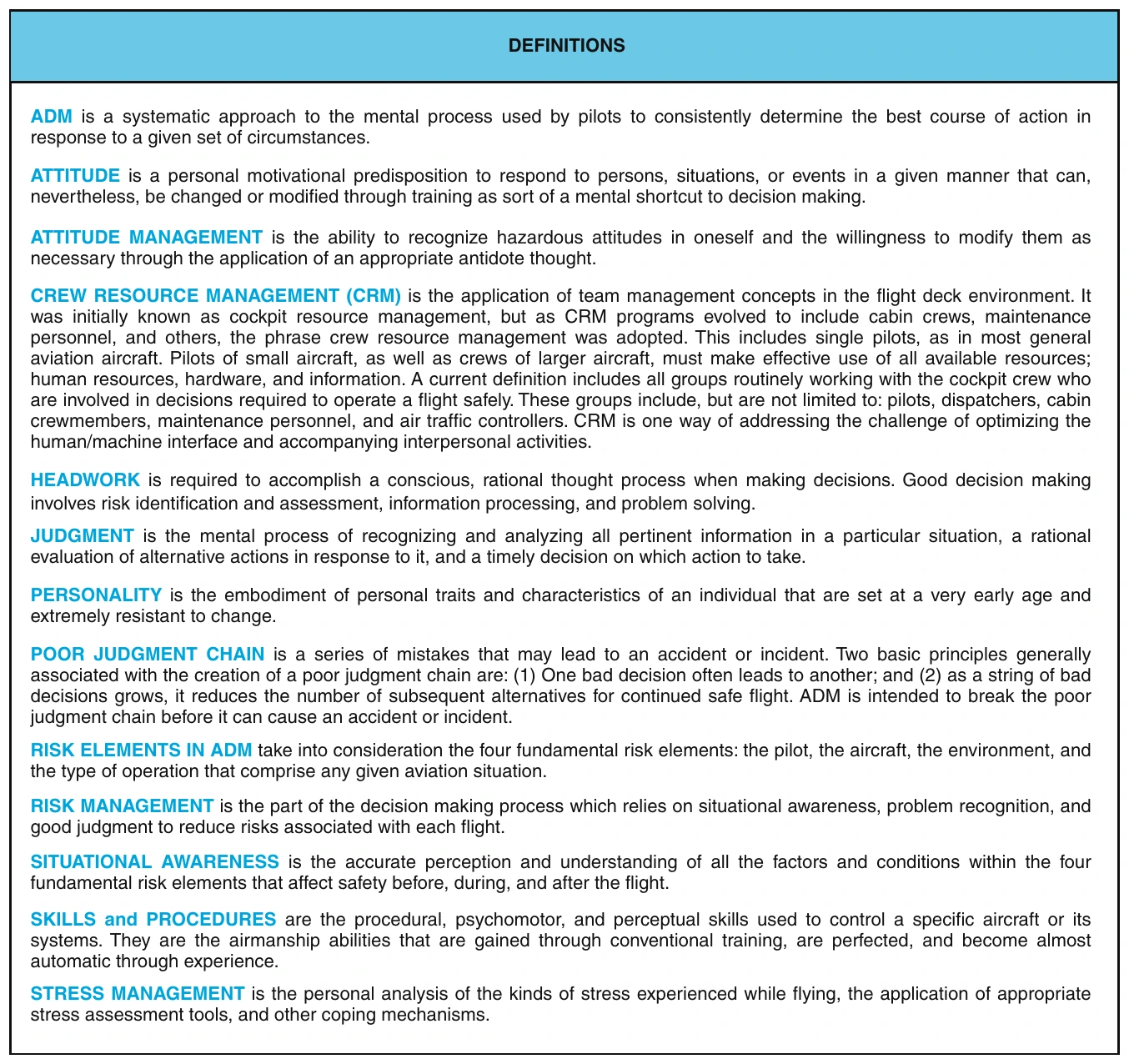
The airlines developed some of the first training programs that focused on improving aeronautical decision making. Human factors-related accidents motivated the airline industry to implement crew resource management (CRM) training for flight crews. The focus of CRM programs is the effective use of all available resources; human resources, hardware, and information. Human resources include all groups routinely working with the cockpit crew (or pilot) who are involved in decisions that are required to operate a flight safely. These groups include, but are not limited to: ground personnel, dispatchers, cabin crewmembers, maintenance personnel, external-load riggers, and air traffic controllers. Although the CRM concept originated as airlines developed ways of facilitating crew cooperation to improve decision making in the cockpit, CRM principles, such as workload management, situational awareness, communication, the leadership role of the captain, and crewmember coordination have direct application to the general aviation cockpit. This also includes single pilot operations since pilots of small aircraft, as well as crews of larger aircraft, must make effective use of all available resources—human resources, hardware, and information. You can also refer to AC 60-22, Aeronautical Decision Making, which provides background references, definitions, and other pertinent information about ADM training in the general aviation environment. [Figure 14-1]
The Decision-Making Process
An understanding of the decision-making process provides you with a foundation for developing ADM skills. Some situations, such as engine failures, require you to respond immediately using established procedures with little time for detailed analysis. Traditionally, pilots have been well trained to react to emergencies, but are not as well prepared to make decisions that require a more reflective response. Typically during a flight, you have time to examine any changes that occur, gather information, and assess risk before reaching a decision. The steps leading to this conclusion constitute the decision-making process.
Defining the Problem
Problem definition is the first step in the decision-making process. Defining the problem begins with recognizing that a change has occurred or that an expected change did not occur. A problem is perceived first by the senses, then is distinguished through insight and experience. These same abilities, as well as an objective analysis of all available information, are used to determine the exact nature and severity of the problem.
While doing a hover check after picking up fire fighters at the bottom of a canyon, you realize that you are only 20 pounds under maximum gross weight. What you failed to realize is that they had stowed some of their heaviest gear in the baggage compartment, which shifted the CG slightly behind the aft limits.
Since weight and balance had never created any problems for you in the past, you did not bother to calculate CG and power required. You did, however, try to estimate it by remembering the figures from earlier in the morning at the base camp. At a 5,000 foot density altitude and maximum gross weight, the performance charts indicated you had plenty of excess power. Unfortunately, the temperature was 93°F and the pressure altitude at the pick up point was 6,200 feet (DA = 9,600 feet). Since there was enough power for the hover check, you felt there was sufficient power to take off.
Even though the helicopter accelerated slowly during the takeoff, the distance between the helicopter and the ground continued to increase. However, when you attempted to establish the best rate of climb speed, the nose wanted to pitch up to a higher than normal attitude, and you noticed that the helicopter was not gaining enough altitude in relation to the canyon wall a couple hundred yards ahead.
Choosing a Course of Action
After the problem has been identified, you must evaluate the need to react to it and determine the actions that need to be taken to resolve the situation in the time available. The expected outcome of each possible action should be considered and the risks assessed before you decide on a response to the situation.