
Chapter 14
Aeronautical Decision Making
Your first thought was to pull up on the collective and yank back on the cyclic, but after weighing the consequences of possibly losing rotor r.p.m. and not being able to maintain the climb rate sufficiently enough to clear the canyon wall, which is now only a hundred yards away, you realize that your only course is to try to turn back to the landing zone on the canyon floor.
Implementing the Decision and Evaluating the Outcome
Although a decision may be reached and a course of action implemented, the decision-making process is not complete. It is important to think ahead and determine how the decision could affect other phases of the flight.
As the flight progresses, you must continue to evaluate the outcome of the decision to ensure that it is producing the desired result.
As you make your turn to the downwind, the airspeed drops nearly to zero, and the helicopter becomes very difficult to control. At this point, you must increase airspeed in order to maintain translational lift, but since the CG is aft of limits, you need to apply more forward cyclic than usual. As you approach the landing zone with a high rate of descent, you realize that you are in a potential settling-with-power situation if you try to trade airspeed for altitude and lose ETL. Therefore, you will probably not be able to terminate the approach in a hover. You decide to make as shallow of an approach as possible and perform a run-on landing.
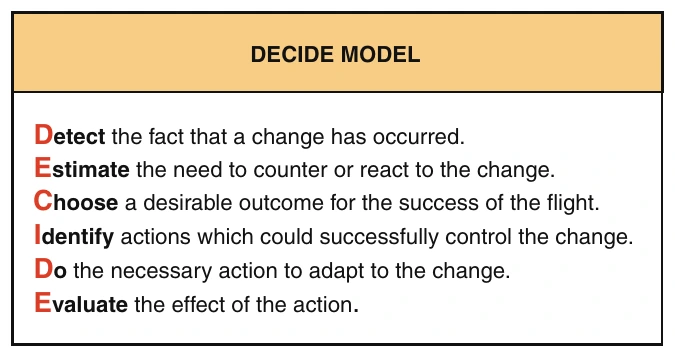
The decision making process normally consists of several steps before you choose a course of action. To help you remember the elements of the decision-making process, a six-step model has been developed using the acronym “DECIDE.” [Figure 14-2]
Risk Management
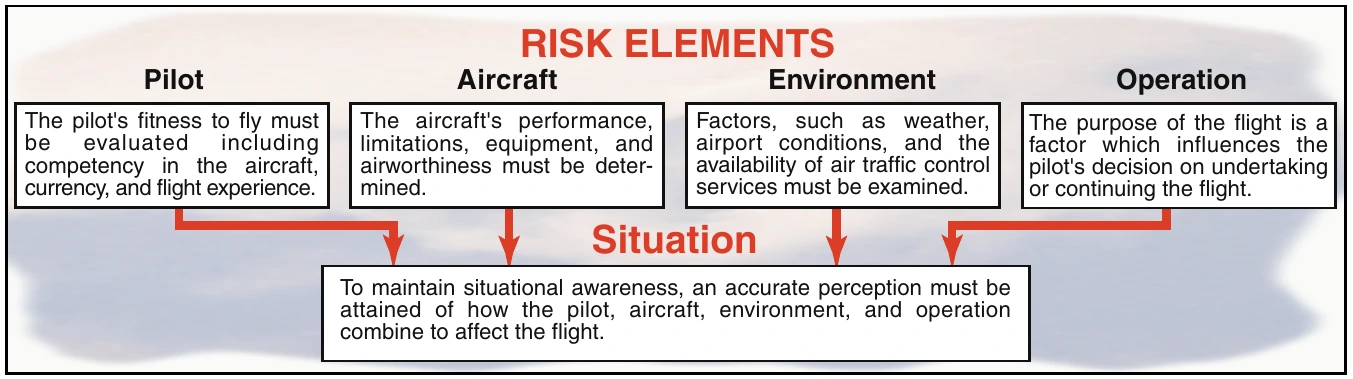
During each flight, decisions must be made regarding events that involve interactions between the four risk elements—the pilot in command, the aircraft, the environment, and the operation. The decision-making process involves an evaluation of each of these risk elements to achieve an accurate perception of the flight situation. [Figure 14-3]
One of the most important decisions that a pilot in command must make is the go/no-go decision. Evaluating each of these risk elements can help you decide whether a flight should be conducted or continued. Let us evaluate the four risk elements and how they affect our decision making regarding the following situations.
Pilot—As a pilot, you must continually make decisions about your own competency, condition of health, mental and emotional state, level of fatigue, and many other variables. For example, you are called early in the morning to make a long flight. You have had only a few hours of sleep, and are concerned that the congestion you feel could be the onset of a cold. Are you safe to fly?
Aircraft—You will frequently base decisions on your evaluations of the aircraft, such as its powerplant, performance, equipment, fuel state, or airworthiness. Picture yourself in this situation: you are en route to an oil rig an hour’s flight from shore, and you have just passed the shoreline. Then you notice the oil temperature at the high end of the caution range. Should you continue out to sea, or return to the nearest suitable heliport/airport?
Environment—This encompasses many elements not pilot or aircraft related. It can include such factors as weather, air traffic control, navaids, terrain, takeoff and landing areas, and surrounding obstacles. Weather is one element that can change drastically over time and distance. Imagine you are ferrying a helicopter cross country and encounter unexpected low clouds and rain in an area of rising terrain. Do you try to stay under them and “scud run,” or turn around, stay in the clear, and obtain current weather information?
Operation—The interaction between you as the pilot, your aircraft, and the environment is greatly influenced by the purpose of each flight operation. You must evaluate the three previous areas to decide on the desirability of undertaking or continuing the flight as planned. It is worth asking yourself why the flight is being made, how critical is it to maintain the schedule, and is the trip worth the risks? For instance, you are tasked to take some technicians into rugged mountains for a routine survey, and the weather is marginal. Would it be preferable to wait for better conditions to ensure a safe flight?
How would the priorities change if you were tasked to search for cross-country skiers who had become lost in deep snow and radioed for help?
Assessing Risk
Examining NTSB reports and other accident research can help you to assess risk more effectively. For example, the accident rate decreases by nearly 50 percent once a pilot obtains 100 hours, and continues to decrease until the 1,000 hour level. The data suggest that for the first 500 hours, pilots flying VFR at night should establish higher personal limitations than are required by the regulations and, if applicable, apply instrument flying skills in this environment. [Figure 14-4]
Studies also indicate the types of flight activities that are most likely to result in the most serious accidents.
The majority of fatal general aviation accident causes fall under the categories of maneuvering flight, approaches, takeoff/initial climb, and weather. Delving deeper into accident statistics can provide some important details that can help you to understand the risks involved with specific flying situations. For example, maneuvering flight is one of the largest single producers of fatal accidents. Fatal accidents, which occur during approach, often happen at night or in IFR conditions. Takeoff/initial climb accidents frequently are due to the pilot’s lack of awareness of the effects of density altitude on aircraft performance or other improper takeoff planning resulting in loss of control during, or shortly after takeoff. The majority of weather-related accidents occur after attempted VFR flight into IFR conditions.