
Chapter 3
Aerodynamics of Flight
Once a helicopter leaves the ground, it is acted upon by the four aerodynamic forces. In this chapter, we will examine these forces as they relate to flight maneuvers.
Powered Flight
In powered flight (hovering, vertical, forward, sideward, or rearward), the total lift and thrust forces of a rotor are perpendicular to the tip-path plane or plane of rotation of the rotor.
Hovering Flight
For standardization purposes, this discussion assumes a stationary hover in a no-wind condition. During hovering flight, a helicopter maintains a constant position over a selected point, usually a few feet above the ground. For a helicopter to hover, the lift and thrust produced by the rotor system act straight up and must equal the weight and drag, which act straight down.
While hovering, you can change the amount of main rotor thrust to maintain the desired hovering altitude.
This is done by changing the angle of attack of the main rotor blades and by varying power, as needed. In this case, thrust acts in the same vertical direction as lift. [Figure 3-1]
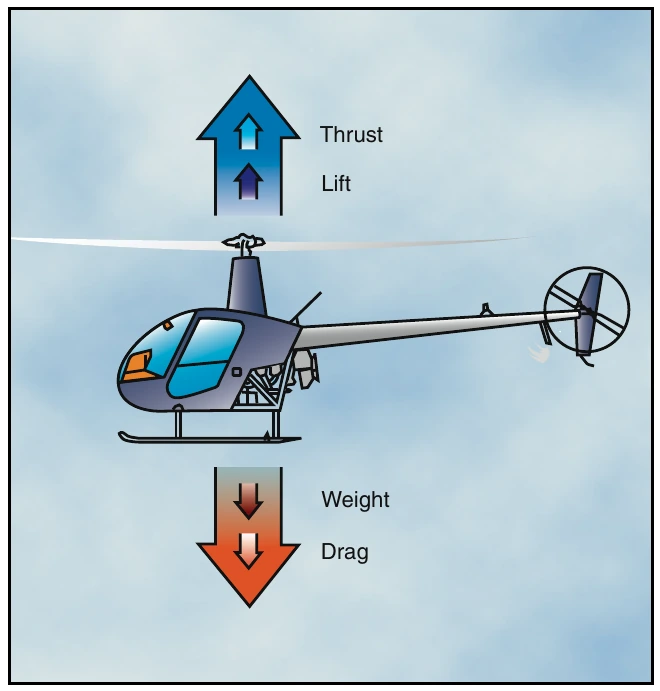
The weight that must be supported is the total weight of the helicopter and its occupants. If the amount of thrust is greater than the actual weight, the helicopter gains altitude; if thrust is less than weight, the helicopter loses altitude.
The drag of a hovering helicopter is mainly induced drag incurred while the blades are producing lift. There is, however, some profile drag on the blades as they rotate through the air. Throughout the rest of this discussion, the term “drag” includes both induced and profile drag.
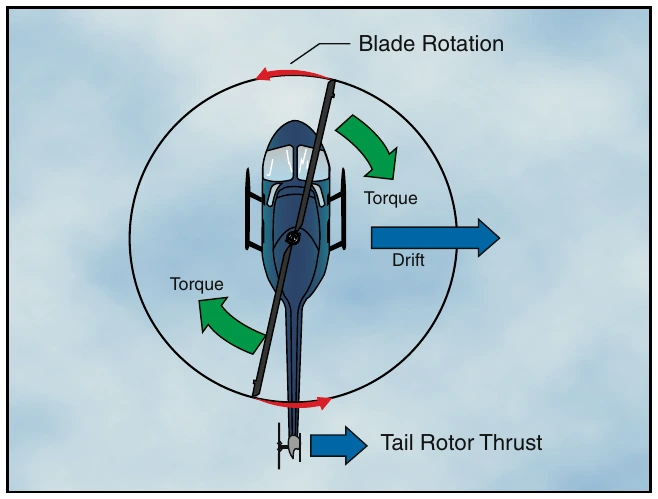
An important consequence of producing thrust is torque. As stated before, for every action there is an equal and opposite reaction. Therefore, as the engine turns the main rotor system in a counterclockwise direction, the helicopter fuselage turns clockwise. The amount of torque is directly related to the amount of engine power being used to turn the main rotor system.
Remember, as power changes, torque changes.
To counteract this torque-induced turning tendency, an antitorque rotor or tail rotor is incorporated into most helicopter designs. You can vary the amount of thrust produced by the tail rotor in relation to the amount of torque produced by the engine. As the engine supplies more power, the tail rotor must produce more thrust.
This is done through the use of antitorque pedals.
Translating Tendency or Drift
During hovering flight, a single main rotor helicopter tends to drift in the same direction as antitorque rotor thrust. This drifting tendency is called translating tendency. [Figure 3-2]
To counteract this drift, one or more of the following features may be used:
- The main transmission is mounted so that the rotor mast is rigged for the tip-path plane to have a built-in tilt opposite tail thrust, thus producing a small sideward thrust.
- Flight control rigging is designed so that the rotor disc is tilted slightly opposite tail rotor thrust when the cyclic is centered.
- The cyclic pitch control system is designed so that the rotor disc tilts slightly opposite tail rotor thrust when in a hover.
Counteracting translating tendency, in a helicopter with a counterclockwise main rotor system, causes the left skid to hang lower while hovering. The opposite is true for rotor systems turning clockwise when viewed from above.