
Chapter 3
Aerodynamics of Flight
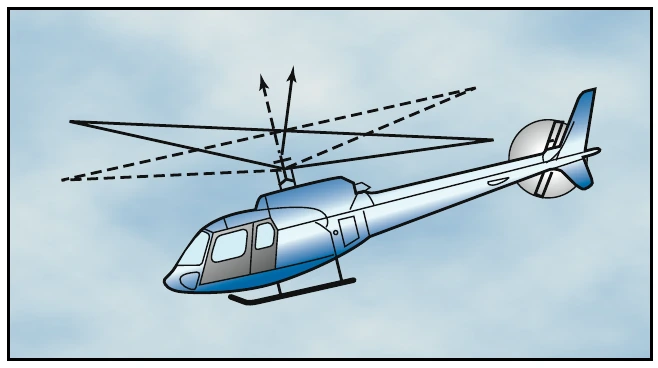
Sideward Flight
In sideward flight, the tip-path plane is tilted in the direction that flight is desired. This tilts the total lift-thrust vector sideward. In this case, the vertical or lift component is still straight up and weight straight down, but the horizontal or thrust component now acts sideward with drag acting to the opposite side. [Figure 3-17]
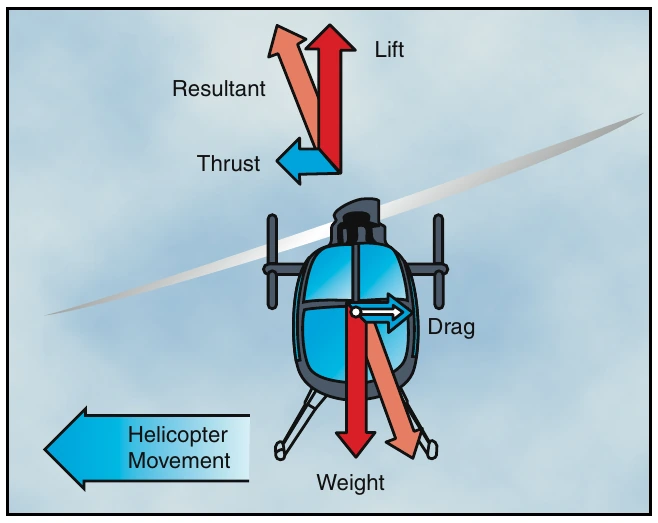
Rearward Flight
For rearward flight, the tip-path plane is tilted rearward, which, in turn, tilts the lift-thrust vector rearward. Drag now acts forward with the lift component straight up and weight straight down. [Figure 3-18]
Turning Flight
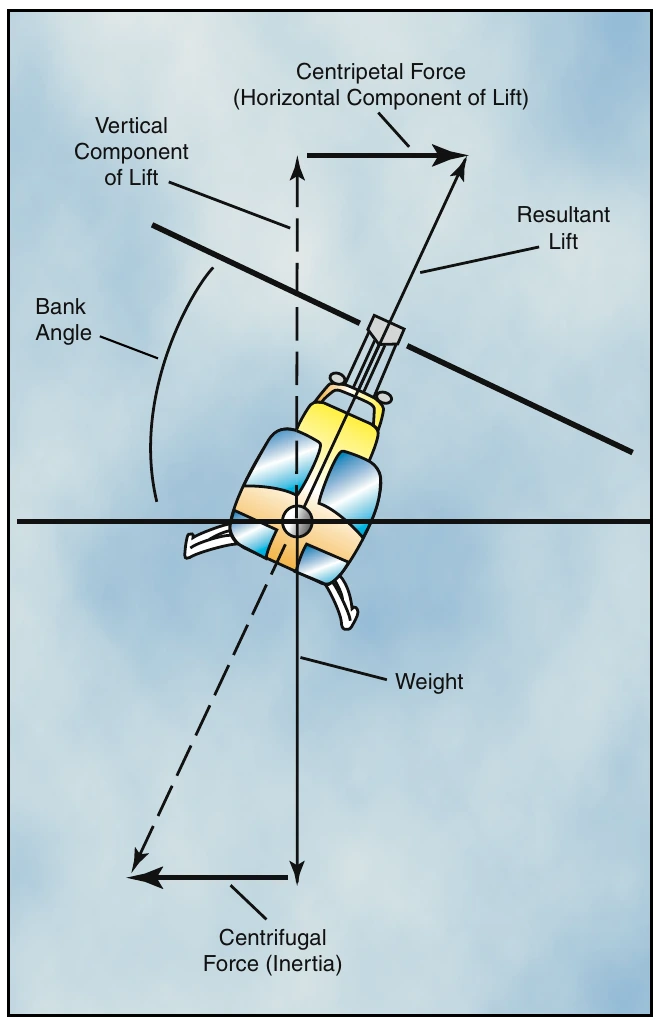
In forward flight, the rotor disc is tilted forward, which also tilts the total lift-thrust force of the rotor disc forward. When the helicopter is banked, the rotor disc is tilted sideward resulting in lift being separated into two components. Lift acting upward and opposing weight is called the vertical component of lift. Lift acting horizontally and opposing inertia (centrifugal force) is the horizontal component of lift (centripetal force). [Figure 3-19]
As the angle of bank increases, the total lift force is tilted more toward the horizontal, thus causing the rate of turn to increase because more lift is acting horizontally. Since the resultant lifting force acts more horizontally, the effect of lift acting vertically is deceased. To compensate for this decreased vertical lift, the angle of attack of the rotor blades must be increased in order to maintain altitude. The steeper the angle of bank, the greater the angle of attack of the rotor blades required to maintain altitude. Thus, with an increase in bank and a greater angle of attack, the resultant lifting force increases and the rate of turn is faster.
Autorotation
Autorotation is the state of flight where the main rotor system is being turned by the action of relative wind rather than engine power. It is the means by which a helicopter can be landed safely in the event of an engine failure. In this case, you are using altitude as potential energy and converting it to kinetic energy during the descent and touchdown. All helicopters must have this capability in order to be certified.
Centripetal Force— The force opposite centrifugal force and attracts a body toward its axis of rotation.
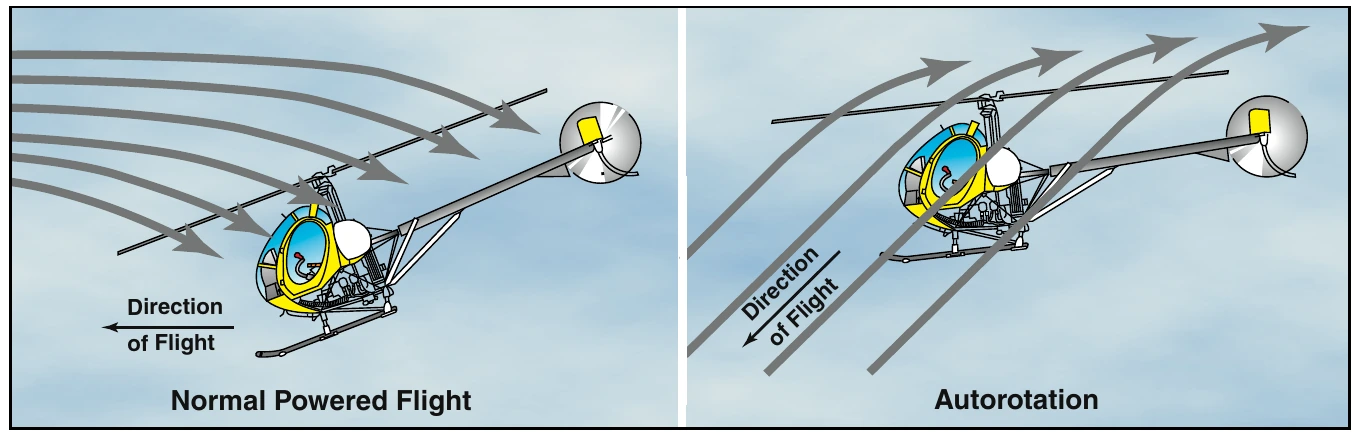
Autorotation is permitted mechanically because of a freewheeling unit, which allows the main rotor to continue turning even if the engine is not running. In normal powered flight, air is drawn into the main rotor system from above and exhausted downward. During autorotation, airflow enters the rotor disc from below as the helicopter descends. [Figure 3-20]
Autorotation (Vertical Flight)
Most autorotations are performed with forward speed.
For simplicity, the following aerodynamic explanation is based on a vertical autorotative descent (no forward speed) in still air. Under these conditions, the forces that cause the blades to turn are similar for all blades regardless of their position in the plane of rotation.
Therefore, dissymmetry of lift resulting from helicopter airspeed is not a factor.
During vertical autorotation, the rotor disc is divided into three regions as illustrated in figure 3-21—the driven region, the driving region, and the stall region.