
Chapter 7
Weight and Balance
When a helicopter is delivered from the factory, the basic empty weight, empty weight center of gravity (CG), and useful load are recorded on a weight and balance data sheet included in the FAA-Approved Rotocraft Flight Manual. The basic empty weight can vary even in the same model of helicopter because of differences in installed equipment. If the owner or operator of a helicopter has equipment removed, replaced, or additional equipment installed, these changes must be reflected in the weight and balance records. In addition, major repairs or alterations must be recorded by a certified mechanic. When the revised weight and moment are recorded on a new form, the old record is marked with the word “superseded” and dated with the effective date of the new record. This makes it easy to determine which weight and balance form is the latest version.
You must use the latest weight and balance data for computing all loading problems.
Balance
Helicopter performance is not only affected by gross weight, but also by the position of that weight. It is essential to load the aircraft within the allowable center-of-gravity range specified in the rotorcraft flight manual’s weight and balance limitations.
Center of Gravity
The center of gravity is defined as the theoretical point where all of the aircraft’s weight is considered to be concentrated. If a helicopter was suspended by a cable attached to the center-of-gravity point, it would balance like a teeter-totter. For helicopters with a single main rotor, the CG is usually close to the main rotor mast.
Improper balance of a helicopter’s load can result in serious control problems. The allowable range in which the CG may fall is called the “CG range.” The exact CG location and range are specified in the rotorcraft flight manual for each helicopter. In addition to making a helicopter difficult to control, an out-of-balance loading condition also decreases maneuverability since cyclic control is less effective in the direction opposite to the CG location.
Ideally, you should try to perfectly balance a helicopter so that the fuselage remains horizontal in hovering flight, with no cyclic pitch control needed except for wind correction. Since the fuselage acts as a pendulum suspended from the rotor, changing the center of gravity changes the angle at which the aircraft hangs from the rotor. When the center of gravity is directly under the rotor mast, the helicopter hangs horizontal; if the CG is too far forward of the mast, the helicopter hangs with its nose tilted down; if the CG is too far aft of the mast, the nose tilts up. [Figure 7-1]
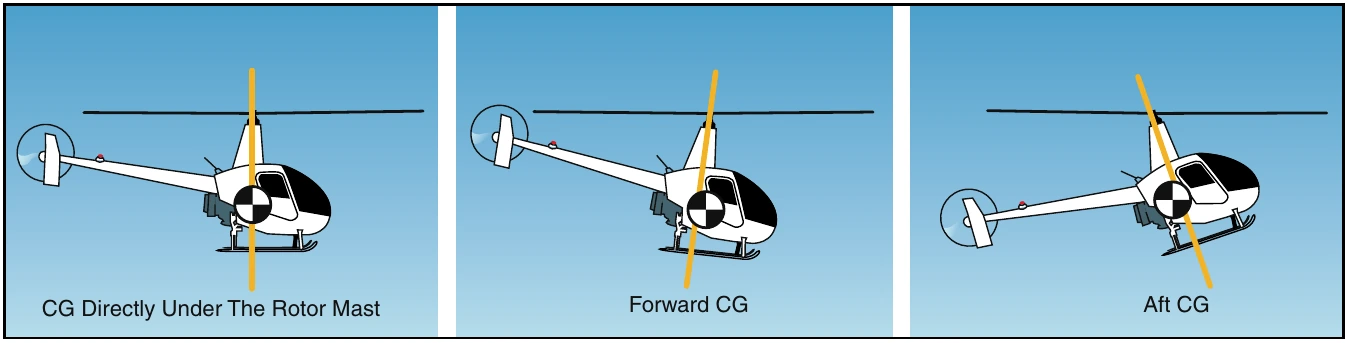
CG Forward of Forward Limit
A forward CG may occur when a heavy pilot and passenger take off without baggage or proper ballast located aft of the rotor mast. This situation becomes worse if the fuel tanks are located aft of the rotor mast because as fuel burns the weight located aft of the rotor mast becomes less.
You can recognize this condition when coming to a hover following a vertical takeoff. The helicopter will have a nose-low attitude, and you will need excessive rearward displacement of the cyclic control to maintain a hover in a no-wind condition. You should not continue flight in this condition, since you could rapidly run out of rearward cyclic control as you consume fuel. You also may find it impossible to decelerate sufficiently to bring the helicopter to a stop. In the event of engine failure and the resulting autorotation, you may not have enough cyclic control to flare properly for the landing.
A forward CG will not be as obvious when hovering into a strong wind, since less rearward cyclic displacement is required than when hovering with no wind. When determining whether a critical balance condition exists, it is essential to consider the wind velocity and its relation to the rearward displacement of the cyclic control.
CG Aft of Aft Limit
Without proper ballast in the cockpit, exceeding the aft CG may occur when:
- A lightweight pilot takes off solo with a full load of fuel located aft of the rotor mast.
- A lightweight pilot takes off with maximum baggage allowed in a baggage compartment located aft of the rotor mast.
- A lightweight pilot takes off with a combination of baggage and substantial fuel where both are aft of the rotor mast.
You can recognize the aft CG condition when coming to a hover following a vertical takeoff. The helicopter will have a tail-low attitude, and you will need excessive forward displacement of cyclic control to maintain a hover in a no-wind condition. If there is a wind, you need even greater forward cyclic.
If flight is continued in this condition, you may find it impossible to fly in the upper allowable airspeed range due to inadequate forward cyclic authority to maintain a nose-low attitude. In addition, with an extreme aft CG, gusty or rough air could accelerate the helicopter to a speed faster than that produced with full forward cyclic control. In this case, dissymmetry of lift and blade flapping could cause the rotor disc to tilt aft. With full forward cyclic control already applied, you might not be able to lower the rotor disc, resulting in possible loss of control, or the rotor blades striking the tailboom.
Lateral Balance
For most helicopters, it is usually not necessary to determine the lateral CG for normal flight instruction and passenger flights. This is because helicopter cabins are relatively narrow and most optional equipment is located near the center line. However, some helicopter manuals specify the seat from which you must conduct solo flight. In addition, if there is an unusual situation, such as a heavy pilot and a full load of fuel on one side of the helicopter, which could affect the lateral CG, its position should be checked against the CG envelope. If carrying external loads in a position that requires large lateral cyclic control displacement to maintain level flight, fore and aft cyclic effectiveness could be dramatically limited.