
Chapter 7
Weight and Balance
Weight and Balance Calculations
When determining whether your helicopter is properly loaded, you must answer two questions:
- Is the gross weight less than or equal to the maximum allowable gross weight?
- Is the center of gravity within the allowable CG range, and will it stay within the allowable range as fuel is burned off?
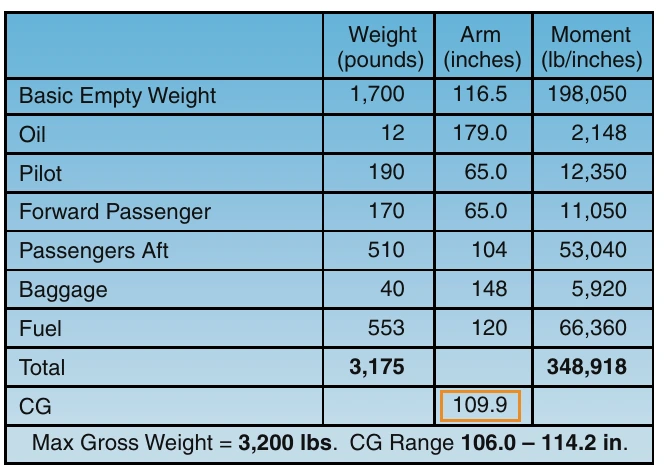
To answer the first question, just add the weight of the items comprising the useful load (pilot, passengers, fuel, oil, if applicable, cargo, and baggage) to the basic empty weight of the helicopter. Check that the total weight does not exceed the maximum allowable gross weight.
To answer the second question, you need to use CG or moment information from loading charts, tables, or graphs in the rotorcraft flight manual. Then using one of the methods described below, calculate the loaded moment and/or loaded CG and verify that it falls within the allowable CG range shown in the rotorcraft flight manual.
It is important to note that any weight and balance computation is only as accurate as the information provided.
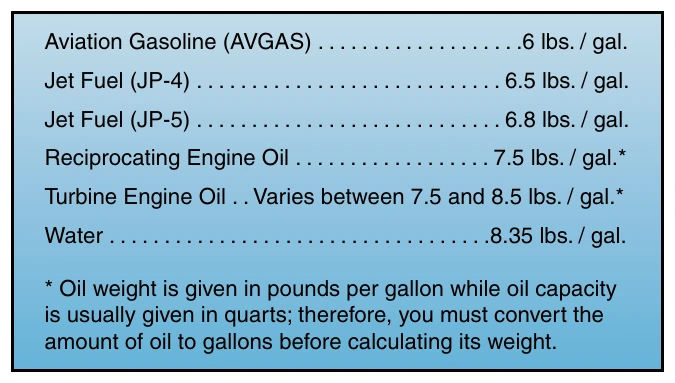
Therefore, you should ask passengers what they weigh and add a few pounds to cover the additional weight of clothing, especially during the winter months. The baggage weight should be determined by the use of a scale, if practical. If a scale is not available, be conservative and overestimate the weight. Figure 7-2 indicates the standard weights for specific operating fluids.
The following terms are used when computing a helicopter’s balance.
Reference Datum
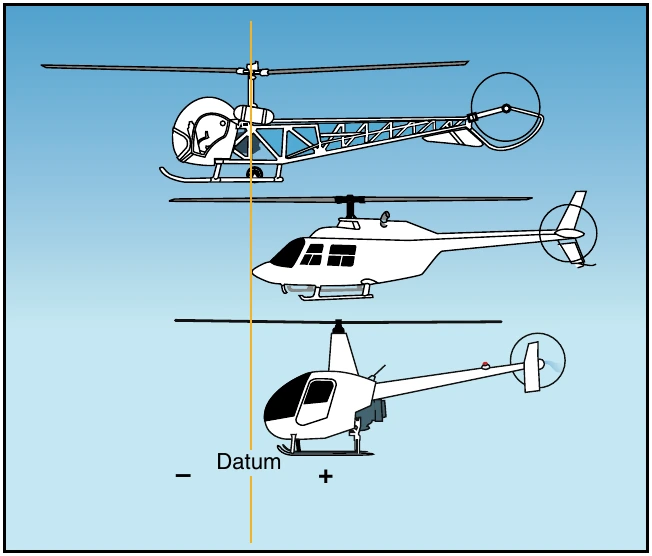
Balance is determined by the location of the CG, which is usually described as a given number of inches from the reference datum. The horizontal reference datum is an imaginary vertical plane or point, arbitrarily fixed somewhere along the longitudinal axis of the helicopter, from which all horizontal distances are measured for weight and balance purposes. There is no fixed rule for its location. It may be located at the rotor mast, the nose of the helicopter, or even at a point in space ahead of the helicopter. [Figure 7-3]
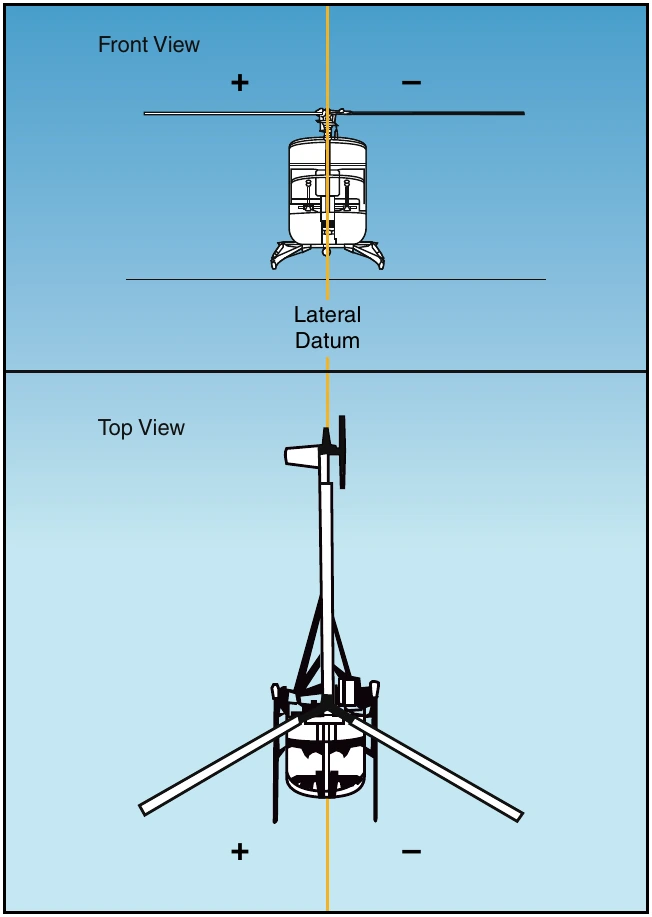
The lateral reference datum, is usually located at the center of the helicopter. The location of the reference datums is established by the manufacturer and is defined in the rotorcraft flight manual. [Figure 7-4]
Arm
The horizontal distance from the datum to any component of the helicopter or to any object located within the helicopter is called the arm. Another term that can be used interchangeably with arm is station.
If the component or object is located to the rear of the datum, it is measured as a positive number and usually is referred to as inches aft of the datum.
Conversely, if the component or object is located forward of the datum, it is indicated as a negative number and is usually referred to as inches forward of the datum.