
Chapter 9
Weight and Balance Control—Commuter Category and Large Aircraft
Effects of Loading or Offloading Cargo
Both the weight and CG of an aircraft are changed when cargo is loaded or offloaded. In the following example, the new weight and CG are calculated after 2,500 pounds of cargo is offloaded from the forward cargo hold.
Aircraft specifications are:
- Loaded weight — 90,000 lb
- Loaded CG — 22.5 percent MAC
- Weight change — 2,500 lb
- Forward cargo hold centroid — station 352.1
- MAC — 141.5 in
- LEMAC — station 549.13
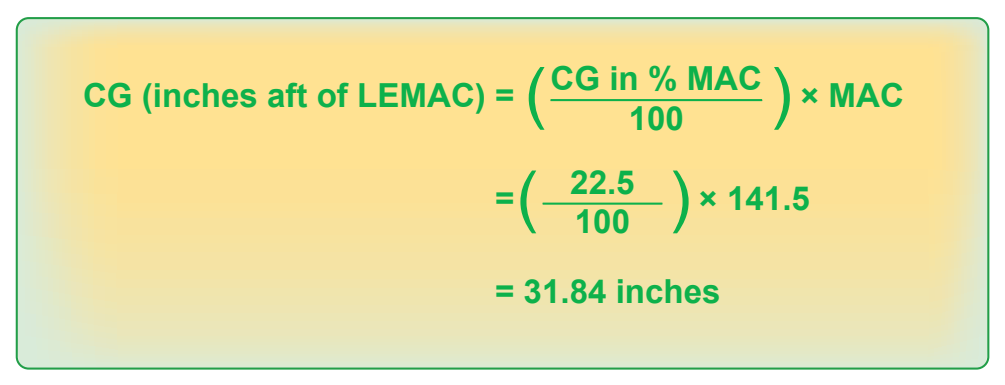
- Determine the CG location in inches from the datum before the cargo is removed. Do this by first determining the distance of the CG aft of the LEMAC. [Figure 9-12]
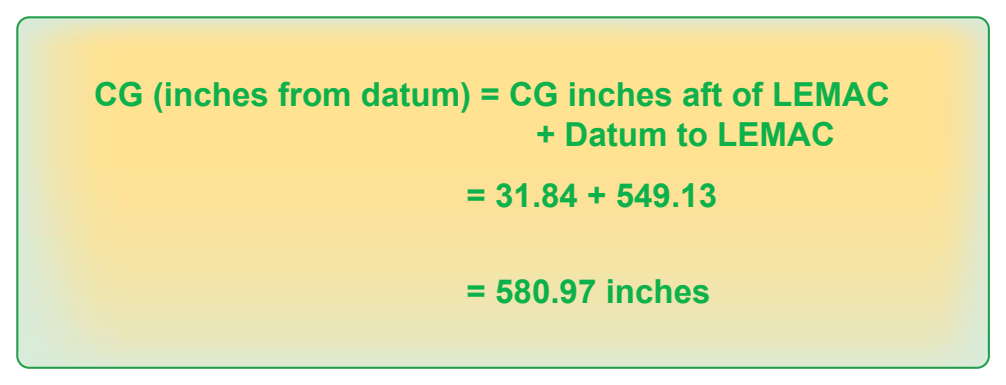
- Determine the distance between the CG and the datum by adding the CG in inches aft of LEMAC to the distance from the datum to LEMAC. [Figure 9-13]
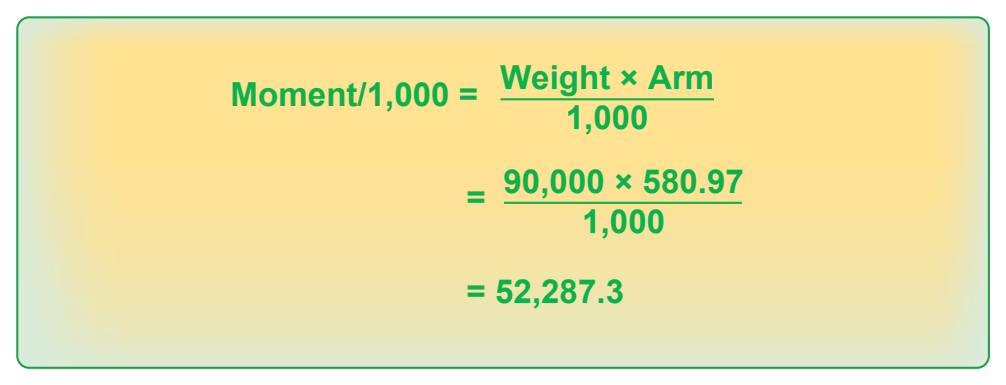
- Determine the moment/1,000 for the original weight. [Figure 9-14]
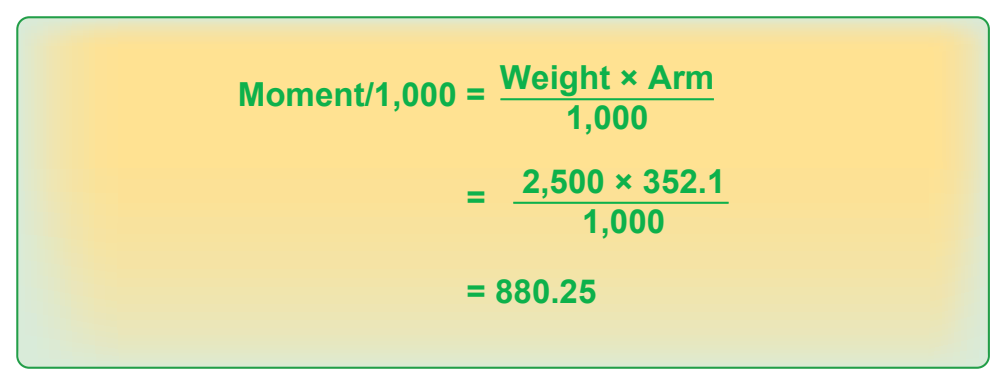
- Determine the new weight and new CG by first determining the moment/1,000 of the removed weight. Multiply the weight removed (2,500 pounds) by the centroid of the forward cargo hold (352.1 inches), and then divide the result by 1,000. [Figure 9-15]
- Subtract the removed weight from the original weight and subtract the moment/1,000 of the removed weight from the original moment/1,000. [Figure 9-16]
- Determine the location of the new CG by dividing the total moment/1,000 by the total weight and multiplying this by the reduction factor of 1,000. [Figure 9-17]
- Convert the new CG location to percent MAC. First, determine the distance between the CG location and LEMAC. [Figure 9-18]
- Then, determine the new CG in percent MAC. [Figure 9-19]

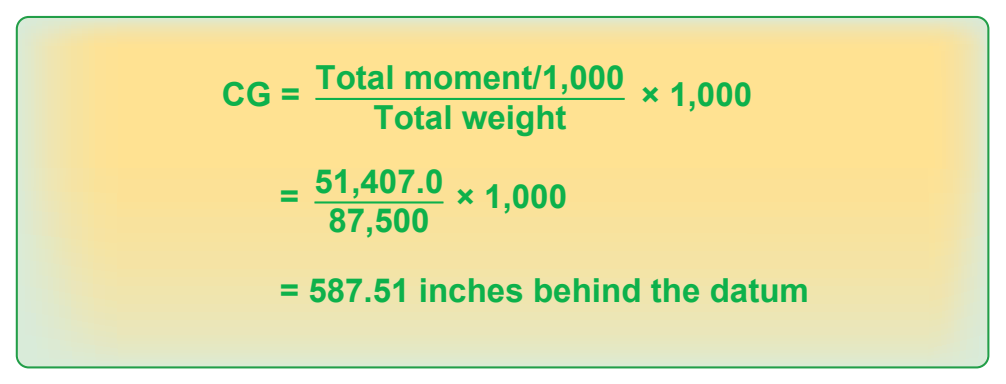
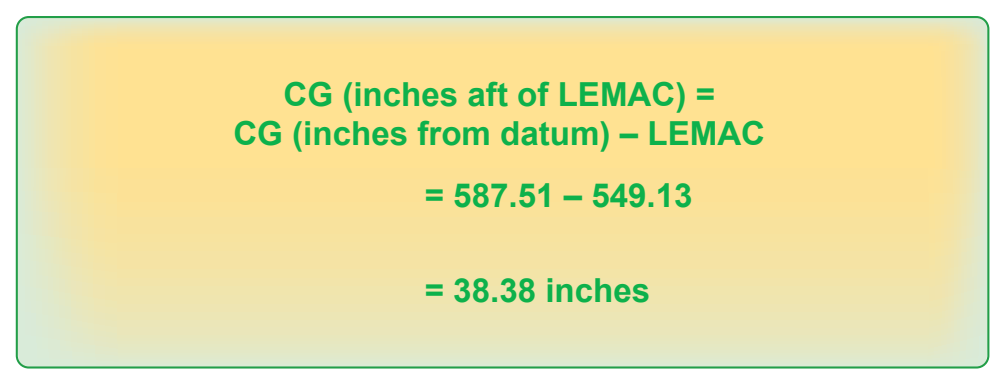
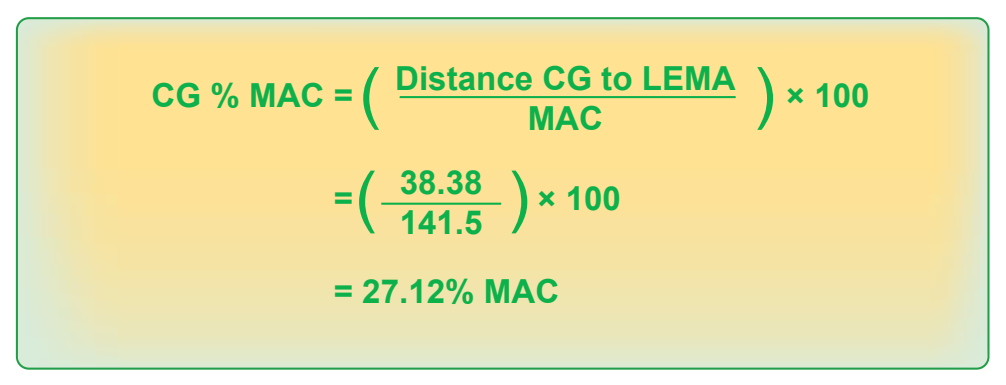
Offloading 2,500 pounds of cargo from the forward cargo hold moves the CG aft 6.54 inches, from 22.5 percent MAC to 27.12 percent MAC.
Effects of Shifting Cargo From One Hold to Another
When cargo is shifted from one cargo hold to another, the CG changes, but the total weight of the aircraft remains the same.
For example, use the following data:
- Loaded weight — 90,000 lb
- Loaded CG — station 580.97 (22.5 percent MAC)
- Forward cargo hold centroid — station 352
- Aft cargo hold centroid — station 724.9
- MAC — 141.5 in
- LEMAC — station 549
To determine the change in CG (ΔCG) caused by shifting 2,500 pounds of cargo from the forward cargo hold to the aft cargo hold, use the formula in Figure 9-20.