Chapter 9
Weight and Balance Control—Commuter Category and Large Aircraft
Notice that the new CG is in the same location whether the distances are measured from the datum or from the index point.
Determining Cargo Pallet Loads and Floor Loading Limits
Each cargo hold has a structural floor loading limit based on the weight of the load and the area over which this weight is distributed. To determine the maximum weight of a loaded cargo pallet that can be carried in a cargo hold, divide its total weight, which includes the weight of the empty pallet and its tie down devices, by its area in square feet. This load per square foot must be equal to or less than the floor load limit.
In this example, determine the maximum load that can be placed on this pallet without exceeding the floor loading limit:
- Pallet dimensions — 36 by 48 in
- Empty pallet weight — 47 lb
- Tie-down devices — 33 lb
- Floor load limit — 169 lb per square foot
The pallet has an area of 36 inches (3 feet) by 48 inches (4 feet), which equals 12 square feet, and the floor has a load limit of 169 pounds per square foot. Therefore, the total weight of the loaded pallet can be 169 × 12 = 2,028 pounds. Subtracting the weight of the pallet and the tie down devices gives an allowable load of 1,948 pounds (2,028 – [47 + 33]).
Determine the floor loading limit needed to carry a loaded cargo pallet having the following dimensions and weights:
- Pallet dimensions — 48.5 by 33.5 in
- Pallet weight — 44 lb
- Tie-down devices — 27 lb
- Cargo weight — 786.5 lb
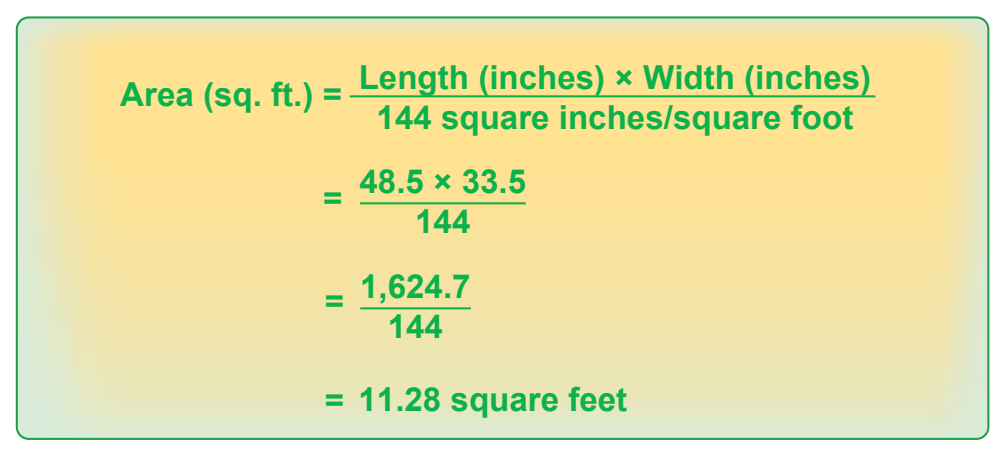
First, determine the number of square feet of pallet area as shown in Figure 9-28. Then, determine the total weight of the loaded pallet:
- Pallet — 44.0 lb
- Tie-down devices — 27.0 lb
- Cargo — 786.5 lb
- Total — 857.5 lb
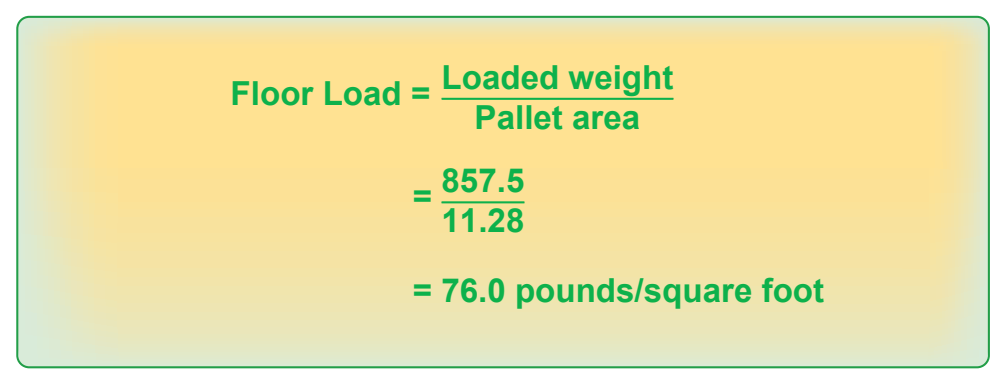
Determine the load imposed on the floor by the loaded pallet. [Figure 9-29] The floor must have a minimum loading limit of 76 pounds per square foot.
Determining the Maximum Amount of Payload That Can Be Carried
The primary function of a transport or cargo aircraft is to carry payload, which is the portion of the useful load, passengers, or cargo that produces revenue. To determine the maximum amount of payload that can be carried, both the maximum limits for the aircraft and the trip limits imposed by the particular trip must be considered. In each of the following steps, the trip limit must be less than the maximum limit. If it is not, the maximum limit must be used.
These are the specifications for the aircraft in this example:
- Basic operating weight (BOW) — 100,500 lb
- Maximum zero fuel weight — 138,000 lb
- Maximum landing weight — 142,000 lb
- Maximum takeoff weight — 184,200 lb
- Fuel tank load — 54,000 lb
- Estimated fuel burn en route — 40,000 lb
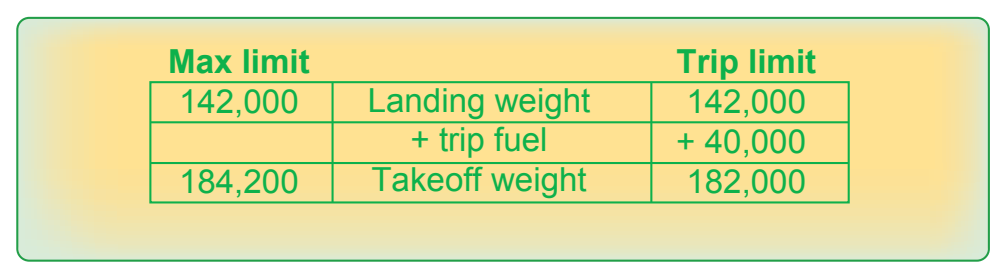
- Compute the maximum takeoff weight for this trip. This is the maximum landing weight plus the trip fuel. [Figure 9-30]
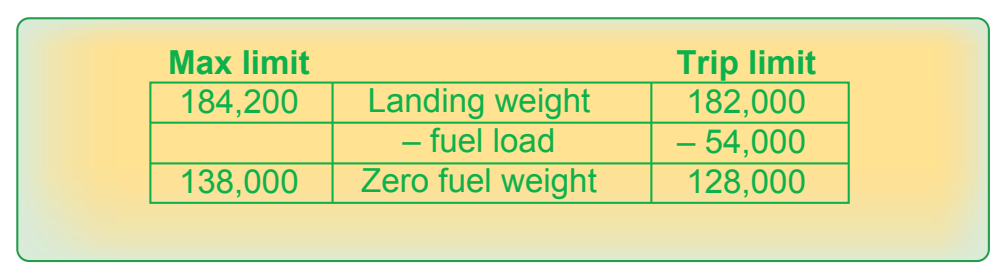
- The trip limit is lower than the maximum takeoff weight, so it is used to determine the zero fuel weight. [Figure 9-31]
- The trip limit is again lower than the maximum takeoff weight, so use it to compute the maximum payload for this trip. [Figure 9-32]