Chapter 9
Weight and Balance Control—Commuter Category and Large Aircraft
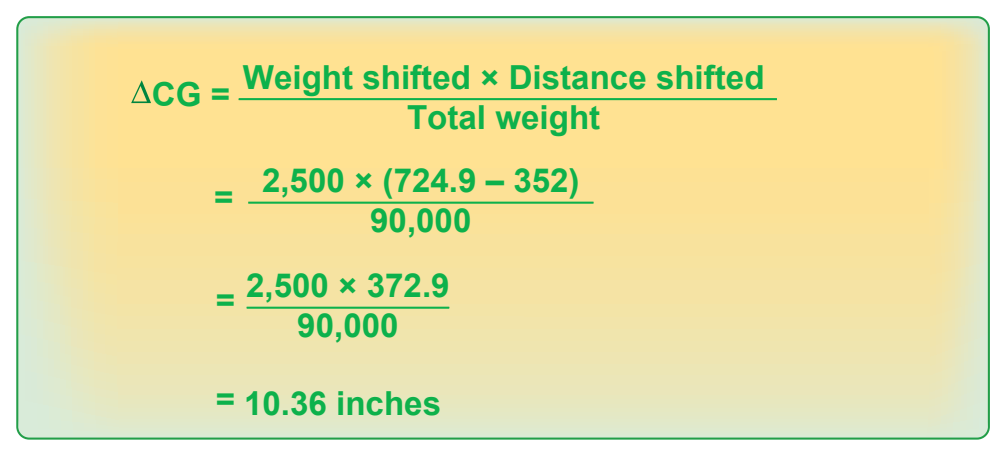
Since the weight was shifted aft, the CG moved aft and the CG change is positive. If the shift were forward, the CG change would be negative.
Before the cargo was shifted, the CG was located at station 580.97, which is 22.5 percent of MAC. The CG moved aft 10.36 inches, so the new CG is found using the formula from [Figure 9-21].

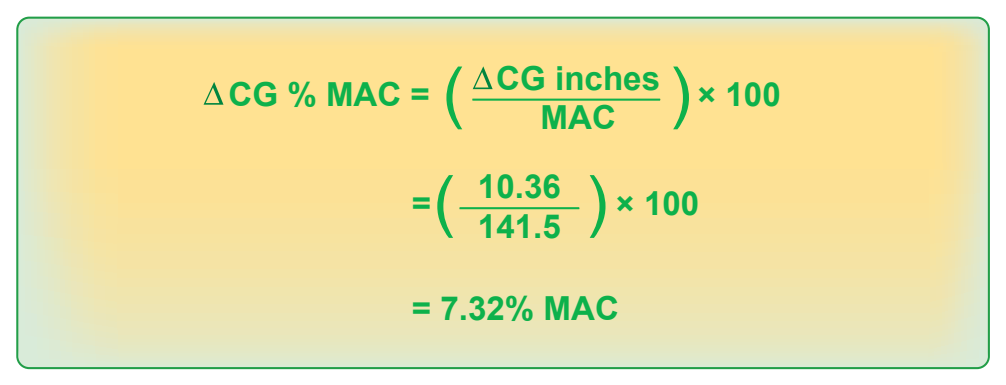
Convert the location of the CG in inches aft of the datum to percent MAC by using the formula in Figure 9-22.
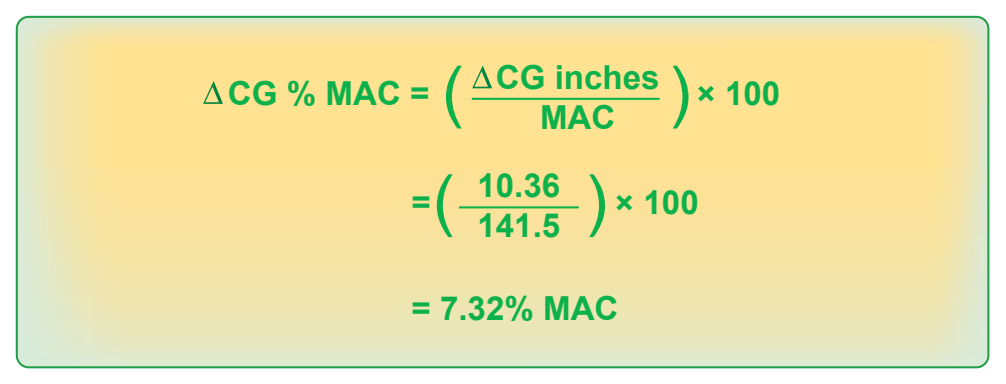
The new CG in percent MAC caused by shifting the cargo is the sum of the old CG plus the change in CG. [Figure 9-23]

Some AFMs locate the CG relative to an index point rather than the datum or the MAC. An index point is a location specified by the aircraft manufacturer from which arms used in weight and balance computations are measured. Arms measured from the index point are called index arms, and objects ahead of the index point have negative index arms, while those behind the index point have positive index arms.
Use the same data as in the previous example, except for these changes:
- Loaded CG — index arm of 0.97, which is 22.5 percent of MAC
- Index point — fuselage station 580.0
- Forward cargo hold centroid — –227.9 index arm
- Aft cargo hold centroid — +144.9 index arm
- MAC — 141.5 in
- LEMAC — –30.87 index arm
The weight was shifted 372.8 inches (–227.9 + Δ = +144.9, Δ = 372.8).
The change in CG can be calculated by using this formula found in Figure 9-24.
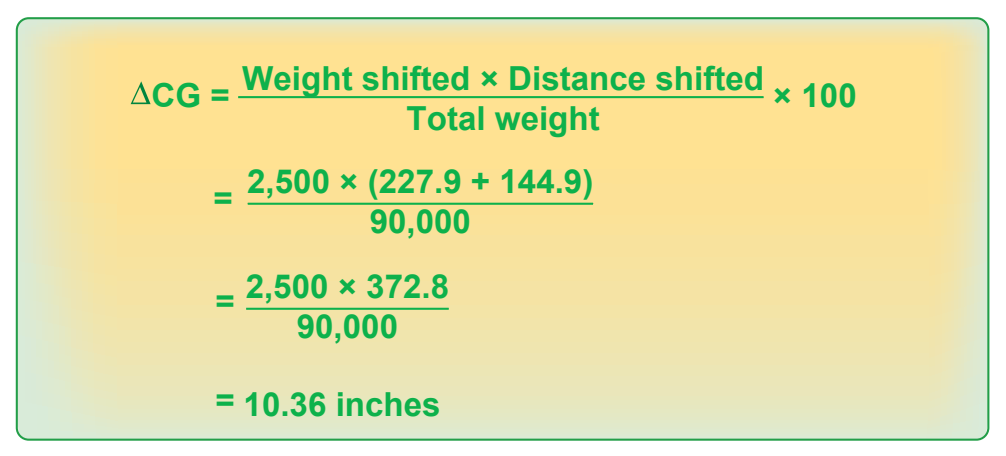
Since the weight was shifted aft, the CG moved aft, and the CG change is positive. If the shift were forward, the CG change would be negative. Before the cargo was shifted, the CG was located at 0.97 index arm, which is 22.5 percent MAC. The CG moved aft 10.36 inches, and the new CG is shown using the formula in Figure 9-25.

The change in the CG in percent MAC is determined by using the formula in Figure 9-26.

The new CG in percent MAC is the sum of the old CG plus the change in CG. [Figure 9-27]