
Chapter 5
Maintaining Aircraft Control: Upset Prevention and Recovery Training
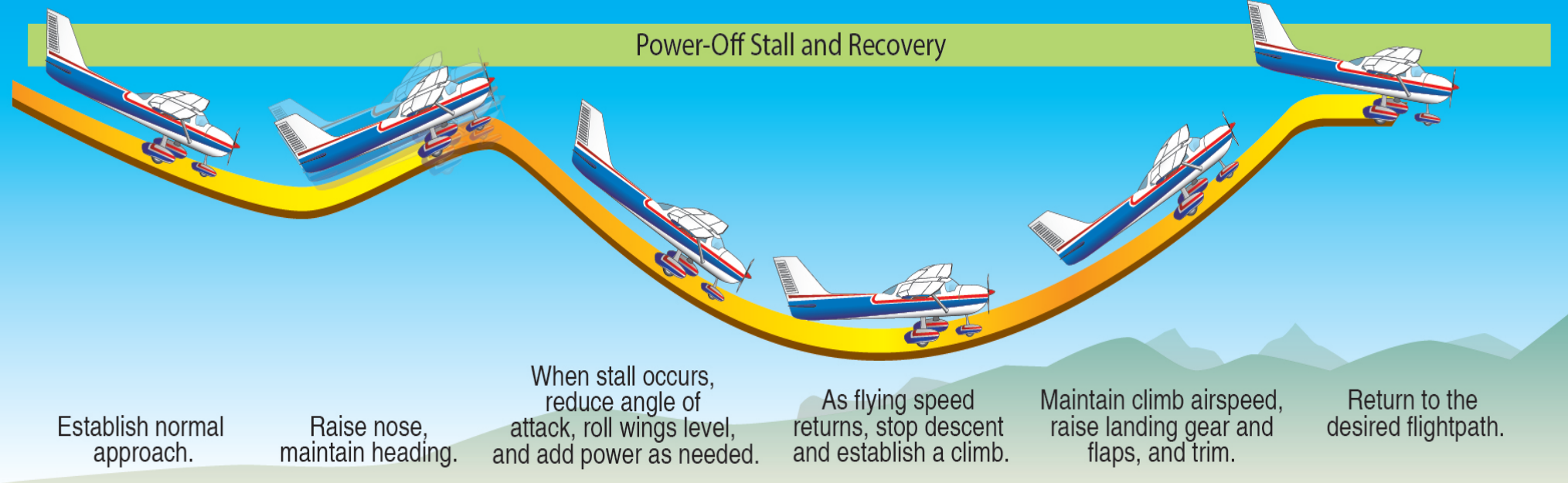
To set up the entry for a straight-ahead power-off stall, airplanes equipped with flaps or retractable landing gear should be in the landing configuration. After extending the landing gear, applying carburetor heat (if applicable), and retarding the throttle sufficiently, the pilot holds the airplane at a constant altitude until the airspeed decelerates to normal approach speed. The airplane should then be smoothly pitched down to a normal approach attitude to maintain that airspeed. Wing flaps should be extended and pitch attitude adjusted to maintain the airspeed. Once in a normal approach, the pilot sets the power to idle.
When the approach attitude and airspeed have stabilized, the pilot should smoothly raise the airplane’s nose to an attitude that induces a stall. Directional control should be maintained and wings held level by coordinated use of the ailerons and rudder. Once the airplane reaches an attitude that will lead to a stall, the pitch attitude is maintained with the elevator until the stall occurs. The stall is recognized by the full-stall cues previously described.
Recovery from the stall is accomplished by reducing the AOA, applying as much nose-down control input as required to eliminate the stall warning, leveling the wings, maintaining coordinated flight, and then applying power as needed. Right rudder pressure may be necessary to overcome the engine torque effects as power is advanced and the nose is being lowered. [Figure 5-11] If simulating an inadvertent stall on approach to landing, the pilot should initiate a go-around by establishing a positive rate of climb. Once in a climb, the flaps and landing gear should be retracted as necessary.
Recovery from power-off stalls should also be practiced from shallow banked turns to simulate an inadvertent stall during a turn from base leg to final approach. During the practice of these stalls, the pilot should take care to ensure that the airplane remains coordinated and the turn continues at a constant bank angle until the full stall occurs. If the airplane is allowed to slip, the outer wing may stall first and move downward abruptly. In a skid, the bank angle may increase further to a potentially dangerous attitude. The recovery procedure is the same, regardless of whether one wing rolls off first. The pilot should apply as much nose-down control input as necessary to eliminate the stall warning, level the wings with ailerons, coordinate with rudder, and add power as needed. In the practice of turning stalls, no attempt should be made to stall or recover the airplane on a predetermined heading. However, to simulate a turn from base to final approach, the stall normally should be made to occur within a heading change of approximately 90°.
Full Stalls, Power-On
Power-on stall recoveries are practiced from straight climbs and climbing turns (15° to 20° bank) to help the pilot recognize the potential for an accidental stall during takeoff, go around, climb, or when trying to clear an obstacle. Airplanes equipped with flaps or retractable landing gear should normally be in the takeoff configuration; however, power-on stalls should also be practiced with the airplane in a clean configuration (flaps and gear retracted) to ensure practice with all possible takeoff and climb configurations. When practicing takeoff stall recovery, the airplane should be at maximum power, although for some airplanes it may be reduced to a setting that will prevent an excessively high pitch attitude.
To set up the entry for power-on stalls, the pilot establishes the airplane in the takeoff or climb configuration and slows the airplane to normal lift-off speed while continuing to clear the area of other traffic. Upon reaching the desired speed, the pilot sets takeoff power or the recommended climb power for the power-on stall (often referred to as a departure stall) while establishing a climb attitude. The purpose of reducing the airspeed to lift-off airspeed before the throttle is advanced to the recommended setting is to avoid an excessively steep nose-up attitude for a long period before the airplane stalls.
After establishing the climb attitude, the pilot should smoothly raise the nose to increase the AOA, and hold that attitude until the full stall occurs. As described in connection with the stall characteristics discussion, continual adjustments should be made to aileron pressure, elevator pressure, and rudder pressure to maintain coordinated flight while holding the attitude until the full stall occurs. In most airplanes, as the airspeed decreases the pilot should move the elevator control progressively further back while simultaneously adding right rudder and maintaining the climb attitude until reaching the full stall.
The pilot should recognize when the stall has occurred and take action without delay to prevent a prolonged stalled condition. The pilot should recover from the stall by immediately reducing the AOA and applying as much nose-down control input as required to eliminate the stall warning, level the wings with ailerons, coordinate with rudder, and smoothly advance the power as needed. Since the throttle is already at the climb power setting, this step may simply mean confirming the proper power setting. [Figure 5-12]
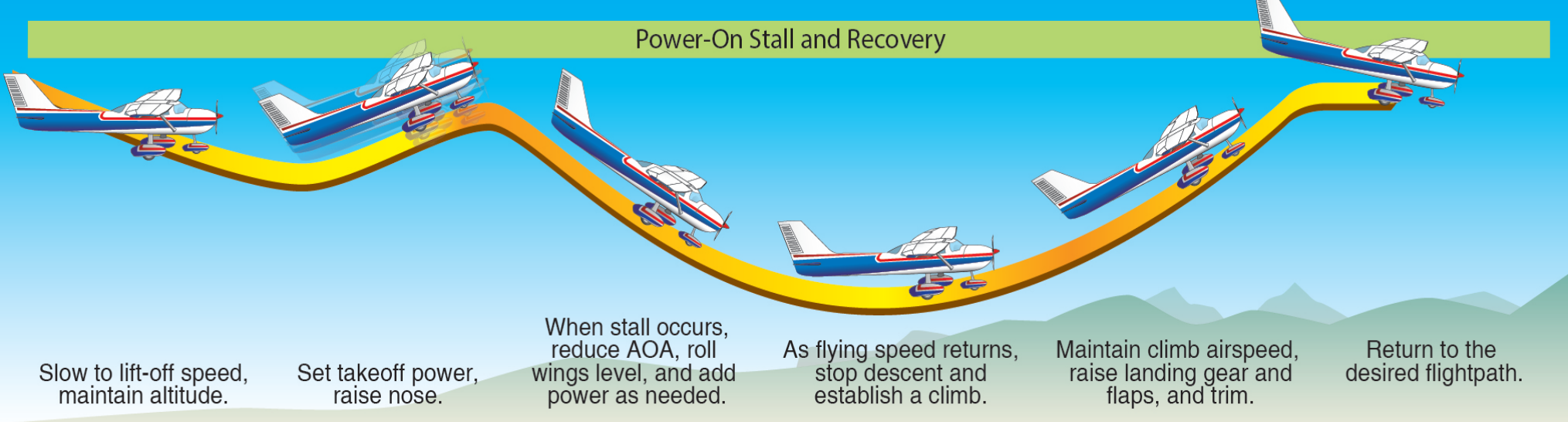
The final step is to return the airplane to the desired flightpath (e.g., straight and level or departure/climb attitude). With sufficient airspeed and control effectiveness, the pilot may return the throttle to the appropriate power setting.
Secondary Stall
A secondary stall is so named because it occurs after recovery from a preceding stall. A normal recovery usually involves pointing the nose of the airplane toward the ground. However, if a stall should occur at low altitude, the pilot's natural impulse is to bring the nose up as soon as possible and to do so abruptly. This reaction is amplified as proximity to the ground increases. To demonstrate how this occurs at altitude, the pilot makes an abrupt recovery after one stall and exceeds the critical AOA a second time. Note that this stall may occur after any stall when the pilot does not sufficiently reduce the AOA by lowering the pitch attitude or attempts to break the stall by using power only. [Figure 5-13]
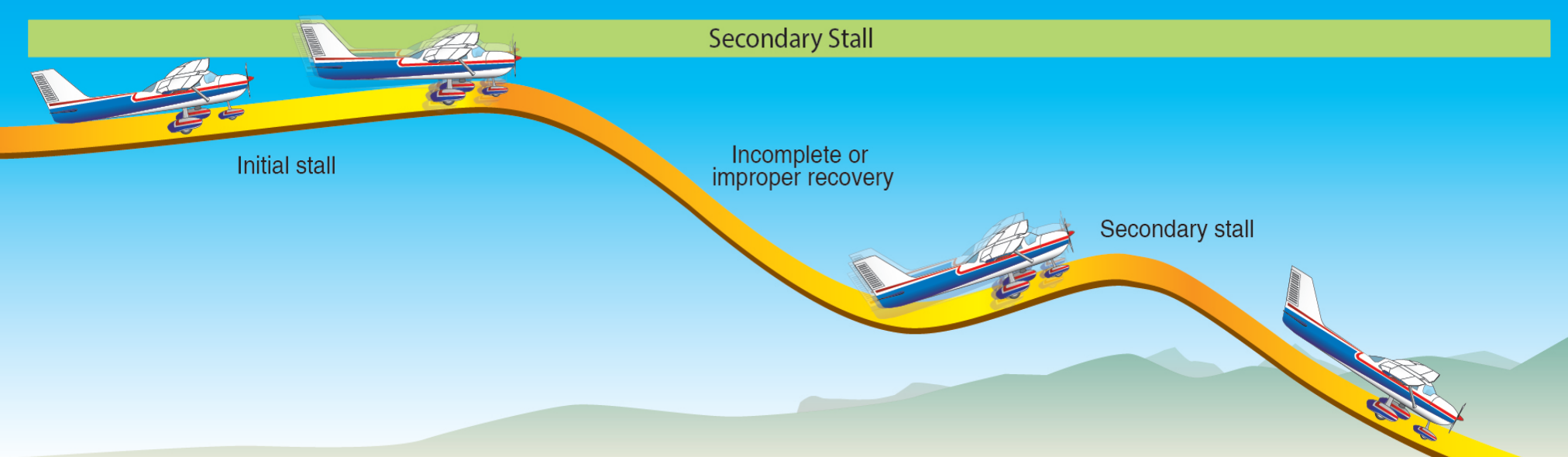
If a secondary stall occurs, the pilot should again perform the stall recovery procedures by applying nose-down elevator pressure as required to eliminate the stall warning, level the wings with ailerons, coordinate with rudder, and adjust power as needed. When the airplane is no longer in a stalled condition the pilot can return the airplane to the desired flightpath. For pilot certification, this is a demonstration-only maneuver. Only flight instructor applicants may be required to perform it on a practical test.
Accelerated Stalls
While pilots may understand the cause of an accelerated stall, it takes training to experience how these stalls develop and occur. The objectives of demonstrating an accelerated stall are to determine the stall characteristics of the airplane, experience stalls at speeds greater than the +1G stall speed, and develop the ability to instinctively recover at the onset of such stalls. This is a maneuver only commercial pilot and flight instructor applicants may be required to perform or demonstrate on a practical test. However, all pilots should be familiar with the situations that can cause an accelerated stall, how to recognize this type of stall, and how to execute the appropriate recovery should one occur.
At the same gross weight, airplane configuration, CG location, power setting, and environmental conditions, a given airplane consistently stalls at the same indicated airspeed provided the airplane is at +1G (i.e., steady-state unaccelerated flight). However, the airplane can also stall at a higher indicated airspeed when the airplane is subject to an acceleration greater than +1G, such as when turning, pulling up, or other abrupt changes in flightpath. Stalls encountered any time the G-load exceeds +1G are called “accelerated maneuver stalls.” The accelerated stall would most frequently occur inadvertently during improperly executed turns, stall and spin recoveries, pullouts from steep dives, or when overshooting a base to final turn. An accelerated stall is typically demonstrated during steep turns.
A pilot should never practice accelerated stalls with wing flaps in the extended position due to the lower design G-load limitations in that configuration. Accelerated stalls should be performed with a bank of approximately 45°, and in no case at a speed greater than the airplane manufacturer’s recommended airspeed, or the specified design maneuvering speed (VA) or operating maneuvering speed (VO).