
Chapter 9
Approaches and Landings
The objective of a good final approach is to descend at an angle that permits the airplane to reach the desired aiming point at an airspeed that results in a predictable float where touchdown occurs on or within a specified distance beyond a designated point. To accomplish this, it is essential that both the descent angle and the airspeed be accurately controlled.
Unlike a normal approach when the power setting is variable, on a power-off approach the power is fixed at the idle setting. Pitch attitude is adjusted to control the airspeed. This also changes the glide or descent angle. If an airplane is on approach with an airspeed higher than best glide, pitching down will increase the airspeed and steepen the descent angle, while pitching up will reduce the airspeed and shallow the descent angle. Conversely, if the airspeed is below best glide, then pitching down will increase the airspeed and shallow the descent angle, while pitching up will reduce the airspeed and will greatly steepen the descent angle. If the airspeed is too high, the pilot
should raise the nose; and when the airspeed is too low, lower the nose. If the pitch attitude is raised too high, the airplane settles rapidly due to a slow airspeed and insufficient lift. For this reason, the pilot should never try to stretch a glide to reach the desired landing spot.
Note that certain single-engine turboprop airplanes experience an excessive rate of descent if the power is set to flight idle. In some cases, if the powerplant failed, the manufacturer's checklist calls for feathering the propeller during a power-off glide. During flight training in these airplanes, the propeller is not feathered as would be the case in an emergency or true power-off glide. During training and pilot certification, where the manufacturer's checklist calls for propeller feathering in a power-off situation, the pilot should set sufficient power to provide the performance that would be expected with the propeller feathered.
Uniform approach patterns, such as the 90° or 180° power-off approaches, are described further in this chapter. Practicing these approaches provides a pilot with a basis on which to develop judgment in gliding distance and in planning an approach. While square patterns demonstrate good planning, they are not required and may not be appropriate for every approach. For example, when conditions are not as expected, pilots may need to dog-leg away from the runway on base or dog-leg toward the runway on base. Pilots may use S-turns, slips, early or late extension of flaps, reduce airspeed below best glide, or increase airspeed slightly above best glide in a headwind in order to stabilize the remaining approach, to reach the desired aiming point at an appropriate speed, and to touch down where planned. Note that selection of the runway numbers as the touchdown point does not provide a safety cushion in case of a mechanical problem or misjudgment. Selecting a point farther down the runway establishes an increased safety margin.
The basic procedure in these approaches involves closing the throttle at a given altitude and gliding to a key position. Starting with the same energy (airspeed and height) each time the throttle is closed, makes the maneuver more predictable. The key position, like the pattern itself, is not the primary objective; it is merely a convenient point in the air from which the pilot can judge what to do such that the landing occurs at or just beyond the desired point. The selected key position should be one that is appropriate for the available altitude and the wind condition. From the key position, the pilot should constantly evaluate the situation.
It should be emphasized that, although accurate spot touchdowns are important, safe and properly executed approaches and landings are vital. A pilot should never sacrifice a good approach or landing just to land on the desired spot.
90° Power-Off Approach
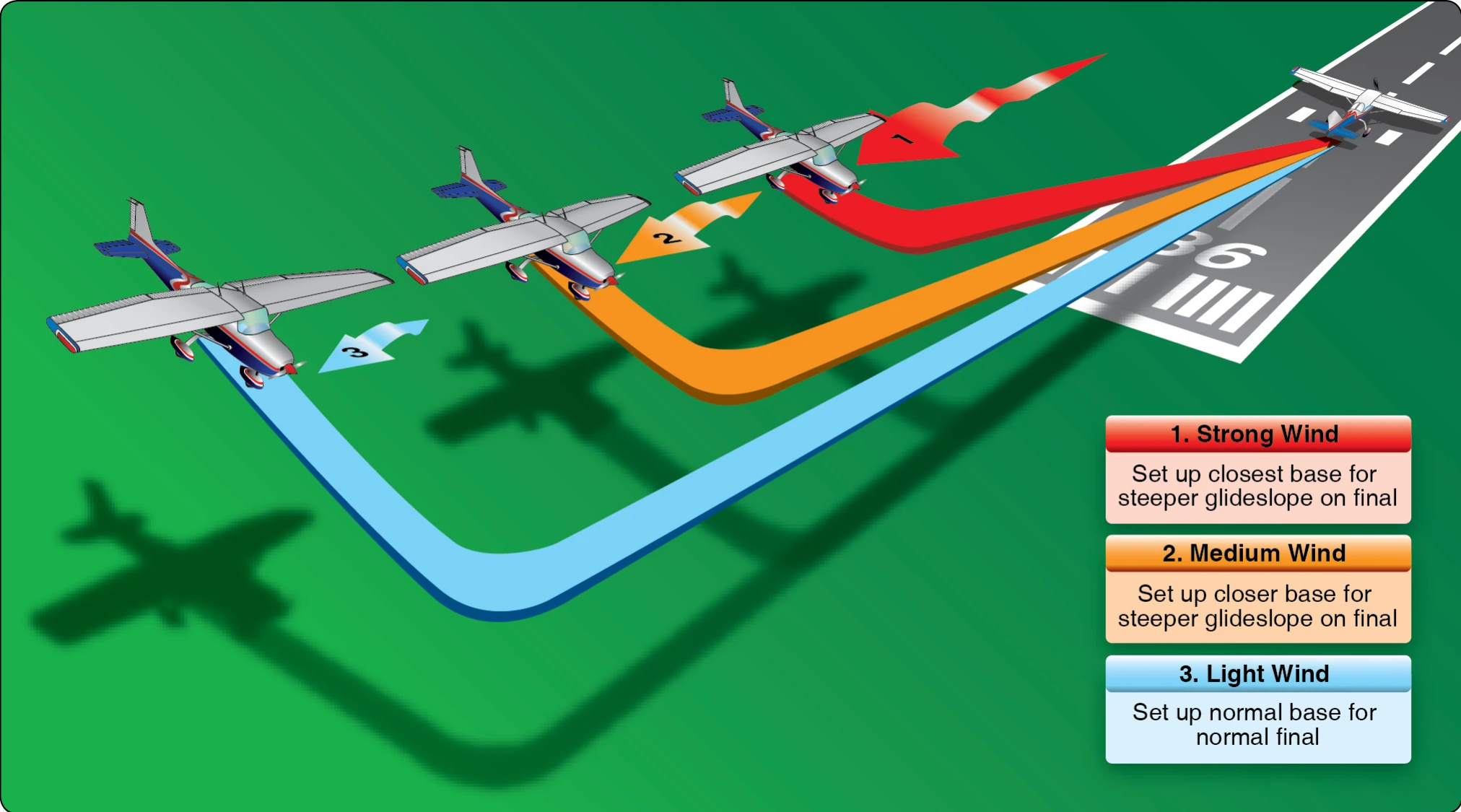
The 90° power-off approach is made from a base leg and requires an approximate 90° turn onto the final approach. The approach path may be varied by positioning the base leg closer to or farther out from the approach end of the runway according to wind conditions. [Figure 9-25] The glide from the key position on the base leg through the 90° turn to the final approach is the final part of all accuracy landing maneuvers. The 90° power-off approach usually begins from a rectangular pattern at approximately 1,000 feet above the ground or at normal traffic pattern altitude. The airplane is flown on a downwind leg at the same distance from the landing surface as in a normal traffic pattern. The before-landing checklist should be completed on the downwind leg, including extension of the landing gear if the airplane is equipped with retractable gear.
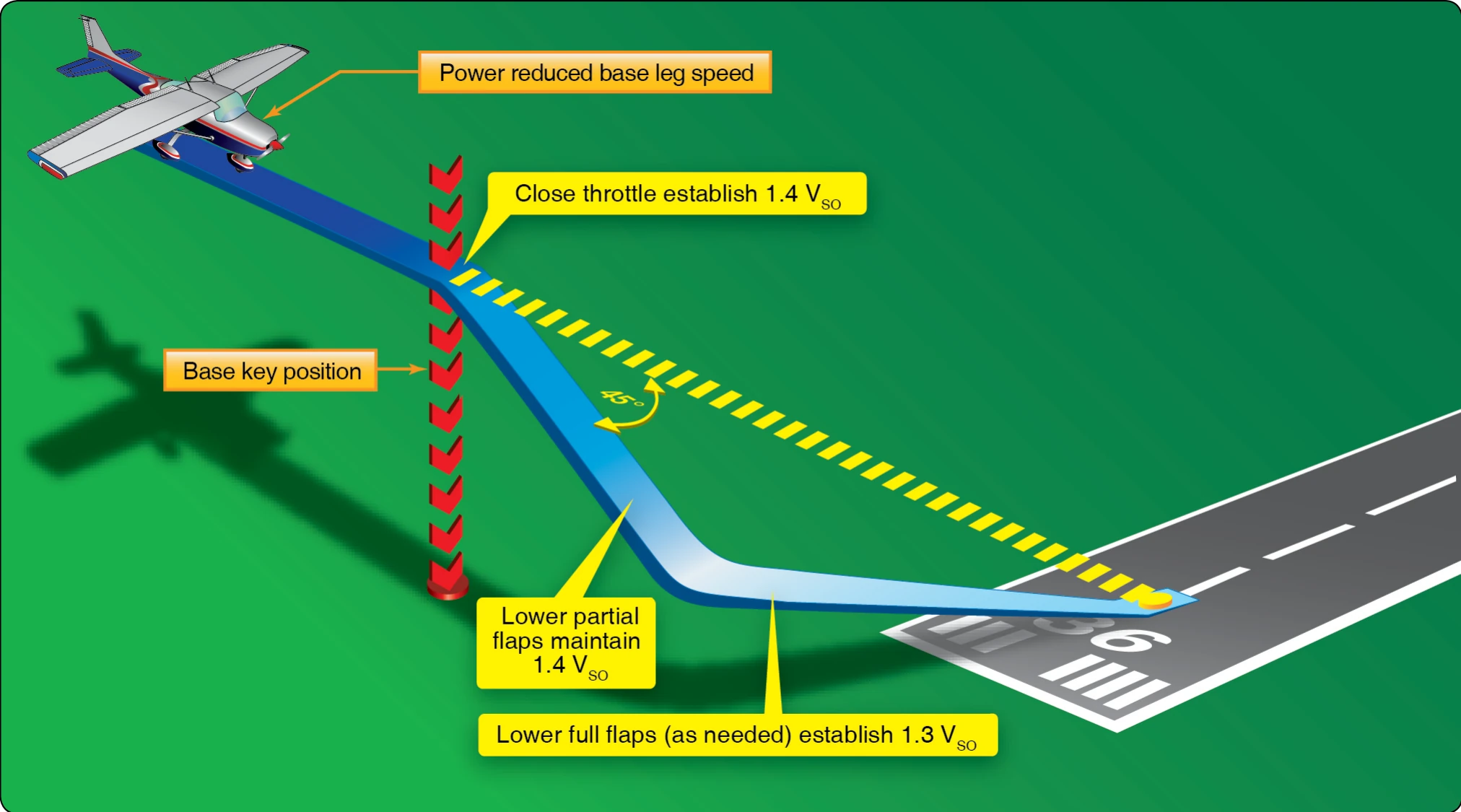
After a medium-banked turn onto the base leg is completed, the throttle is retarded slightly and the airspeed allowed to decrease to the normal base-leg speed. [Figure 9-26] On the base leg, the airspeed, wind drift correction, and altitude are maintained while proceeding to the 45° key position. At this position, the intended landing spot appears to be on a 45° angle from the airplane’s nose.
The pilot can determine the strength and direction of the wind from the amount of crab necessary to hold the desired ground track on the base leg. This helps in planning the turn onto the final approach and provides some indication of when to lower the flaps.
At the 45° key position, the throttle is closed completely, the propeller control (if equipped) advanced to the full increase revolution per minute (rpm) position, and altitude maintained until the airspeed decreases to the manufacturer’s recommended glide speed. In the absence of a recommended speed, the pilot should use 1.4 VSO. When this airspeed is attained, the nose is lowered to maintain the gliding speed and the controls trimmed. The wing flaps may be gradually lowered and the pitch attitude adjusted, as needed, to establish the proper descent angle. The base-to-final turn is planned and accomplished so that upon rolling out of the turn, the airplane is aligned with the runway centerline. If the approach is planned to be slightly high in the current configuration, the pilot will be assured of making the aiming point. The wing flaps may be lowered, as needed, and the pitch attitude adjusted, as needed, to establish the proper descent angle and airspeed (1.3 VSO ), and the controls trimmed. Slight adjustments in pitch attitude and slips are used as necessary to control the glide angle and airspeed. A crab or side slip can be used to maintain the desired flight path. A forward slip may be used momentarily to steepen the descent without changing the airspeed. Full flaps should be delayed until it is clear that adding them will not cause the landing to be short of the point. The pilot should never try to stretch the glide or retract the flaps to reach the desired landing spot.
On short final, full attention is given to making a good, safe landing rather than concentrating on the selected landing spot. The approach angle used and final approach airspeed determine the probability of landing on the spot, and late adjustments to these parameters are not appropriate. It is always better to execute a good landing away from the spot than to make a poor landing precisely on or just past the spot.
180° Power-Off Approach
The 180° power-off approach is executed by gliding with idle power from a given point on a downwind leg to a preselected landing spot. [Figure 9-27] It is an extension of the principles involved in the 90° power-off approach just described. The objective is to further develop judgment in estimating distances and glide ratios, in that the airplane is flown without power from a higher altitude and through a 90° turn to reach the base-leg position at a proper altitude for executing the 90° approach.
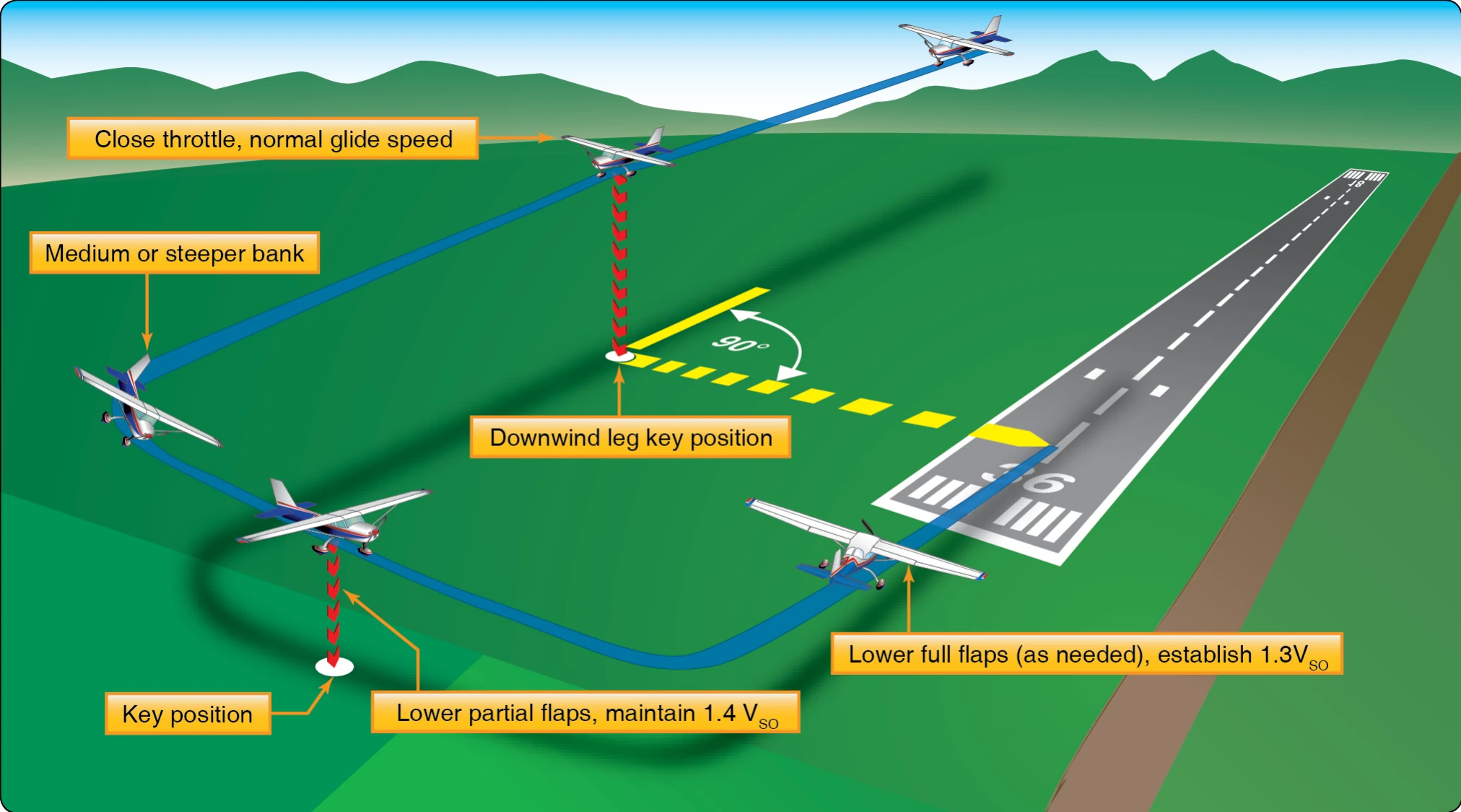
The 180° power-off approach requires more planning and judgment than the 90° power-off approach. In the execution of 180° power-off approaches, the airplane is flown on a downwind heading parallel to the landing runway. The altitude from which this type of approach is started varies with the type of airplane, but should usually not exceed 1,000 feet above the ground, except with large airplanes. Greater accuracy in judgment and maneuvering is required at higher altitudes.
When abreast of or opposite the desired landing spot, the throttle is closed and altitude maintained while decelerating to the manufacturer’s recommended glide speed or 1.4 VSO. The point at which the throttle is closed is the downwind key position.