
Chapter 9
Approaches and Landings
The turn from the downwind leg to the base leg is a uniform turn with a medium or slightly steeper bank. The degree of bank and amount of this initial turn depend upon the glide angle of the airplane and the velocity and direction of the wind. Again, the base leg is positioned as needed for the altitude or wind condition. Position the base leg to conserve or dissipate altitude so as to reach the desired landing spot.
The turn onto the base leg is made at an altitude high enough and close enough to permit the airplane to glide to what would normally be the base key position in a 90° power-off approach. Initial flaps may be extended prior to the base key position if needed.
Although the base key position is important, it should not be overemphasized nor considered as a fixed point on the ground. Many inexperienced pilots may gain a conception of it as a particular landmark, such as a tree, crossroad, or other visual reference, to be reached at a certain altitude. This misconception leaves the pilot at a total loss any time such objects are not present. Both altitude and geographical location should be varied as much as is practical to eliminate any such misconceptions. After reaching the base key position, the approach and landing are the same as in the 90° power-off approach.
Common Errors
Common errors in the performance of power-off accuracy approaches are:
- Downwind leg is too far from the runway/landing area.
- Overextension of downwind leg resulting from a tailwind.
- Inadequate compensation for wind drift on base leg.
- Skidding turns in an effort to increase gliding distance.
- Failure to lower landing gear in retractable gear airplanes.
- Attempting to “stretch” the glide during an undershoot.
- Premature flap extension/landing gear extension.
- Use of throttle to increase the glide instead of merely clearing the engine.
- Forcing the airplane onto the runway in order to avoid overshooting the designated landing spot.
Emergency Approaches and Landings (Simulated)
During dual training flights, the instructor should give simulated emergency landings by retarding the throttle and calling “simulated emergency landing.” The objective of these simulated emergency landings is to develop a pilot’s accuracy, judgment, planning, procedures, and confidence when little or no power is available. A simulated emergency landing may be given with the airplane in any configuration. If the simulated power failure occurs while above best glide speed, the pilot allows the airplane to slow (or may even bleed off speed by climbing) until reaching best glide speed. When reaching that speed, the nose can be lowered and the airplane trimmed to maintain that speed. If the failure occurs at or below best glide speed, the nose should be lowered immediately to maintain or accelerate to best glide speed. The pilot should ensure that the flaps and landing gear are in the proper configuration for the existing situation.
A constant gliding speed is usually maintained because variations of gliding speed nullify all attempts at accuracy in judgment of gliding distance and the landing spot. The many variables, such as altitude, obstruction, wind direction, landing direction, landing surface and gradient, and landing distance requirements of the airplane, determine the pattern and approach procedures to use.
The pilot may use any combination of normal gliding maneuvers, from wings level to spirals to eventually arrive at the normal key position at a normal traffic pattern altitude for the selected landing area. From the key point on, the approach is a normal power-off approach. [Figure 9-28]
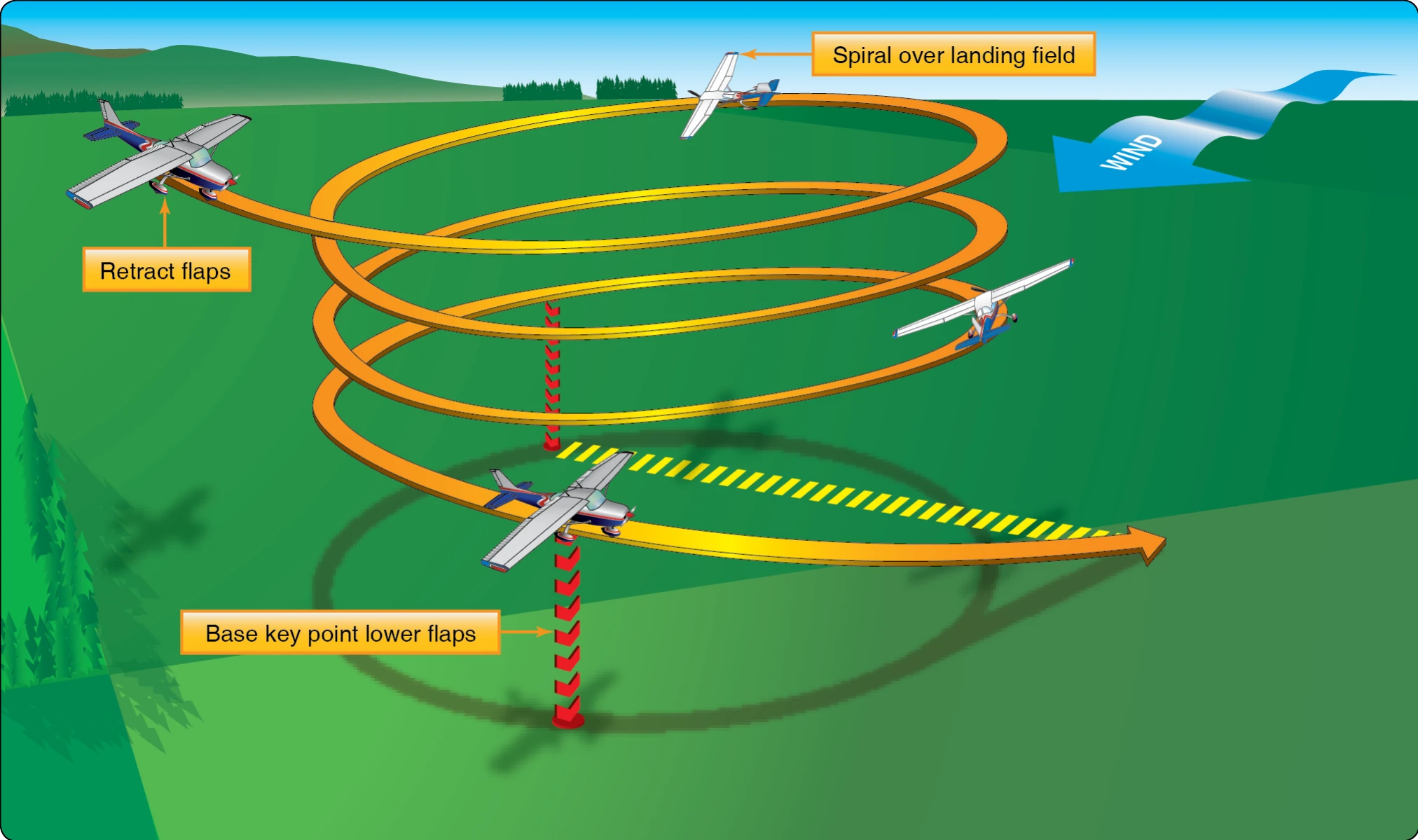
With the greater choice of fields afforded by higher altitudes, the inexperienced pilot may be inclined to delay making a decision, and with considerable altitude in which to maneuver, errors in maneuvering and estimation of glide distance may develop.
All pilots should learn to determine the wind direction and estimate its speed from the windsock at the airport, smoke from factories or houses, dust, brush fires, wind farms, or patterns displayed on nearby bodies of water.
Once a field has been selected, a pilot should indicate the proposed landing area to the instructor. Normally, the pilot should plan and fly a pattern for landing on the field first elected until the instructor terminates the simulated emergency landing. This provides the instructor an opportunity to explain and correct any errors; it also gives the pilot an opportunity to see the results of the errors. However, if the pilot realizes during the approach that a poor field has been selected—one that would obviously result in disaster if a landing were to be made—and there is a more advantageous field within gliding distance, a change to the better field should be permitted. The instructor should thoroughly explain the hazards involved in these last-minute decisions, such as excessive maneuvering at very low altitudes.
Instructors should stress slipping the airplane, using flaps, varying the position of the base leg, and varying the turn onto final approach as ways of correcting for misjudgment of altitude and glide angle.
Eagerness to get down is one of the most common faults of inexperienced pilots during simulated emergency landings. They forget about speed and arrive at the edge of the field with too much speed to permit a safe landing. Too much speed is just as dangerous as too little;
it results in excessive floating and overshooting the desired landing spot. Instructors need to stress during their instruction that pilots cannot dive at a field and expect to land on it.
During all simulated emergency landings, keep the engine warm and cleared. During a simulated emergency landing, either the instructor or the pilot should have complete control of the throttle. There should be no doubt as to who has control since many near accidents have occurred from such misunderstandings.
Every simulated emergency landing approach is terminated as soon as it can be determined whether or not a safe landing is assured. In no case should it be continued to a point where it creates an undue hazard or an annoyance to persons or property on the ground.
In addition to flying the airplane from the point of simulated engine failure to where it is known that a reasonable safe landing could be made (or to where it is known that the approach cannot be salvaged), a pilot should also receive instruction on certain emergency flight deck procedures. The habit of performing these procedures should be developed to such an extent that, if an engine failure actually occurs, a pilot checks the critical items that might get the engine operating again while selecting a field and planning an approach. Combining the two operations—accomplishing emergency procedures and planning and flying the approach—is difficult during the early training in emergency landings.