
Chapter 14
Aircraft Fuel Systems
The soft flexible nature of bladder fuel tanks requires that they remain wet. Should it become necessary to store a bladder tank without fuel in it for an extended period of time, it is common to wipe the inside of the tank with a coating of clean engine oil. Follow the manufacturer’s instructions for the dry storage procedures for fuel cells.
Integral Fuel Tanks
On many aircraft, especially transport category and high-performance aircraft, part of the structure of the wings or fuselage is sealed with a fuel resistant two-part sealant to form a fuel tank. The sealed skin and structural members provide the highest volume of space available with the lowest weight. This type of tank is called an integral fuel tank since it forms a tank as a unit within the airframe structure.
Integral fuel tanks in the otherwise unused space inside the wings are most common. Aircraft with integral fuel tanks in the wings are said to have wet wings. For fuel management purposes, sometimes a wing is sealed into separate tanks and may include a surge tank or an overflow tank, which is normally empty but sealed to hold fuel when needed.
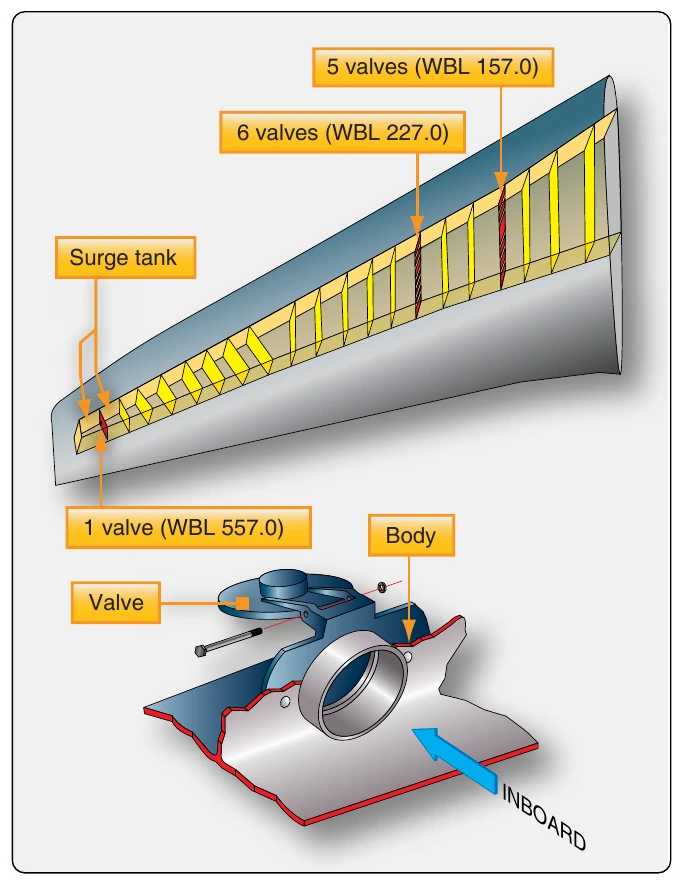
When an aircraft maneuvers, the long horizontal nature of an integral wing tank requires baffling to keep the fuel from sloshing. The wing ribs and box beam structural members serve as baffles and others may be added specifically for that purpose. Baffle check valves are commonly used. These valves allow fuel to move to the low, inboard sections of the tank but prevent it from moving outboard. They ensure that the fuel boost pumps located in the bottom of the tanks at the lowest points above the sumps always have fuel to pump regardless of aircraft attitude. [Figure 14-32]
Integral fuel tanks must have access panels for inspection and repairs of the tanks and other fuel system components. On large aircraft, technicians physically enter the tank for maintenance. Transport category aircraft often have more than a dozen oval access panels or tank plates on the bottom surface of the wing for this purpose. [Figure 14-33A] These aluminum panels are each sealed into place with an O-ring and an aluminum gasket for electrostatic bonding. An outer clamp ring is tightened to the inner panel with screws, as shown in Figure 14-33B.
When entering and performing maintenance on an integral fuel tank, all fuel must be emptied from the tank and strict safety procedures must be followed. Fuel vapors must be purged from the tank and respiratory equipment must be used A Boost pump access
FORWARD Tank access panel N.. t INBOARD No
No. 6
No. 8
No. 10
No. 12
No. 14
No No. 9
No. 11 No. 13 nel No. 1
- · 1
No. 2
CL APL
No. 3 No. 5