
Chapter 15
Ice & Rain Protection
Holdover Time (HOT)
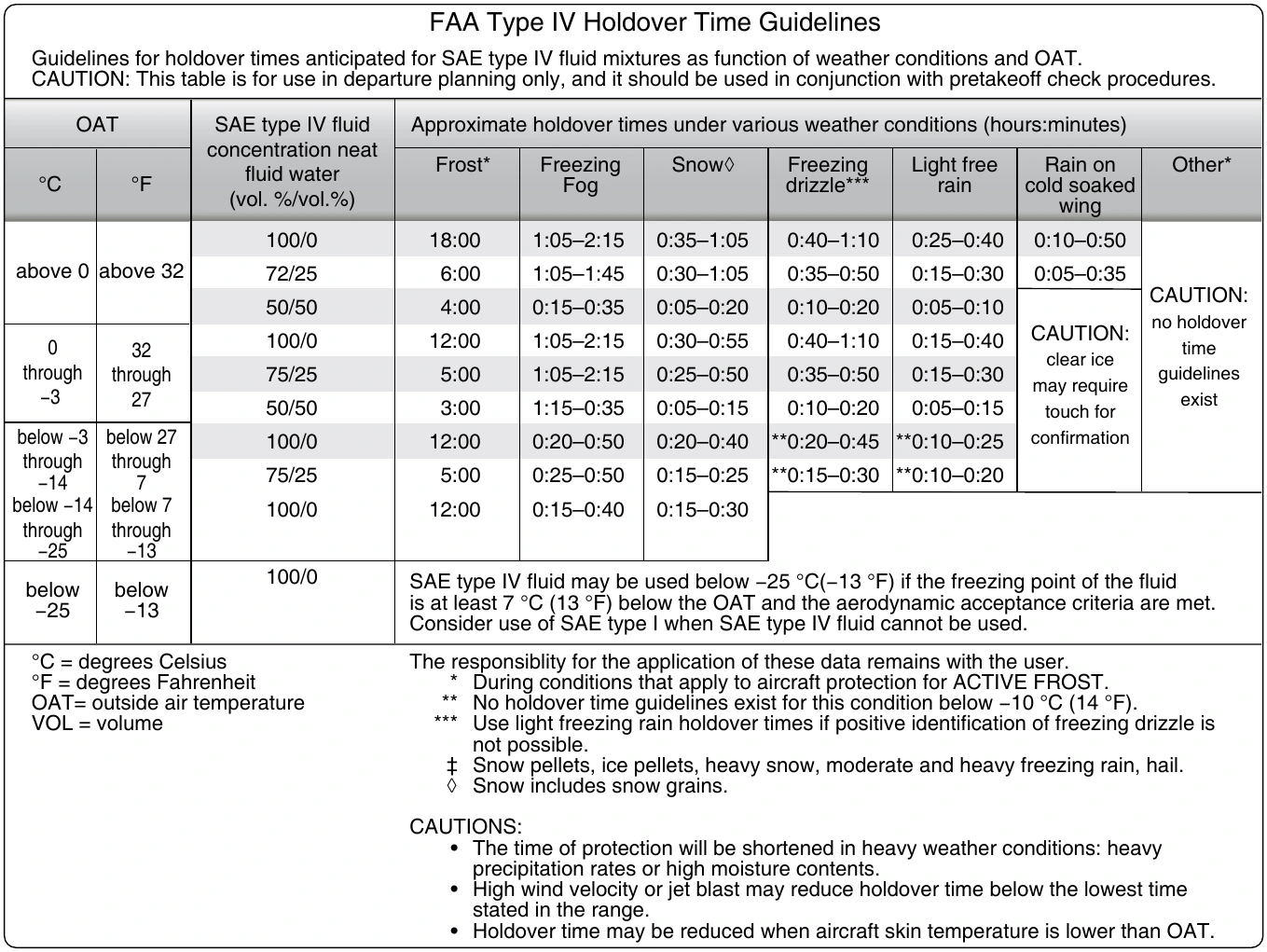
Holdover Time (HOT) is the estimated time that deicing/anti-icing fluid prevents the formation of frost or ice and the accumulation of snow on the critical surfaces of an aircraft. HOT begins when the final application of deicing/anti-icing fluid commences and expires when the deicing/anti-icing fluid loses its effectiveness. Figure 15-38 shows a holdover timetable for Type IV fluid.
Critical Surfaces
Basically, all surfaces that have an aerodynamic, control, sensing, movement, or measuring function must be clean. These surfaces cannot necessarily be cleaned and protected in the same conventional deicing/anti-icing manner as the wings. Some areas require only a cleaning operation, while others need protection against freezing. The procedure of deicing may also vary according to aircraft limitations. The use of hot air may be required when deicing (e.g., landing gear or propellers).
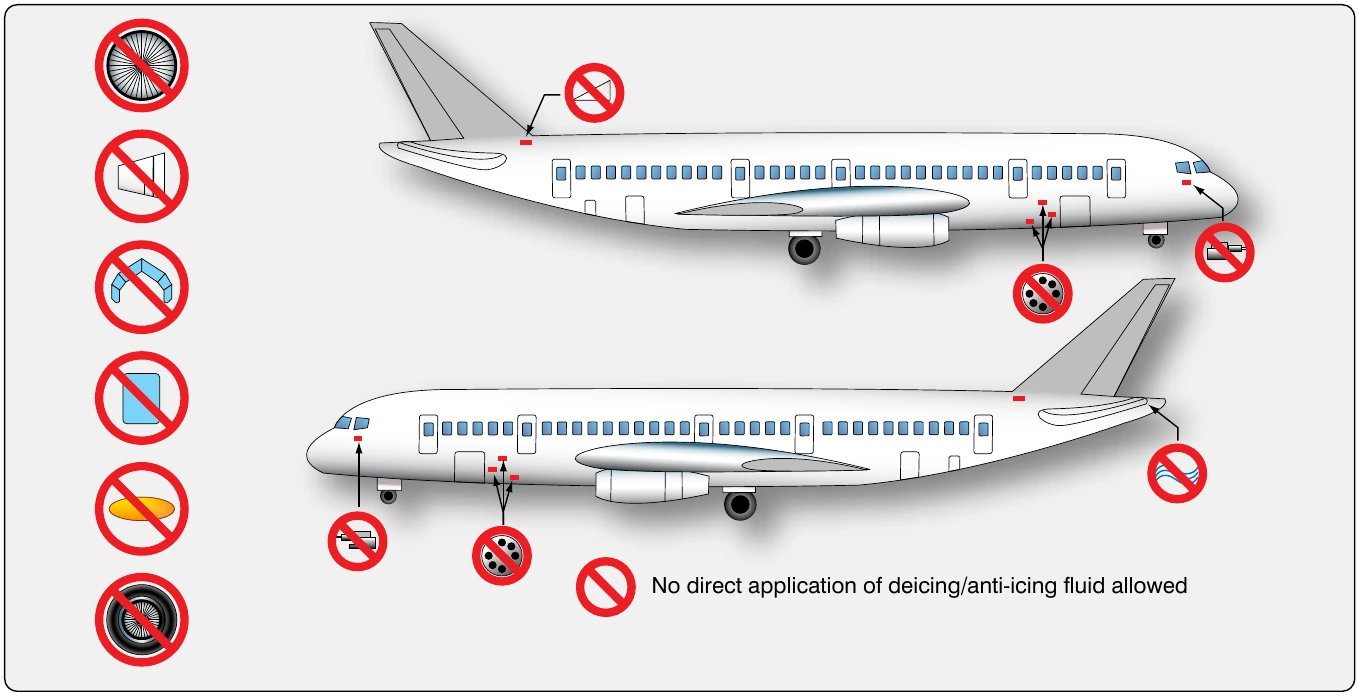
Figure 15-39 shows critical areas on an aircraft that should not be sprayed directly. Some critical elements and procedures that are common for most aircraft are:
- Deicing/anti-icing fluids must not be sprayed directly on wiring harnesses and electrical components (e.g., receptacles, junction boxes), onto brakes, wheels, exhausts, or thrust reversers.
- Deicing/anti-icing fluid shall not be directed into the orifices of pitot heads, static ports, or directly onto
airstream direction detectors probes/angle of attack airflow sensors.
- All reasonable precautions shall be taken to minimize fluid entry into engines, other intakes/outlets, and control surface cavities.
- Fluids shall not be directed onto flight deck or cabin windows as this can cause crazing of acrylics or penetration of the window seals.
- Any forward area from which fluid can blow back onto windscreens during taxi or subsequent takeoff shall be free of residues prior to departure.
- If Type II, III, or IV fluids are used, all traces of the fluid on flight deck windows should be removed prior to departure, particular attention being paid to windows fitted with wipers.
- Landing gear and wheel bays shall be kept free from buildup of slush, ice, or accumulations of blown snow.
- When removing ice, snow, slush, or frost from aircraft surfaces, care shall be taken to prevent it entering and accumulating in auxiliary intakes or control surface hinge areas (e.g., manually remove snow from wings and stabilizer surfaces forward toward the leading edge and remove from ailerons and elevators back towards the trailing edge).
Ice & Snow Removal
Probably the most difficult deposit to deal with is deep, wet snow when ambient temperatures are slightly above the freezing point. This type of deposit should be removed with a soft brush or squeegee. Use care to avoid damage to antennas, vents, stall warning devices, vortex generators, etc., that may be concealed by the snow. Light, dry snow in subzero temperatures should be blown off whenever possible; the use of hot air is not recommended, since this would melt the snow, which would then freeze and require further treatment. Moderate or heavy ice and residual snow deposits should be removed with a deicing fluid. No attempt should be made to remove ice deposits or break an ice bond by force.
After completion of deicing operations, inspect the aircraft to ensure that its condition is satisfactory for flight. All external surfaces should be examined for signs of residual snow or ice, particularly in the vicinity of control gaps and hinges. Check the drain and pressure sensing ports for obstructions. When it becomes necessary to physically remove a layer of snow, all protrusions and vents should be examined for signs of damage. Control surfaces should be moved to ascertain that they have full and free movement. The landing gear mechanism, doors and bay, and wheel brakes should be inspected for snow or ice deposits and the operation of up-locks and microswitches checked.
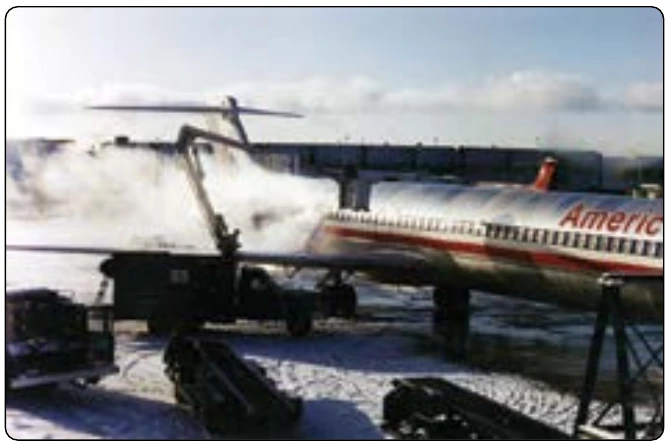
Snow or ice can enter turbine engine intakes and freeze in the compressor. If the compressor cannot be turned by hand for this reason, hot air should be blown through the engine until the rotating parts are free.
Rain Control Systems
There are several different ways to remove the rain from the windshields. Most aircraft use one or a combination of the following systems: windshield wipers, chemical rain repellent, pneumatic rain removal (jet blast), or windshields treated with a hydrophobic surface seal coating.
Windshield Wiper Systems
In an electrical windshield wiper system, the wiper blades are driven by an electric motor(s) that receive (s) power from the aircraft’s electrical system. On some aircraft, the pilot’s and copilot’s windshield wipers are operated by separate systems to ensure that clear vision is maintained through one of the windows should one system fail. Each windshield wiper assembly consists of a wiper, wiper arm, and a wiper motor/converter. Almost all windshield wiper systems use electrical motors. Some older aircraft might be equipped with hydraulic wiper motors. [Figure 15-40]
Maintenance performed on windshield wiper systems consists of operational checks, adjustments, and troubleshooting. An operational check should be performed whenever a system component is replaced or whenever the system is suspected of not working properly. During the check, make sure that the windshield area covered by the wipers is free of foreign matter and is kept wet with water. Adjustment of a windshield wiper system consists of adjusting the wiper blade tension, the angle at which the blade sweeps across the windshield, and proper parking of the wiper blades.