
Chapter 15
Ice & Rain Protection
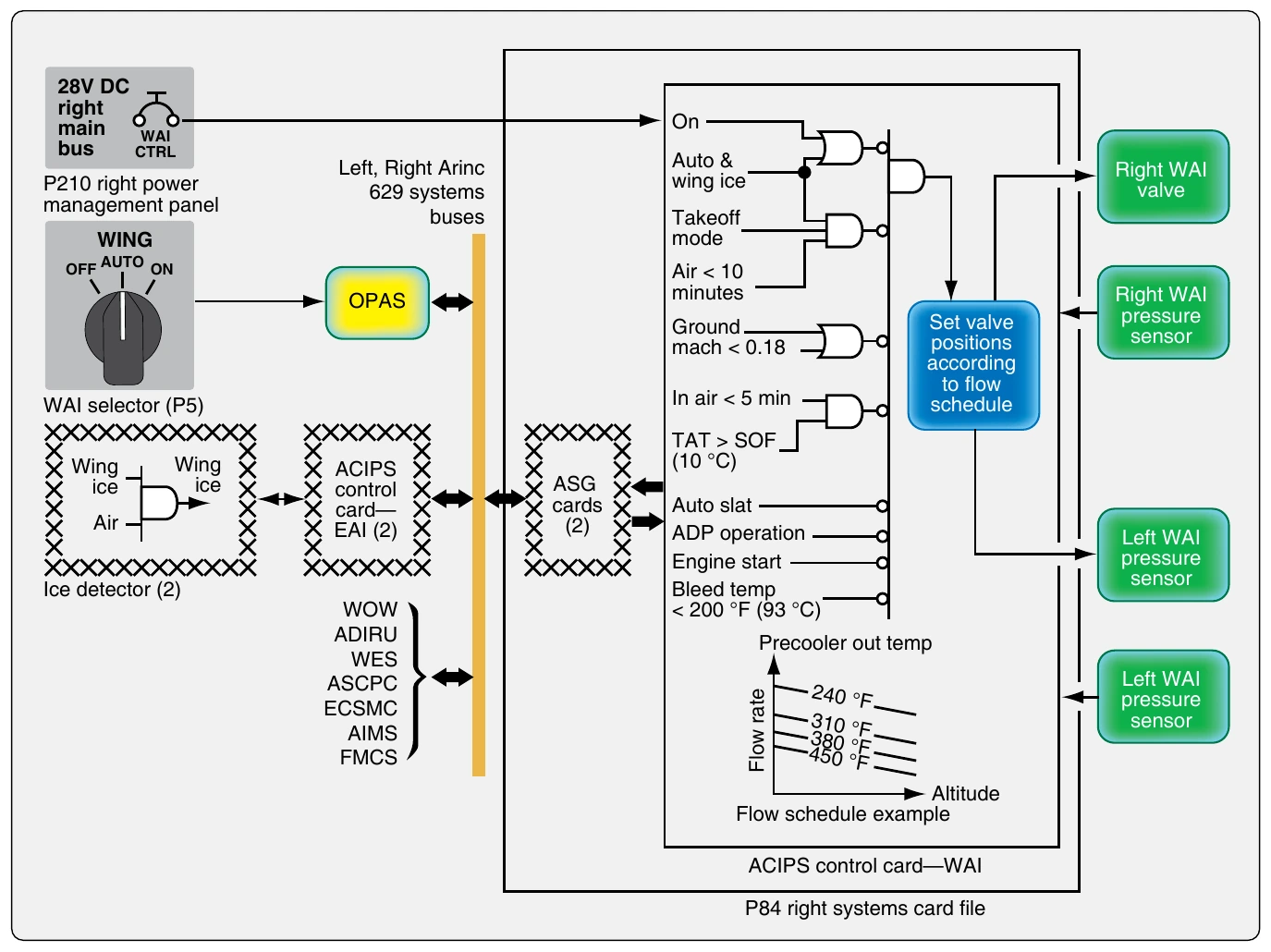
The aircrew can monitor the WAI system on the onboard computer maintenance page. [Figure 15-13] The following information is shown:
- WING MANIFOLD PRESS—pneumatic duct pressure in PSIG.
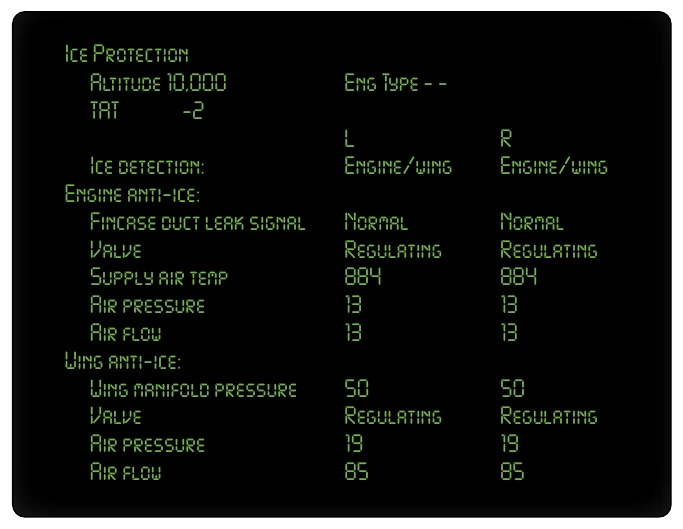
- VALVE—WAI valve open, closed, or regulating.
- AIR PRESS—pressure downstream of the WAI valves in PSIG.
- AIR FLOW—air flow through the WAI valves in pounds per minute.
WAI System Built-In Test Equipment (BITE) Test
BITE circuits in the WAI ACIPS computer card continuously monitor the WAI system. Faults that affect the dispatch of the aircraft cause status messages. Other faults cause central maintenance computer system (CMCS) maintenance messages. The BITE in the WAI ACIPS computer card also performs automatic power-up and periodic tests. Faults found during these tests that affect dispatch cause status messages. Other faults cause CMCS maintenance messages. The power-up test occurs when the card gets power. BITE does a test of the card hardware and software functions and the valve and pressure sensor interfaces. The valves do not move during this test.
The periodic test occurs when all these conditions are true:
- The airplane has been on the ground between 1 and 5 minutes.
- The WAI selector is set to auto or on.
- Air-driven hydraulic pumps are not in intermittent operation.
- Bleed pressure is sufficient to open the WAI valves.
- The time since the last periodic test is more than 24 hours.
- During this test, the WAI valves cycle open and closed. This test makes sure that valve malfunctions are detected.
Thermal Electric Anti-Icing
Electricity is used to heat various components on an aircraft so that ice does not form. This type of anti-ice is typically limited to small components due to high amperage draw. Effective thermal electric anti-ice is used on most air data probes, such as pitot tubes, static air ports, TAT and AOA probes, ice detectors, and engine P2/T2 sensors. Water lines, waste water drains, and some turboprop inlet cowls are also heated with electricity to prevent ice from forming. Transport category and high-performance aircraft use thermal electric anti-icing in windshields.
In devices that use thermal electric anti-ice, current flows through an integral conductive element that produces heat. The temperature of the component is elevated above the freezing point of water, so ice cannot form. Various schemes are used, such as an internal coil wire, externally wrapped blankets or tapes, as well as conductive films and heated gaskets. A basic discussion of probe heat follows. Windshield heat and portable water heat anti-ice are discussed later in this chapter. Propeller deice boots, which also are used for anti-ice, are also thermal electric and discussed in this chapter.
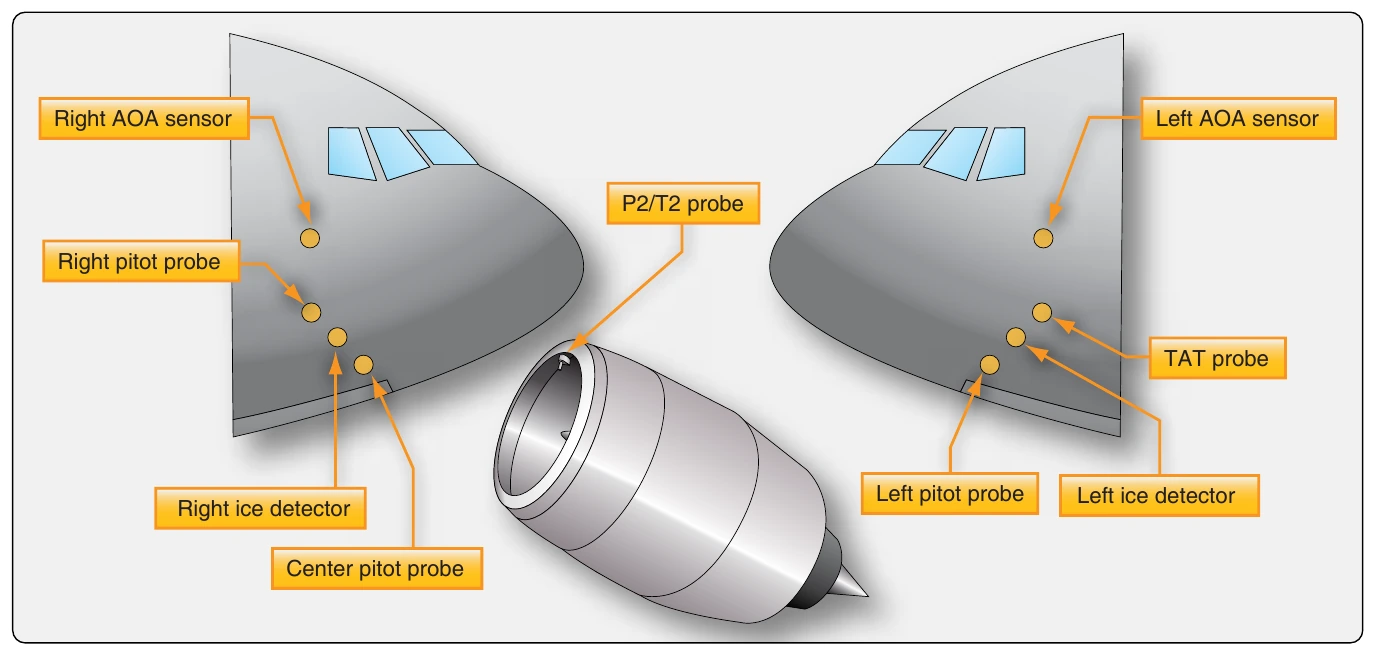
Data probes that protrude into the ambient airstream are particularly susceptible to ice formation in flight. Figure 15-14 illustrates the types and location probes that use thermal electric heat on one airliner. A pitot tube, for example, contains an internal electric element that is controlled by a switch in the flight deck. Use caution checking the function of the pitot heat when the aircraft is on the ground. The tube gets extremely hot since it must keep ice from forming at altitude in temperatures near -50 °F at speeds possibly over 500 miles per hour. An ammeter or load meter in the circuit can be used to safely determine functionality.
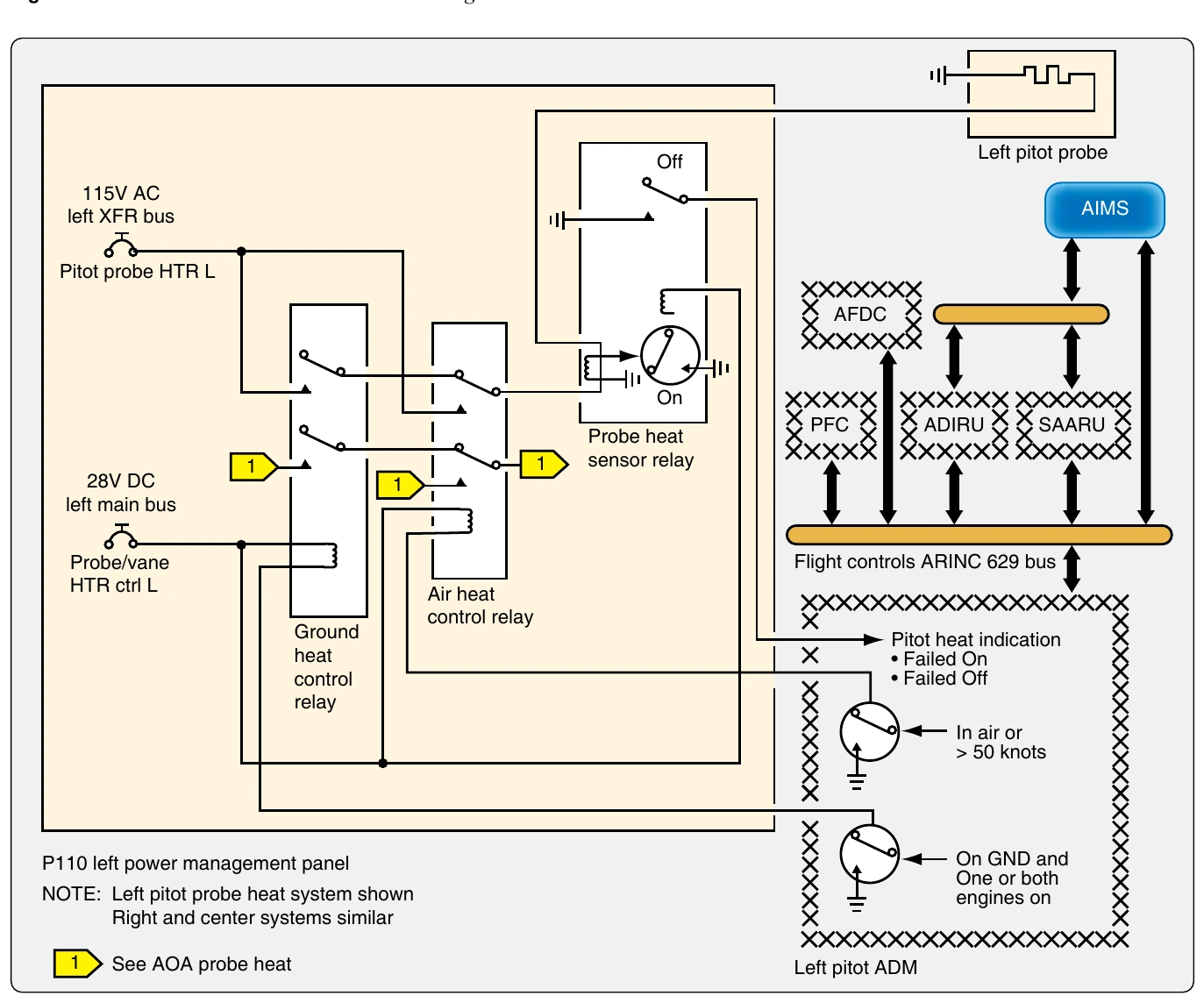
Simple probe heat circuits exist on GA aircraft with a switch and a circuit breaker to activate and protect the device. Advanced aircraft may have more complex circuitry in which control is by computer and flight condition of the aircraft is considered before thermal electric heaters are activated automatically. Figure 15-15 shows such a circuit for a pitot tube. The primary flight computer (PFC) supplies signals for the air data card (ADC) to energize ground and air heat control relays to activate probe heat. Information concerning speed of the aircraft, whether it is in the air or on the ground, and if the engines are running, are factors considered by the ADC logic. Similar controls are used for other probe heaters.
Chemical Anti-Icing
Chemical anti-icing is used in some aircraft to anti-ice the leading edges of the wing, stabilizers, windshields, and propellers. The wing and stabilizer systems are often called weeping wing systems or are known by their trade name of TKS™ systems. Ice protection is based upon the freezing point depressant concept. An antifreeze solution is pumped from a reservoir through a mesh screen embedded in the leading edges of the wings and stabilizers. Activated by a switch in the flight deck, the liquid flows over the wing and tail surfaces, preventing the formation of ice as it flows. The solution mixes with the supercooled water in the cloud, depresses its freezing point, and allows the mixture to flow off of the aircraft without freezing. The system is designed to anti-ice, but it is also capable of deicing an aircraft as well. When ice has accumulated on the leading edges, the antifreeze solution chemically breaks down the bond between the ice and airframe. This allows aerodynamic forces to carry the ice away. Thus, the system clears the airframe of accumulated ice before transitioning to anti-ice protection. Figure 15-16 shows a chemical anti-ice system.
The TKS™ weeping wing system contains formed titanium panels that are laser drilled with over 800 tiny holes (.0025-inch diameter) per square inch. These are mated with non-perforated stainless-steel rear panels and bonded to wing and stabilizer leading edges. As fluid is delivered from a central reservoir and pump, it seeps through the holes. Aerodynamic forces cause the fluid to coat the upper and lower surfaces of the airfoil. The glycol-based fluid prevents ice from adhering to the aircraft structure.
Some aircraft with weeping wing systems are certified to fly into known icing conditions. Others use it as a hedge against unexpected ice encountered in flight. The systems are basically the same. Reservoir capacity permits 1- 2 hours of operation. TKSTM weeping wings are used primarily on reciprocating aircraft that lack a supply of warm bleed air for the installation of a thermal anti-ice system. However, the system is simple and effective leading to its use on some turbine powered corporate aircraft as well.