
Chapter 16
Cabin Environmental Control Systems
Temperature & Altitude
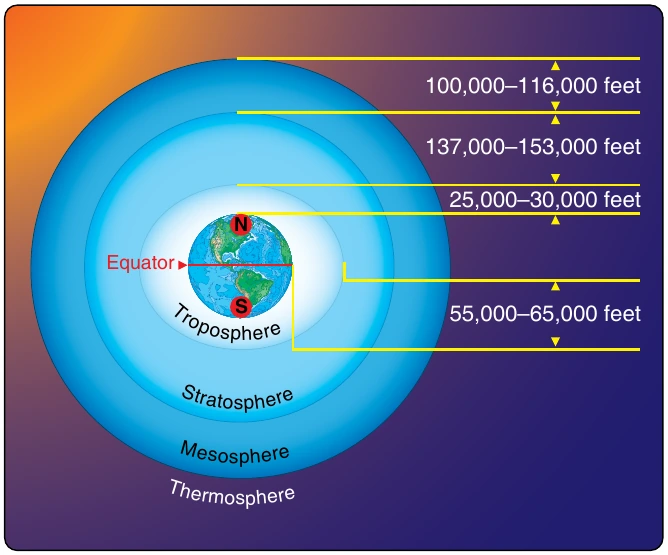
Temperature variations in the atmosphere are of concern to aviators. Weather systems produce changes in temperature near the earth’s surface. Temperature also changes as altitude is increased. The troposphere is the lowest layer of the atmosphere. On average, it ranges from the earth’s surface
troposphere is illustrated in Figure 16-38.
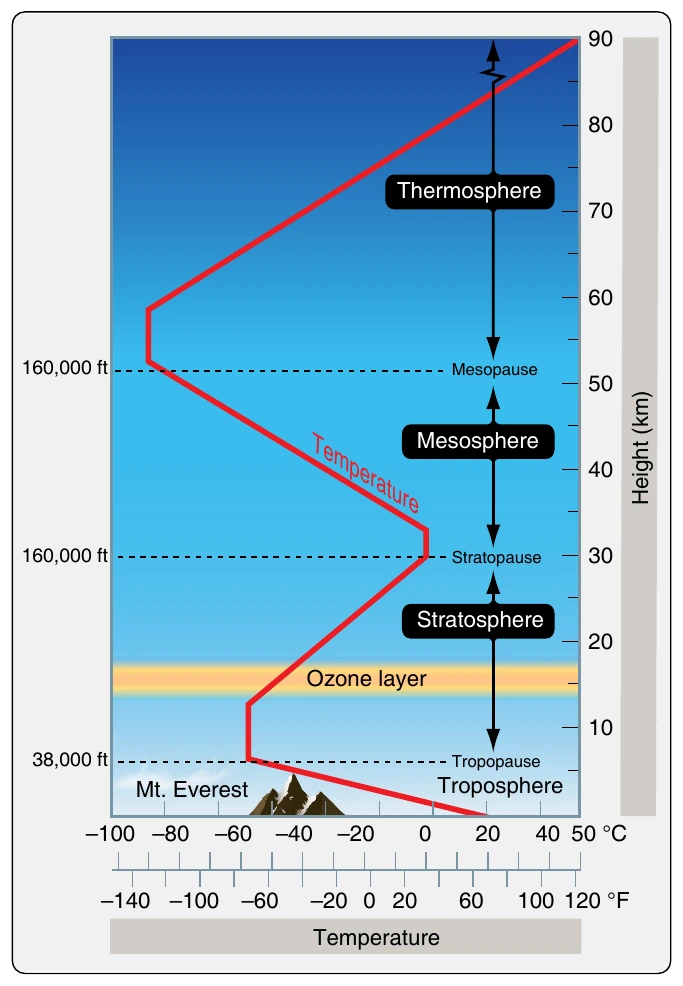
Most civilian aviation takes place in the troposphere in which temperature decreases as altitude increases. The rate of change is somewhat constant at about –2 °C or –3.5 °F for every 1,000 feet of increase in altitude. The upper boundary of the troposphere is the tropopause. It is characterized as a zone of relatively constant temperature of –57 °C or –69 °F.
Above the tropopause lies the stratosphere. Temperature increases with altitude in the stratosphere to near 0 °C before decreasing again in the mesosphere, which lies above it. The stratosphere contains the ozone layer that protects the earth’s inhabitants from harmful UV rays. Some civilian flights and numerous military flights occur in the stratosphere. Figure 16-39 diagrams the temperature variations in different layers of the atmosphere.
When an aircraft is flown at high altitude, it burns less fuel for a given airspeed than it does for the same speed at a lower altitude. This is due to decreased drag that results from the reduction in air density. Bad weather and turbulence can also be avoided by flying in the relatively smooth air above storms and convective activity that occur in the lower troposphere. To take advantage of these efficiencies, aircraft are equipped with environmental systems to overcome extreme temperature and pressure levels. While supplemental oxygen and a means of staying warm suffice, aircraft pressurization and air conditioning systems have been developed to make high altitude flight more comfortable. Figure 16-40 illustrates the temperatures and pressures at various altitudes in the atmosphere.
Pressurization Terms
The following terms should be understood for the discussion of pressurization and cabin environmental systems that follows:
- Cabin altitude—given the air pressure inside the cabin, the altitude on a standard day that has the same pressure as that in the cabin. Rather than saying the pressure inside the cabin is 10.92 psi, it can be
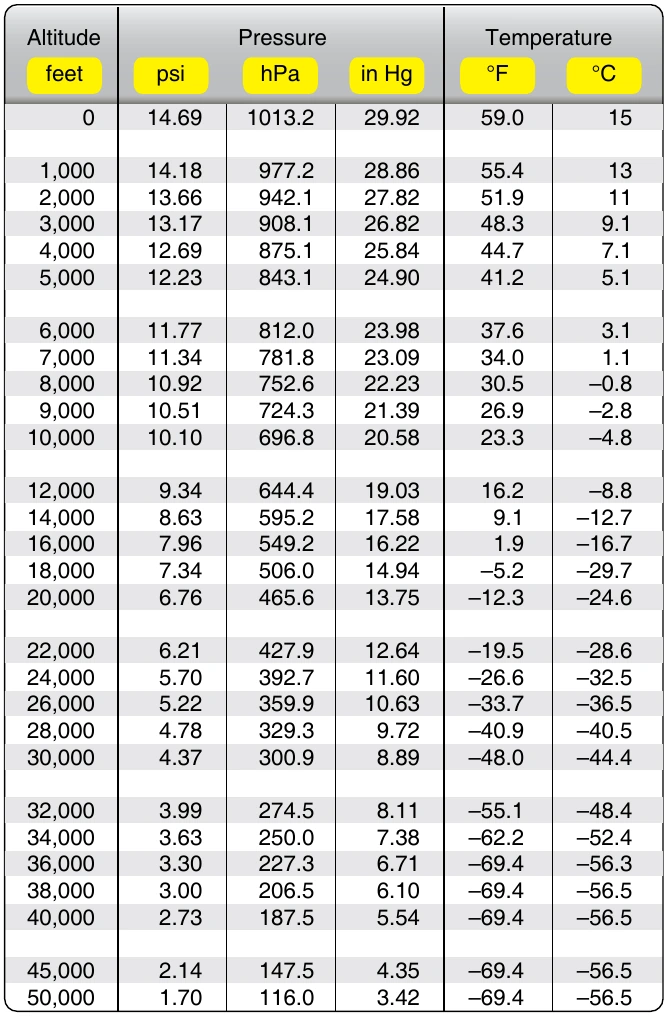
said that the cabin altitude is 8,000 feet (MSL).
- Cabin differential pressure—the difference between the air pressure inside the cabin and the air pressure
of cabin altitude change.
Pressurization Issues
Pressurizing an aircraft cabin assists in making flight possible in the hostile environment of the upper atmosphere. The degree of pressurization and the operating altitude of any aircraft are limited by critical design factors. A cabin pressurization system must accomplish several functions if it is to ensure adequate passenger comfort and safety. It must be capable of maintaining a cabin pressure altitude of approximately 8,000 feet or lower regardless of the cruising altitude of the aircraft. This is to ensure that passengers and crew have enough oxygen present at sufficient pressure to facilitate full blood saturation. A pressurization system must also be designed to prevent rapid changes of cabin pressure, which can be uncomfortable or injurious to passengers and crew. Additionally, a pressurization system should circulate air from inside the cabin to the outside at a rate that quickly eliminates odors and to remove stale air. Cabin air must also be heated or cooled on pressurized aircraft. Typically, these functions are incorporated into the pressurization source.
To pressurize, a portion of the aircraft designed to contain air at a pressure higher than outside atmospheric pressure must be sealed. A wide variety of materials facilitate this. Compressible seals around doors combine with various other seals, grommets, and sealants to essentially establish an air tight pressure vessel. This usually includes the cabin, flight compartment, and the baggage compartments. Air is then pumped into this area at a constant rate sufficient to raise the pressure slightly above that which is needed. Control is maintained by adjusting the rate at which the air is allowed to flow out of the aircraft.