Chapter 16
Cabin Environmental Control Systems
Any oxygen system component should be cleaned thoroughly before installation. Often tubing comes with leftover residue from the bending or flaring processes. Cleaning should be accomplished with nonpetroleum-based cleansers. Trichlorethylene, acetone, and similar cleaners can be used to flush new tubing. Tubing should be blown or baked dry before installation. Follow the manufacturer’s procedures for cleaning oxygen system components.
Some oxygen components make use of tapered pipe fittings. This type of connection is usually sealed with the application of thread lubricant/sealant. Typical thread sealers are petroleum based and should not be used; only oxygen compatible thread lubricant/sealers should be used. Alternatively, Teflon® tape is also used on oxygen pipe fitting connections. Be sure to begin wrapping the Teflon® tape at least two threads from the end of the fitting. This prevents any tape from coming loose and entering the oxygen system.
Prevention of Oxygen Fires or Explosions
Precautions must be observed when working with or around pure oxygen. It readily combines with other substances, some in a violent and explosive manner. As mentioned, it is extremely important to keep distance between pure oxygen and petroleum products. When allowed to combine, an explosion can result. Additionally, there are a variety of inspection and maintenance practices that should be followed to ensure safety when working with oxygen and oxygen systems. Care should be used and, as much as possible, maintenance should be done outside.
When working on an oxygen system, it is essential that the warnings and precautions given in the aircraft maintenance manual be carefully observed. Before any work is attempted, an adequate fire extinguisher should be on hand. Cordon off the area and post “NO SMOKING” placards. Ensure that all tools and servicing equipment are clean and avoid power on checks and use of the aircraft electrical system.
Oxygen System Inspection & Maintenance
When working around oxygen and oxygen systems, cleanliness enhances safety. Clean, grease-free hands, clothes, and tools are essential. A good practice is to use only tools dedicated for work on oxygen systems. There should be absolutely no smoking or open flames within a minimum of 50 feet of the work area. Always use protective caps and plugs when working with oxygen cylinders, system components, or plumbing. Do not use any kind of adhesive tape. Oxygen cylinders should be stored in a designated, cool, ventilated area in the hangar away from petroleum products or heat sources.
Oxygen system maintenance should not be accomplished until the valve on the oxygen supply cylinder is closed and pressure is released from the system. Fittings should be unscrewed slowly to allow any residual pressure to dissipate. All oxygen lines should be marked and should have at least 2 inches of clearance from moving parts, electrical wiring, and all fluid lines. Adequate clearance must also be provided from hot ducts and other sources that might heat the oxygen. A pressure and leak check must be performed each time the system is opened for maintenance. Do not use any lubricants, sealers, cleaners, etc., unless specifically approved for oxygen system use.
Aircraft Pressurization Systems
Pressure of the Atmosphere
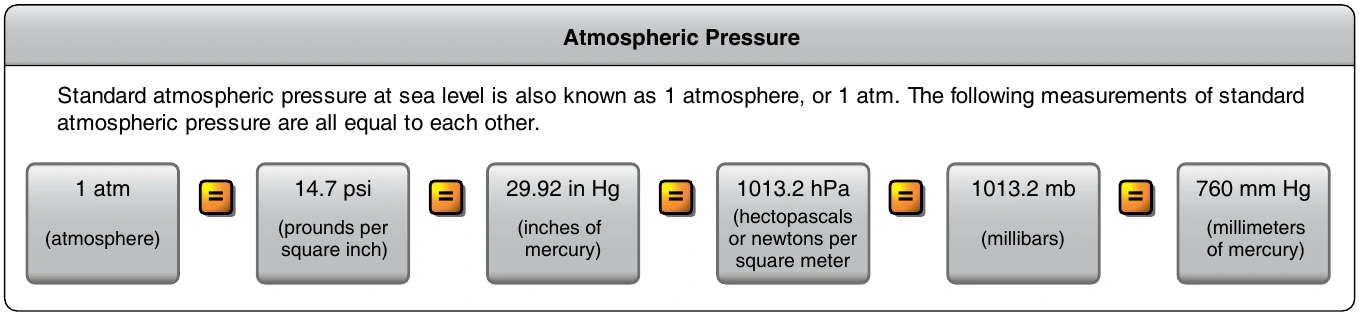
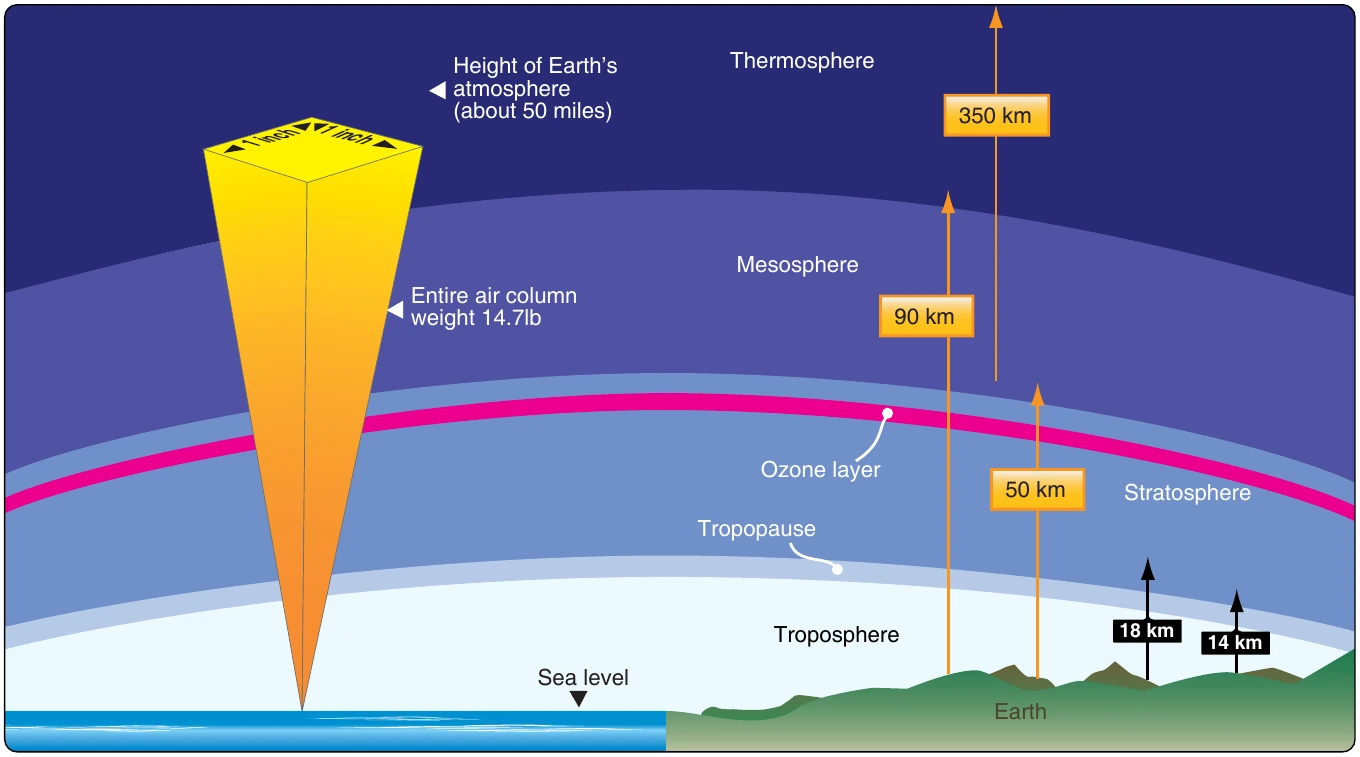
The gases of the atmosphere (air), although invisible, have weight. A one square inch column of air stretching from sea level into space weighs 14.7 pounds. Therefore, it can be stated that the pressure of the atmosphere, or atmospheric pressure, at sea level is 14.7 psi. [Figure 16-34]
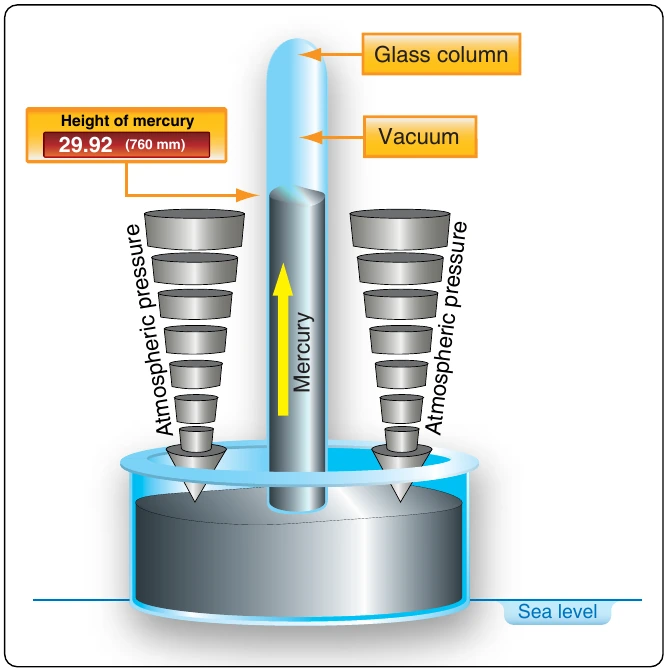
Atmospheric pressure is also known as barometric pressure
and is measured with a barometer. [Figure 16-35] Expressed in various ways, such as in inches of mercury or millimeters of mercury, these measurements come from observing the height of mercury in a column when air pressure is exerted on a reservoir of mercury into which the column is set. The column must be evacuated so air inside does not act against the mercury rising. A column of mercury 29.92 inches high weighs the same as a column of air that extends from sea level to the top of the atmosphere and has the same cross-section as the column of mercury.
Aviators often interchange references to atmospheric pressure between linear displacement (e.g., inches of mercury) and units of force (e.g., psi). Over the years, meteorology has shifted its use of linear displacement representation of atmospheric pressure to units of force. However, the unit of force nearly universally used today to represent atmospheric pressure in meteorology is the hectopascal (hPa). A hectopascal is a metric (SI) unit that expresses force in newtons per square meter. 1,013.2 hPa is equal to 14.7 psi. [Figure 16-36]
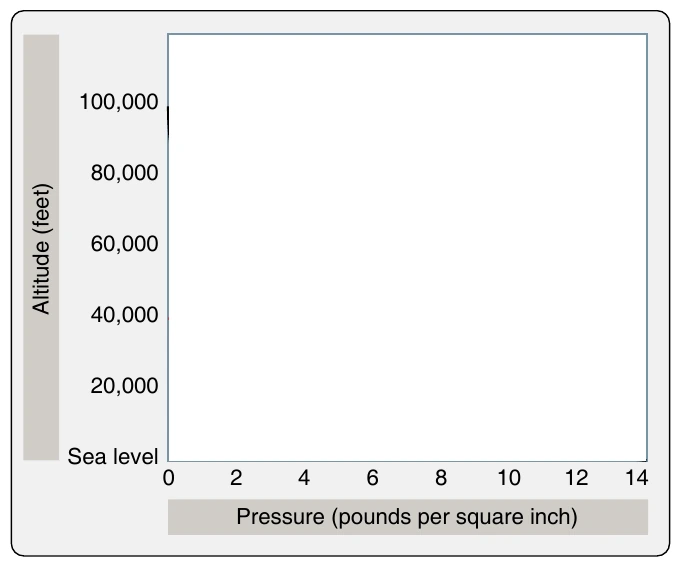
Atmospheric pressure decreases with increasing altitude. The simplest explanation for this is that the column of air that is weighed is shorter. How the pressure changes for a given altitude is shown in Figure 16-37. The decrease in pressure is a rapid one and, at 50,000 feet, the atmospheric pressure has dropped to almost one-tenth of the sea level value.