
Chapter 16
Cabin Environmental Control Systems
Gaseous oxygen systems are prevalent in general, corporate, and airline aviation. The use of lightweight aluminum and composite storage cylinders has improved these simple and reliable life support systems. All gaseous oxygen systems require servicing and maintenance. Various procedures and requirements to perform these functions are covered in this section.
Leak Testing Gaseous Oxygen Systems
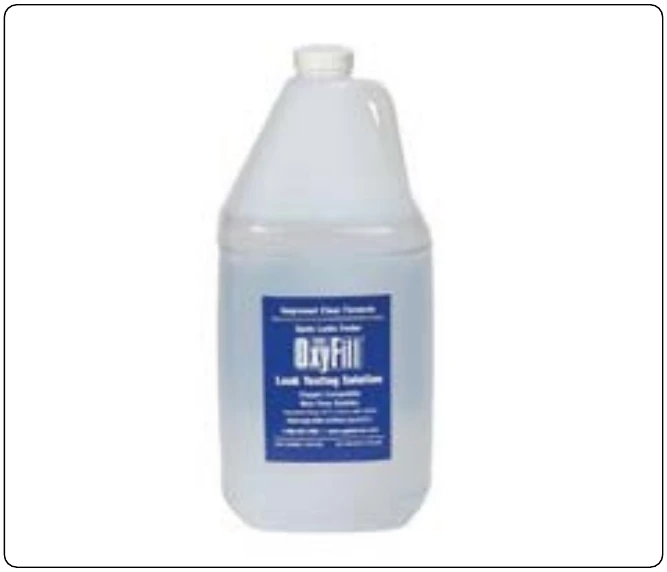
Leaks in a continuous-flow oxygen system may be difficult to detect because the system is open at the user end. Blocking the flow of oxygen allows pressure to build and leak check procedures can be followed that are similar to those used in the high-pressure sections of the systems. Detection of leaks should be performed with oxygen-safe leak check fluid. This is a soapy liquid free from elements that might react with pure oxygen or contaminate the system. As with leak detection on an inflated tire or tube assembly, the oxygen leak detection solution is applied to the outside of fittings and mating surfaces. The formation of bubbles indicates a leak. [Figure 16-30]
Careful assembly of oxygen components and fittings without overtightening or undertightening is required. If a leak is found at a fitting, it should be checked for the proper torque. Tightening may not always stop the leak. If the fitting is torqued properly and a leak still exists, pressure must be released from the system and the fitting must be examined for flaws or contamination. If necessary, the fitting must be replaced. All system components, lines, and fittings must be replaced with the proper parts, which should be cleaned and inspected thoroughly before installation. Follow the manufacturer’s instructions and repeat the leak check when completed.
Use caution when maintaining the high-pressure portion of a gaseous oxygen system. An open tank valve pressurizes the lines and components with up to 1,850 pounds per square inch (psi) of oxygen. Identify the high-pressure section of the system as that portion upstream of the reducer or regulator that has stainless steel tubing. No attempt should be made to tighten a leaky oxygen fitting while the system is charging. The oxygen supply should be isolated in the cylinder and the system depressurized to reduce the consequences of a spark or to minimize spillage and injury should a complete fitting failure occur.
Draining an Oxygen System
The biggest factor in draining an oxygen system is safety. The oxygen must be released into the atmosphere without causing a fire, explosion, or hazard. Draining outside is highly recommended. The exact method of draining can vary. The basic procedure involves establishing a continuous flow in a safe area until the system is empty.
If the cylinder valve is operative, close the valve to isolate the oxygen supply in the cylinder. All that remains is to empty the lines and components. This can be done without disassembling the system by letting oxygen flow from the delivery point(s). If the environment is safe to receive the oxygen, positioning a demand-flow regulator to the emergency setting delivers a continuous flow of oxygen to the mask when plugged in. Hang the mask(s) out of a window while the system drains. Plug in all mask(s) to allow oxygen to drain from a continuous-flow oxygen system. Systems without check valves can be drained by opening the refill valve.
Filling an Oxygen System
Filling procedures for oxygen systems vary. Many general aviation aircraft are set up to simply replace an empty cylinder with one that is fully charged. This is also the case with a portable oxygen system. High performance and air transport category aircraft often have built-in oxygen systems that contain plumbing designed to refill gaseous oxygen cylinders while they are in place. A general discussion of the procedure to fill this type of installation follows.
Before charging any oxygen system, consult the aircraft manufacturer’s maintenance manual. The type of oxygen to be used, safety precautions, equipment to be used, and the procedures for filling and testing the system must be observed. Several general precautions should also be observed when servicing a gaseous oxygen system. Oxygen valves should be opened slowly, and filling should proceed slowly to avoid overheating. The hose from the refill source to the oxygen fill valve on the aircraft should be purged of air before it is used to transfer oxygen into the system. Pressures should also be checked frequently while refilling. Additionally, all items used for oxygen systems must be free of any grease or oil, as this will cause a fire.
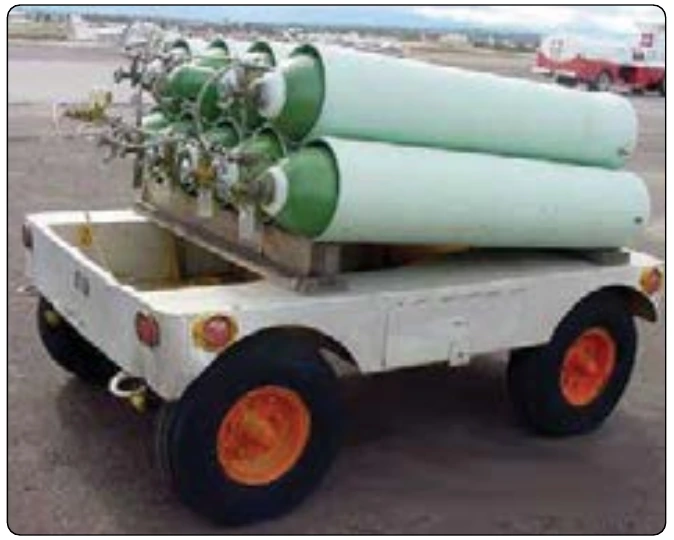
Airline and fixed-base operator maintenance shops often use oxygen filler carts to service oxygen systems. These contain several large oxygen supply cylinders connected to the fill cart manifold. This manifold supplies a fill hose that attaches to the aircraft. Valves and pressure gauges allow awareness and control of the oxygen dispensing process. [Figure 16-31] Be sure all cylinders on the cart are aviator’s breathing oxygen and that all cylinders contain at least 50 psi of oxygen pressure. Each cylinder should also be within its hydrostatic test date interval. After a cart cylinder has dispensed oxygen, the remaining pressure should be recorded. This is usually written on the outside of the cylinder with chalk or in a cylinder pressure log kept with the cart. As such, the technician can tell at a glance the status of each oxygen bottle.
No pump or mechanical device is used to transfer oxygen from the fill cart manifold to the aircraft system. Objects under pressure flow from high pressure to low pressure. Thus, by connecting the cart to the aircraft and systematically opening oxygen cylinders with increasingly higher pressure, a slow increase in oxygen flow to the aircraft can be managed.
The following is a list of steps to safely fill an aircraft oxygen system from a typical oxygen refill cart.
- Check hydrostatic dates on all cylinders, especially those that are to be filled on the aircraft. If a cylinder is out of date, remove and replace it with a specified unit that is serviceable.
- Check pressures on all cylinders on the cart and in the aircraft. If pressure is below 50 psi, replace the cylinder(s). On the aircraft, this may require purging the system with oxygen when completed. Best practices dictate that any low-pressure or empty cylinder(s) on the cart should also be removed and replaced when discovered.
- Take all oxygen handling precautions to ensure a safe environment around the aircraft.
- Ground the refill cart to the aircraft.
- Connect the cart hose from the cart manifold to the aircraft fill port. Purge the air from the refill hose with oxygen before opening the refill valve on the aircraft. Some hoses are equipped with purge valves to do this while the hose is securely attached to the aircraft. Other hoses need to be purged while attached to the refill fitting but not fully tightened.
- Observe the pressure on the aircraft bottle to be filled. Open it. On the refill cart, open the cylinder with the closest pressure to the aircraft cylinder that exceeds it.
- Open the aircraft oxygen system refill valve. Oxygen will flow from cart cylinder (manifold) into the aircraft cylinder.
- When the cylinder pressures equalize, close the cylinder on the cart, and open the cart cylinder with the next highest pressure. Allow it to flow into the
aircraft cylinder until the pressures equalize and flow ceases. Close the cart cylinder and proceed to the cart cylinder with the next highest pressure.
- Continue the procedure in step 8 until the desired pressure in the aircraft cylinder is achieved.
- Close the aircraft refill valve and close all cylinders on the cart.
- The aircraft oxygen cylinder valve(s) should be left in the proper position for normal operations. Remotely mounted cylinders are usually left open.
- Disconnect the refill line from the refill port on the aircraft. Cap or cover both.
- Remove the grounding strap.