
Chapter 2
Aerodynamics, Aircraft Assembly, & Rigging
Stabilizer Systems
Bell Stabilizer Bar System
Arthur M. Young discovered that stability could be increased significantly with the addition of a stabilizer bar perpendicular to the two blades. The stabilizer bar has weighted ends, which cause it to stay relatively stable in the plane of rotation. The stabilizer bar is linked with the swash plate in a manner that reduces the pitch rate. The two blades can flap as a unit and, therefore, do not require lag-lead hinges (the whole rotor slows down and accelerates per turn). Two-bladed systems require a single teetering hinge and two coning hinges to permit modest coning of the rotor disc as thrust is increased. The configuration is known under multiple names, including Hiller panels, Hiller system, Bell-Hiller system, and flybar system.
Offset Flapping Hinge
The offset flapping hinge is offset from the center of the rotor hub and can produce powerful moments useful for controlling the helicopter. The distance of the hinge from the hub (the offset) multiplied by the force produced at the hinge produces a moment at the hub. Obviously, the larger the offset, the greater the moment for the same force produced by the blade.
The flapping motion is the result of the constantly changing balance between lift, centrifugal, and inertial forces. This rising and falling of the blades is characteristic of most helicopters and has often been compared to the beating of a bird’s wing. The flapping hinge, together with the natural flexibility found in most blades, permits the blade to droop considerably when the helicopter is at rest and the rotor is not turning over. During flight, the necessary rigidity is provided by the powerful centrifugal force that results from the rotation of the blades. This force pulls outward from the tip, stiffening the blade, and is the only factor that keeps it from folding up.
Stability Augmentation Systems (SAS)
Some helicopters incorporate stability augmentation systems (SAS) to help stabilize the helicopter in flight and in a hover. The simplest of these systems is a force trim system, which uses a magnetic clutch and springs to hold the cyclic control in the position at which it was released. More advanced systems use electric actuators that make inputs to the hydraulic servos. These servos receive control commands from a computer that senses helicopter attitude. Other inputs, such as heading, speed, altitude, and navigation information may be supplied to the computer to form a complete autopilot system. The SAS may be overridden or disconnected by the pilot at any time. SAS reduces pilot workload by improving basic aircraft control harmony and decreasing disturbances. These systems are very useful when the pilot is required to perform other duties, such as sling loading and search and rescue operations.
Helicopter Vibration
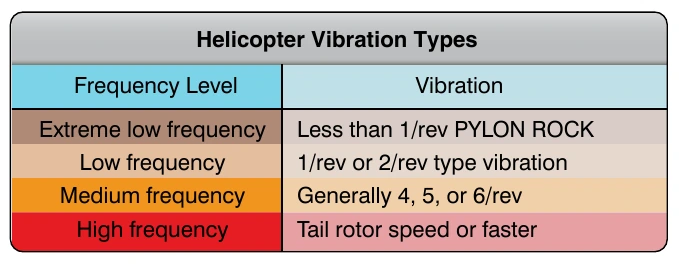
The following paragraphs describe the various types of vibrations. Figure 2-50 shows the general levels into which frequencies are divided.
Extreme Low Frequency Vibration
Extreme low frequency vibration is pretty well limited to pylon rock. Pylon rocking (two to three cycles per second) is inherent with the rotor, mast, and transmission system. To keep the vibration from reaching noticeable levels, transmission mount dampening is incorporated to absorb the rocking.
Low Frequency Vibration
Low frequency vibrations (1/rev and 2/rev) are caused by the rotor itself. 1/rev vibrations are of two basic types: vertical or lateral. A 1/rev is caused simply by one blade developing more lift at a given point than the other blade develops at the same point.
Medium Frequency Vibration
Medium frequency vibration (4/rev and 6/rev) is another vibration inherent in most rotors. An increase in the level of these vibrations is caused by a change in the capability of the fuselage to absorb vibration, or a loose airframe component, such as the skids, vibrating at that frequency.
High Frequency Vibration
High frequency vibrations can be caused by anything in the helicopter that rotates or vibrates at extremely high speeds. A high frequency vibration typically occurs when the tail rotor gears, tail drive shaft or the tail rotor engine, fan or shaft assembly vibrates or rotates at an equal or greater speed than the tail rotor.