
Chapter 4
Aircraft Metal Structural Repair
Hydropress forming is usually limited to relatively flat parts with flanges, beads, and lightening holes. However, some types of large radii contoured parts can be formed by a combination of hand forming and pressing operations.
Spin Forming
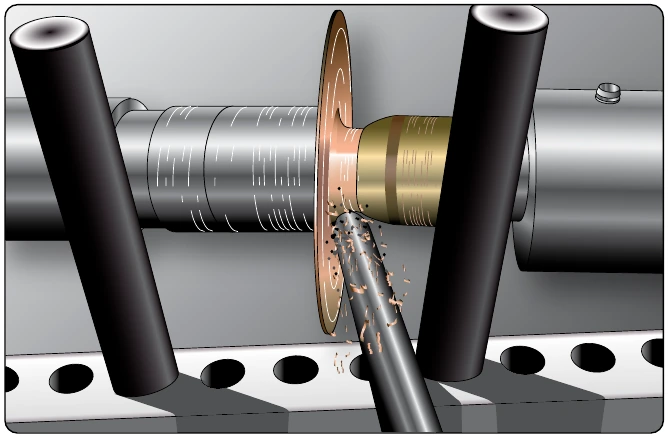
In spin forming, a flat circle of metal is rotated at a very high speed to shape a seamless, hollow part using the combined forces of rotation and pressure. For example, a flat circular blank such as an aluminum disc, is mounted in a lathe in conjunction with a form block (usually made of hardwood). As the aircraft technician revolves the disc and form block together at high speeds, the disc is molded to the form block by applying pressure with a spinning stick or tool. It provides an economical alternative to stamping, casting, and many other metal forming processes. Propeller spinners are sometimes fabricated with this technique.
Aluminum soap, tallow, or ordinary soap can be used as a lubricant. The best adapted materials for spinning are the softer aluminum alloys, but other alloys can be used if the shape to be spun is not excessively deep or if the spinning is done in stages utilizing intermediate annealing to remove the effect of strain hardening that results from the spinning operation. Hot forming is used in some instances when spinning thicker and harder alloys. [Figure 4-63]
Forming with an English Wheel
The English wheel, a popular type of metal forming tool used to create double curves in metal, has two steel wheels between which metal is formed. [Figure 4-64] Keep in mind that the English wheel is primarily a stretching machine, so it stretches and thins the metal before forming it into the desired shape. Thus, the operator must be careful not to over-stretch the metal.
To use the English wheel, place a piece of sheet metal between the wheels (one above and one below the metal). Then, roll the wheels against one another under a pre-adjusted pressure setting. Steel or aluminum can be shaped by pushing the metal back and forth between the wheels. Very little pressure is needed to shape the panel, which is stretched or raised to the desired shape. It is important to work slowly and gradually curve the metal into the desired shape. Monitor the curvature with frequent references to the template.
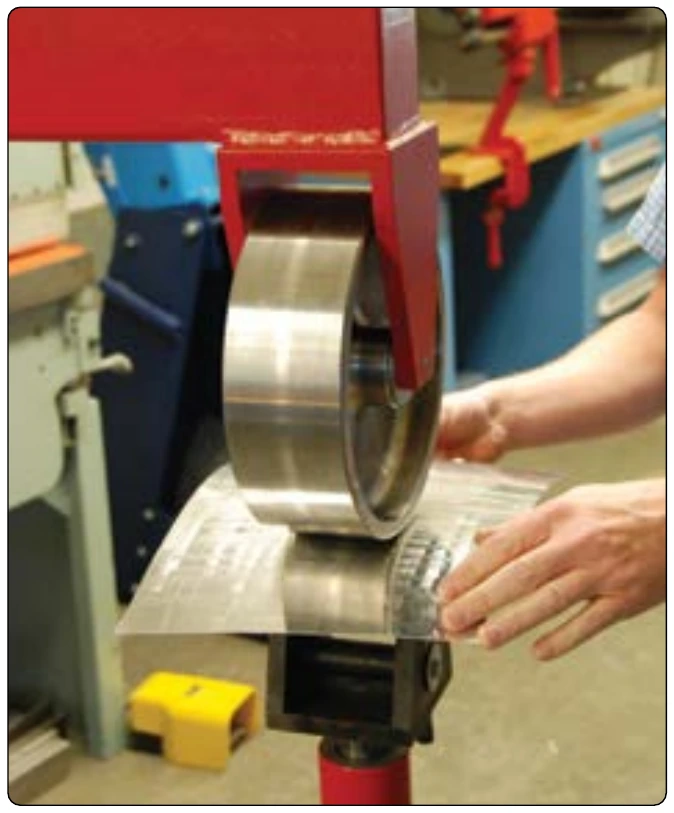
The English wheel is used for shaping low crowns on large panels and polishing or planishing (to smooth the surface of a metal by rolling or hammering it) parts that have been formed with power hammers or hammer and shot bag.
Piccolo Former
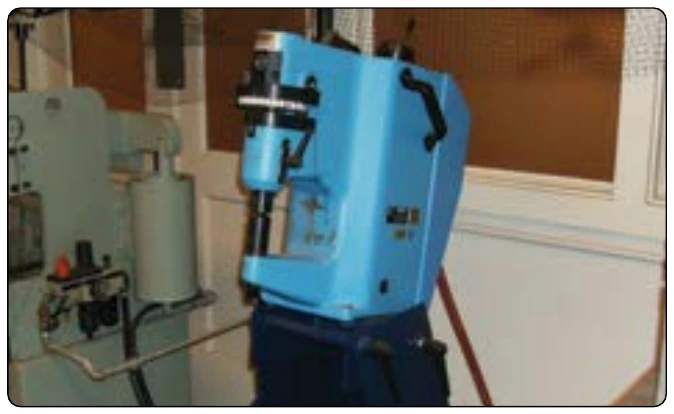
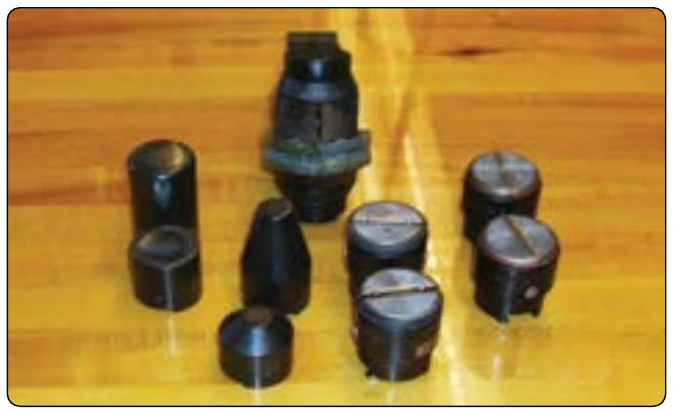
The Piccolo former is used for cold forming and rolling sheet metal and other profile sections (extrusions). [Figure 4-65] The position of the ram is adjustable in height by means of either a handwheel or a foot pedal that permits control of the working pressure. Be sure to utilize the adjusting ring situated in the machine head to control the maximum working pressure. The forming tools are located in the moving ram and the lower tool holder. Depending on the variety of forming tools included, the operator can perform such procedures as forming edges, bending profiles, removing wrinkles, spot shrinking to remove buckles and dents, or expanding dome sheet metal. Available in either fiberglass (to prevent marring the surface) or steel (for working harder materials) faces, the tools are the quick-change type.
Shrinking & Stretching Tools
Shrinking Tools
Shrinking dies repeatedly clamp down on the metal, then shift inward. [Figure 4-66] This compresses the material between the dies, which actually slightly increases the thickness of the metal. Strain hardening takes place during this process, so it is best to set the working pressure high enough to complete the shape rather quickly (eight passes could be considered excessive).
Caution: Avoid striking a die on the radius itself when forming a curved flange. This damages the metal in the radius and decreases the angle of bend.
Stretching Tools
Stretching dies repeatedly clamp down on the surface and then shift outward. This stretches the metal between the dies, which decreases the thickness in the stretched area. Striking the same point too many times weakens and eventually cracks the part. It is advantageous to deburr or even polish the edges of a flange that must undergo even moderate stretching to avoid crack formation. Forming flanges with existing holes causes the holes to distort and possibly crack or substantially weaken the flange.