
Chapter 4
Aircraft Metal Structural Repair
Manual Foot-Operated Sheet Metal Shrinker
The manual foot-operated sheet metal shrinker operates very similarly to the Piccolo former though it only has two primary functions: shrinking and stretching. The only dies available are steel faced and therefore tend to mar the surface of the metal. When used on aluminum, it is necessary to gently blend out the surface irregularities (primarily in the cladding), then treat and paint the part.
Since this is a manual machine, it relies on leg power, as the operator repeatedly steps on the foot pedal. The more force is applied, the more stresses are concentrated at that single point. It yields a better part with a series of smaller stretches (or shrinks) than with a few intense ones. Squeezing the dies over the radius damages the metal and flattens out some of the bend. It may be useful to tape a thick piece of plastic or micarta to the opposite leg to shim the radius of the angle away from the clamping area of the dies.
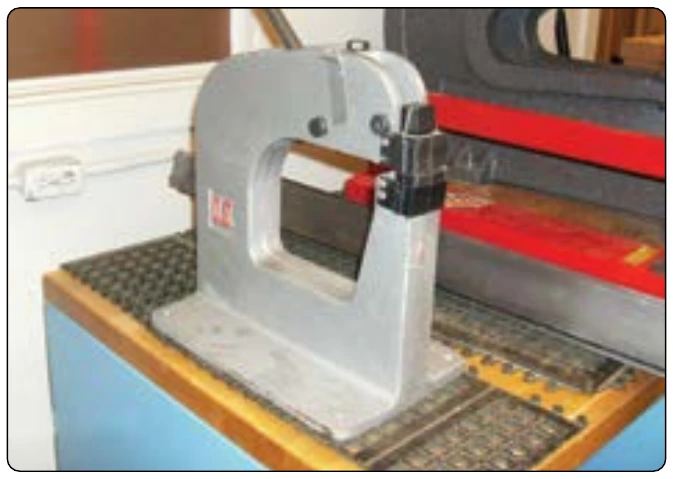
Hand-Operated Shrinker & Stretcher
The hand-operated shrinker and stretcher is similar to the manual foot-operated unit, except a handle is used to apply force to shrinking and stretching blocks. The dies are all metal and leave marks on aluminum that need to be blended out after the shrinking or stretching operation. [Figure 4-67]
Dollies & Stakes
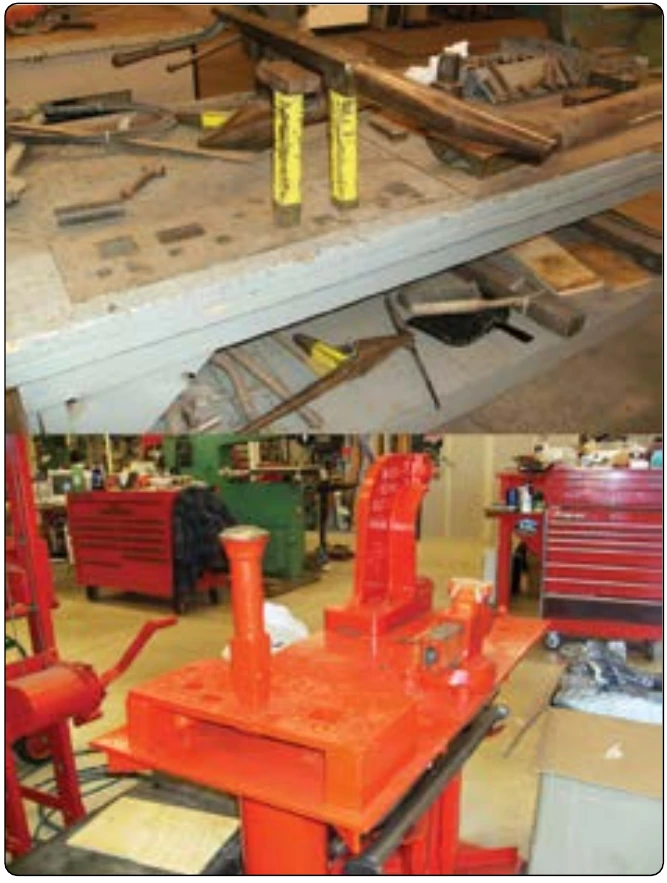
Sheet metal is often formed or finished (planished) over anvils, available in a variety of shapes and sizes, called dollies and stakes. These are used for forming small, odd-shaped parts, or for putting on finishing touches for which a large machine may not be suited. Dollies are meant to be held in the hand, whereas stakes are designed to be supported by a flat cast iron bench plate fastened to the workbench. [Figure 4-68]
Most stakes have machined, polished surfaces that have been hardened. Use of stakes to back up material when chiseling, or when using any similar cutting tool, defaces the surface of the stake and makes it useless for finish work.
Hardwood Form Blocks
Hardwood form blocks can be constructed to duplicate practically any aircraft structural or nonstructural part. The wooden block or form is shaped to the exact dimensions and contour of the part to be formed.
V-Blocks
V-blocks made of hardwood are widely used in airframe metalwork for shrinking and stretching metal, particularly angles and flanges. The size of the block depends on the work being done and on personal preference. Although any type of hardwood is suitable, maple and ash are recommended for best results when working with aluminum alloys.
Shrinking Blocks
A shrinking block consists of two metal blocks and some device for clamping them together. One block forms the base and the other is cut away to provide space where the crimped material can be hammered. The legs of the upper jaw clamp the material to the base block on each side of the crimp to prevent the material from creeping away, but remains stationary while the crimp is hammered flat (being shrunk). This type of crimping block is designed to be held in a bench vise.
Shrinking blocks can be made to fit any specific need. The basic form and principle remain the same, even though the blocks may vary considerably in size and shape.
Sandbags
A sandbag is generally used as a support during the bumping process. A serviceable bag can be made by sewing heavy canvas or soft leather to form a bag of the desired size, and filling it with sand which has been sifted through a fine mesh screen.