
Chapter 4
Aircraft Metal Structural Repair
Bucking faces must be hard enough to resist indentation and remain smooth, but not hard enough to shatter. Sometimes, the more complicated bars must be forged or built up by welding. The bar usually has a concave face to conform to the shape of the shop head to be made. When selecting a bucking bar, the first consideration is shape. [Figure 4-83] If the bar does not have the correct shape, it deforms the rivet head; if the bar is too light, it does not give the necessary bucking weight, and the material may become bulged toward the shop head. If the bar is too heavy, its weight and the bucking force may cause the material to bulge away from the shop head.
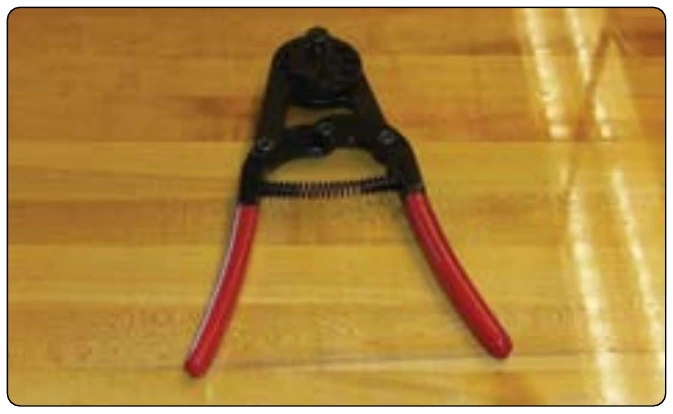
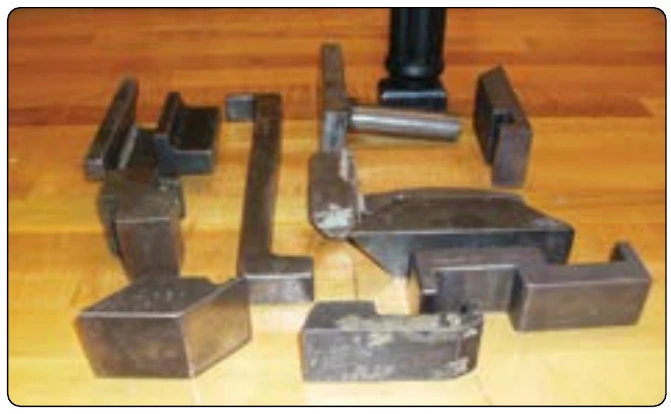
This tool is used by holding it against the shank end of a rivet while the shop head is being formed. Always hold the face of the bucking bar at right angles to the rivet shank. Failure to do so causes the rivet shank to bend with the first blows of the rivet gun and causes the material to become marred with the final blows. The bucker must hold the bucking bar in place until the rivet is completely driven. If the bucking bar is removed while the gun is in operation, the rivet set may be driven through the material. Allow the weight of the bucking bar to do most of the work and do not bear down too heavily on the shank of the rivet. The operator’s hands merely guide the bar and supply the necessary tension and rebound action. Coordinated bucking allows the bucking bar to vibrate in unison with the gun set. With experience, a high degree of skill can be developed.
Defective rivet heads can be caused by lack of proper vibrating action, the use of a bucking bar that is too light or too heavy, and failure to hold the bucking bar at right angles to the rivet. The bars must be kept clean, smooth, and well polished. Their edges should be slightly rounded to prevent marring the material surrounding the riveting operation.
Hand Rivet Set
A hand rivet set is a tool equipped with a die for driving a particular type rivet. Rivet sets are available to fit every size and shape of rivet head. The ordinary set is made of 1⁄2-inch carbon tool steel about 6 inches in length and is knurled to prevent slipping in the hand. Only the face of the set is hardened and polished.
Sets for universal rivets are recessed (or cupped) to fit the rivet head. In selecting the correct set, be sure it provides the proper clearance between the set and the sides of the rivet head and between the surfaces of the metal and the set. Flush or flat sets are used for countersunk and flathead rivets. To seat flush rivets properly, be sure that the flush sets are at least 1 inch in diameter.
Special draw sets are used to draw up the sheets to eliminate any opening between them before the rivet is bucked. Each draw set has a hole 1⁄32-inch larger than the diameter of the rivet shank for which it is made. Occasionally, the draw set and rivet header are incorporated into one tool. The header part consists of a hole shallow enough for the set to expand the rivet and head when struck with a hammer.
Countersinking Tool
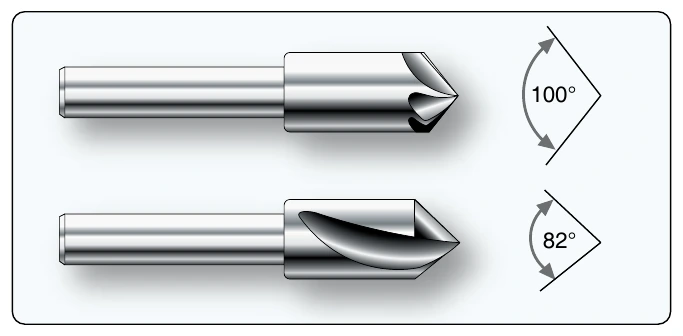
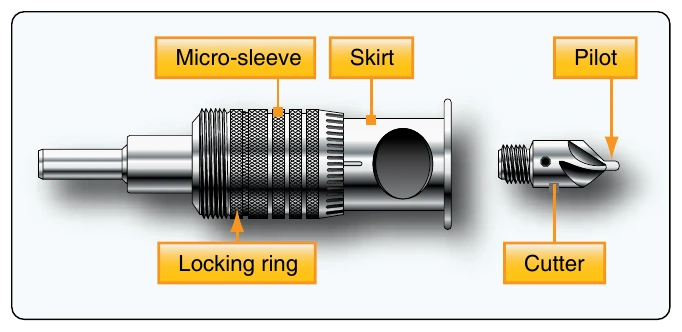
The countersink is a tool that cuts a cone-shaped depression around the rivet hole to allow the rivet to set flush with the surface of the skin. Countersinks are made with angles to correspond with the various angles of countersunk rivet heads. The standard countersink has a 100º angle, as shown in Figure 4-84. Special microstop countersinks (commonly called stop countersinks) are available that can be adjusted to any desired depth and have cutters to allow interchangeable holes with various countersunk angles to be made. [Figure 4-85] Some stop countersinks also have a micrometer set mechanism, in 0.001-inch increments, for adjusting their cutting depths.
Dimpling Dies
Dimpling is done with a male and female die (punch and die set). The male die has a guide the size of the rivet hole and with the same degree of countersink as the rivet. The female die has a hole with a corresponding degree of countersink into which the male guide fits.
Power Tools
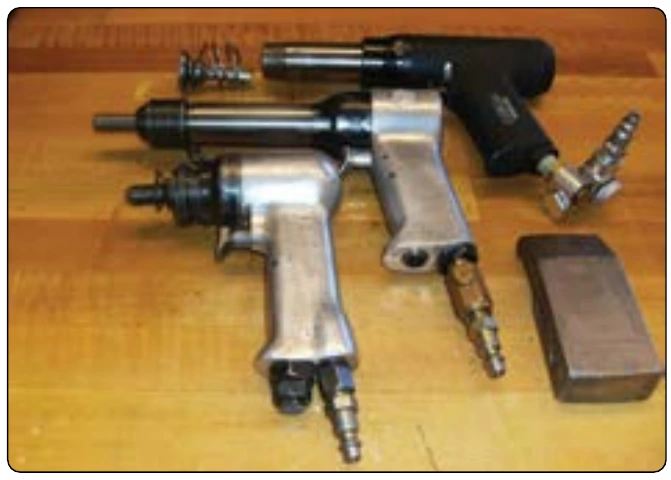
The most common power tools used in riveting are the pneumatic rivet gun, rivet squeezers, and the microshaver.
Pneumatic Rivet Gun
The pneumatic rivet gun is the most common rivet in many sizes and types. [Figure 4-86] The manufacturer’s recommended capacity for each gun is usually stamped on the barrel. Pneumatic guns operate on air pressure of 90 to 100 pounds per square inch and are used in conjunction with interchangeable rivet sets. Each set is designed to fit the specific type of rivet and the location of the work. The shank of the set is designed to fit into the rivet gun. An air-driven hammer inside the barrel of the gun supplies force to buck the rivet.