Chapter 4
Aircraft Metal Structural Repair
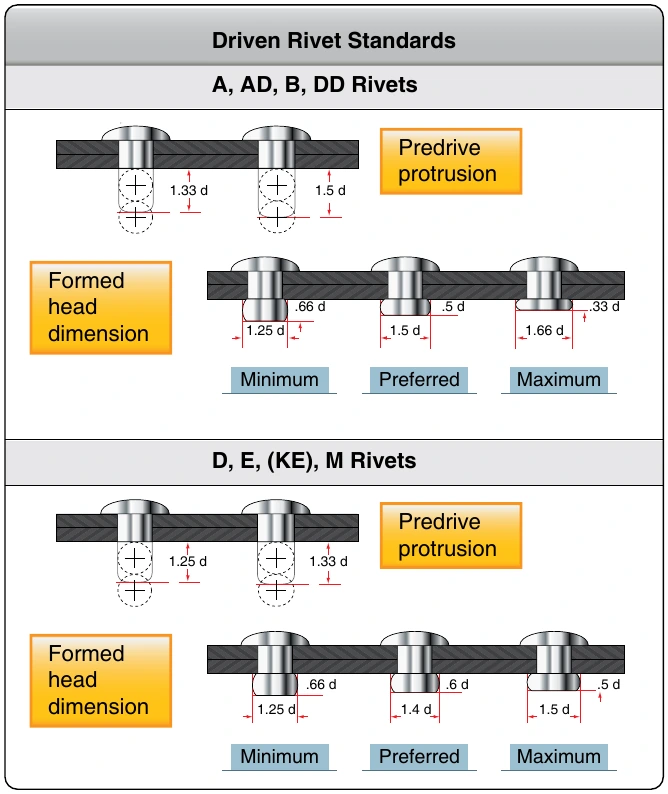
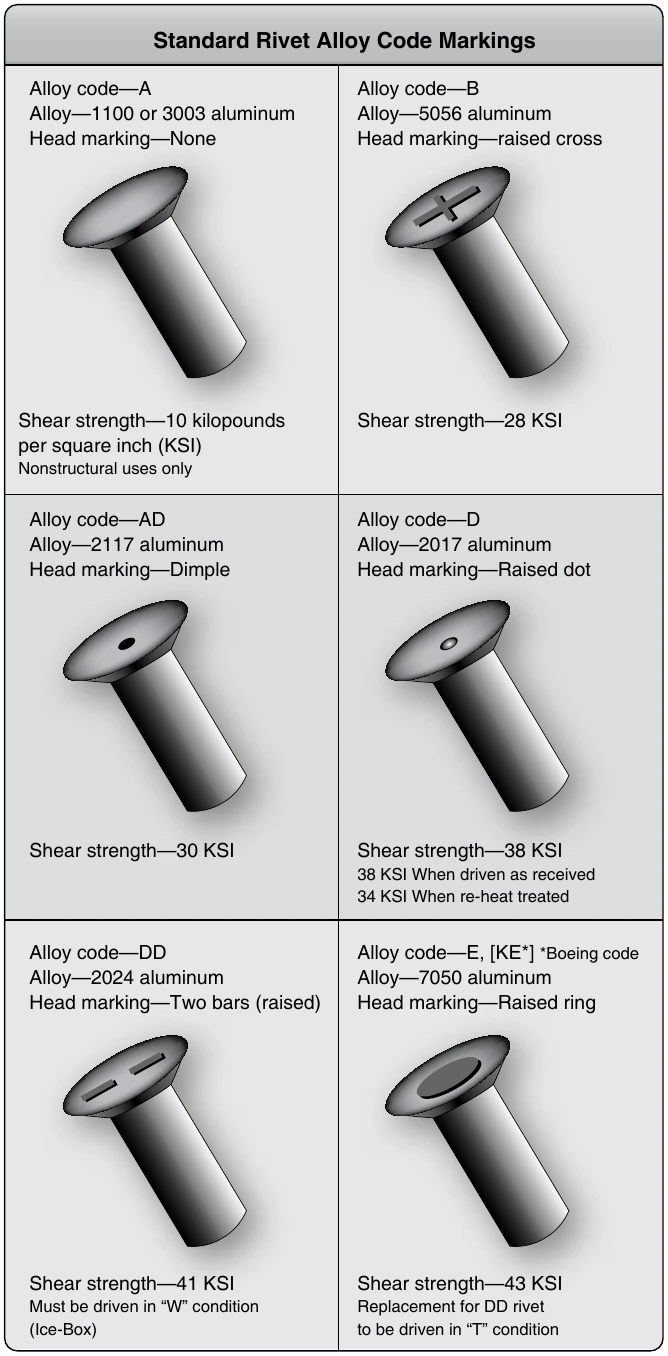
For structural applications, the strength of the replacement rivets is of primary importance. [Figure 4-77] Replace rivets with those of the same size and strength whenever possible. If the rivet hole becomes enlarged, deformed, or otherwise damaged; drill or ream the hole for the next larger size rivet. However, make sure that the edge distance and spacing is not less than minimums listed in the next paragraph. Rivets may not be replaced by a type having lower strength properties, unless the lower strength is adequately compensated by an increase in size or a greater number of rivets. For example, it
rivets for general repairs, provided the replacement rivets
The 2117-T rivet is used for general repair work, since it requires no heat treatment, is fairly soft and strong, and is highly corrosion resistant when used with most types of alloys. Always consult the maintenance manual for correct rivet type and material. The type of rivet head to select for a particular repair job can be determined by referring to the type used within the surrounding area by the manufacturer. A general rule to follow on a flush-riveted aircraft is to apply flush rivets on the upper surface of the wing and stabilizers, on the lower leading edge back to the spar, and on the fuselage back to the high point of the wing. Use universal head rivets in all other surface areas. Whenever possible, select rivets of the same alloy number as the material being riveted.
Stresses Applied to Rivets
Shear is one of the two stresses applied to rivets. The shear strength is the amount of force required to cut a rivet that holds two or more sheets of material together. If the rivet holds two parts, it is under single shear; if it holds three sheets or parts, it is under double shear. To determine the shear strength, the diameter of the rivet to be used must be found by multiplying the thickness of the skin material by 3. For example, a material thickness of 0.040 inch multiplied by 3 equals 0.120 inch. In this case, the rivet diameter selected would be 1⁄8 (0.125) inch.
Tension is the other stress applied to rivets. The resistance to tension is called bearing strength and is the amount of tension required to pull a rivet through the edge of two sheets riveted together or to elongate the hole.
Rivet Spacing
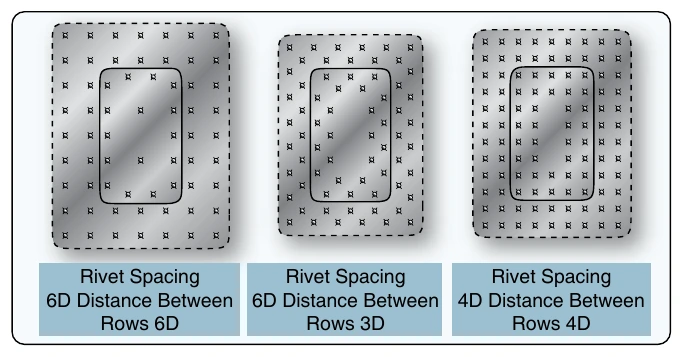
Rivet spacing is measured between the centerlines of rivets in the same row. The minimum spacing between protruding head rivets shall not be less than 31⁄2 times the rivet diameter. The minimum spacing between flush head rivets shall not be less than 4 times the diameter of the rivet. These dimensions may be used as the minimum spacing except when specified differently in a specific repair procedure or when replacing existing rivets.
On most repairs, the general practice is to use the same rivet spacing and edge distance (distance from the center of the hole to the edge of the material) that the manufacturer used in the area surrounding the damage. The SRM for the particular aircraft may also be consulted. Aside from this fundamental rule, there is no specific set of rules that governs spacing of rivets in all cases. However, there are certain minimum requirements that must be observed.
- When possible, rivet edge distance, rivet spacing, and distance between rows should be the same as that of the original installation.
- When new sections are to be added, the edge distance measured from the center of the rivet should never be less than 2 times the diameter of the shank; the distance between rivets or pitch should be at least 3 times the diameter; and the distance between rivet rows should never be less than 21⁄2 times the diameter.
Figure 4-78 illustrates acceptable ways of laying out a rivet pattern for a repair.
Edge Distance
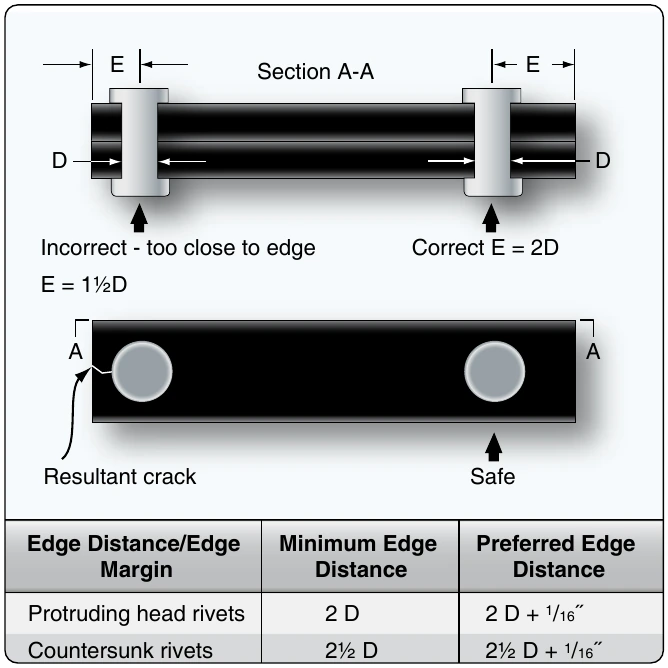
Edge distance, also called edge margin by some manufacturers, is the distance from the center of the first rivet to the edge of the sheet. It should not be less than 2 or more than 4 rivet diameters and the recommended edge distance is about 21⁄2 rivet diameters. The minimum edge distance for universal rivets is 2 times the diameter of the rivet; the minimum edge distance for countersunk rivets is 21⁄2 times the diameter of the rivet. If rivets are placed too close to the edge of the sheet, the sheet may crack or pull away from the rivets. If they are spaced too far from the edge, the sheet is likely to turn up at the edges. [Figure 4-79]
It is good practice to lay out the rivets a little further from the edge so that the rivet holes can be oversized without violating the edge distance minimums. Add 1⁄16-inch to the minimum edge distance or determine the edge distance using the next size of rivet diameter.