
Chapter 4
Aircraft Metal Structural Repair
Riveting Procedure
The riveting procedure consists of transferring and preparing the hole, drilling, and driving the rivets.
Hole Transfer
Accomplish transfer of holes from a drilled part to another part by placing the second part over first and using established holes as a guide. Using an alternate method, scribe hole location through from drilled part onto part to be drilled, spot with a center punch, and drill.
Hole Preparation
It is very important that the rivet hole be of the correct size and shape and free from burrs. If the hole is too small, the protective coating is scratched from the rivet when the rivet is driven through the hole. If the hole is too large, the rivet does not fill the hole completely. When it is bucked, the joint does not develop its full strength, and structural failure may occur at that spot.
If countersinking is required, consider the thickness of the metal and adopt the countersinking method recommended for that thickness. If dimpling is required, keep hammer blows or dimpling pressures to a minimum so that no undue work hardening occurs in the surrounding area.
Drilling
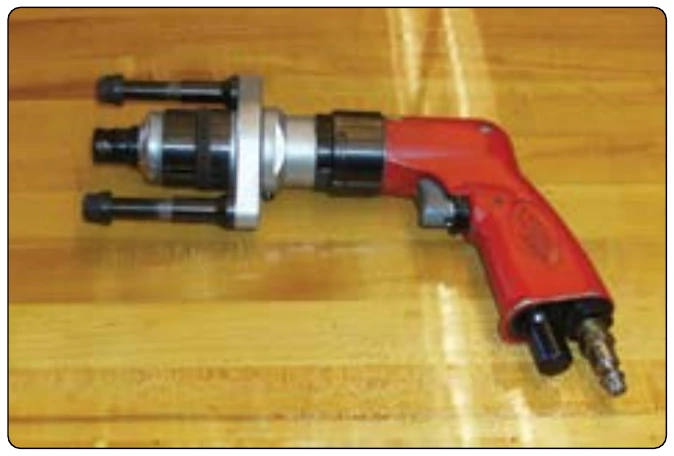
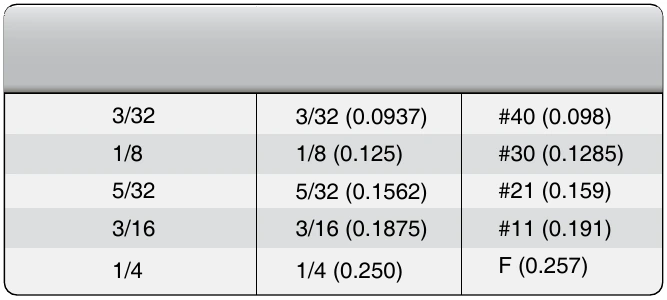
Rivet holes in repair may be drilled with either a light power drill or a hand drill. The standard shank twist drill is most commonly used. Drill bit sizes for rivet holes should be the smallest size that permits easy insertion of the rivet, approximately 0.003-inch greater than the largest tolerance of the shank diameter. The recommended clearance drill bits for the common rivet diameters are shown in Figure 4-90. Hole sizes for other fasteners are normally found on work documents, prints, or in manuals.
Before drilling, center punch all rivet locations. The center punch mark should be large enough to prevent the drill from slipping out of position, yet it must not dent the surface surrounding the center punch mark. Place a bucking bar behind the metal during punching to help prevent denting. To make a rivet hole the correct size, first drill a slightly undersized hole (pilot hole). Ream the pilot hole with a twist drill of the appropriate size to obtain the required dimension.
To drill, proceed as follows:
- Ensure the drill bit is the correct size and shape.
- Place the drill in the center-punched mark. When using a power drill, rotate the bit a few turns before starting the motor.
- While drilling, always hold the drill at a 90º angle to the work or the curvature of the material.
- Avoid excessive pressure, let the drill bit do the cutting, and never push the drill bit through stock.
- Remove all burrs with a metal countersink or a file.
- Clean away all drill chips.
When holes are drilled through sheet metal, small burrs are formed around the edge of the hole. This is especially true when using a hand drill because the drill speed is slow and there is a tendency to apply more pressure per drill revolution. Remove all burrs with a burr remover or larger size drill bit before riveting.
Driving the Rivet
Although riveting equipment can be either stationary or portable, portable riveting equipment is the most common type of riveting equipment used to drive solid shank rivets in airframe repair work.
Before driving any rivets into the sheet metal parts, be sure all holes line up perfectly, all shavings and burrs have been removed, and the parts to be riveted are securely fastened with temporary fasteners. Depending on the job, the riveting process may require one or two people. In solo riveting, the riveter holds a bucking bar with one hand and operates a riveting gun with the other.
If the job requires two aircraft technicians, a shooter, or gunner, and a bucker work together as a team to install rivets. An important component of team riveting is an efficient signaling system that communicates the status of the riveting process. This signaling system usually consists of tapping the bucking bar against the work and is often called the tap code. One tap may mean not fully seated, hit it again, while two taps may mean good rivet, and three taps may mean bad rivet, remove and drive another. Radio sets are also available for communication between the technicians.