
Chapter 4
Aircraft Metal Structural Repair
Right Angle & 45° Drill Motors
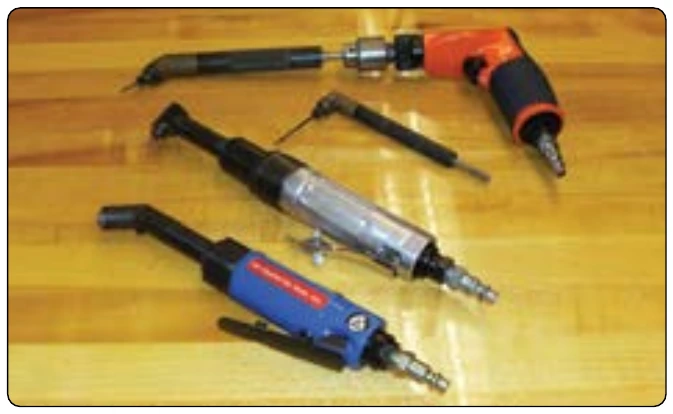
Right angle and 45° drill motors are used for positions that are not accessible with a pistol grip drill motor. Most right angle drill motors use threaded drill bits that are available in several lengths. Heavy-duty right angle drills are equipped with a chuck similar to the pistol grip drill motor. [Figure 4-40]
Two Hole
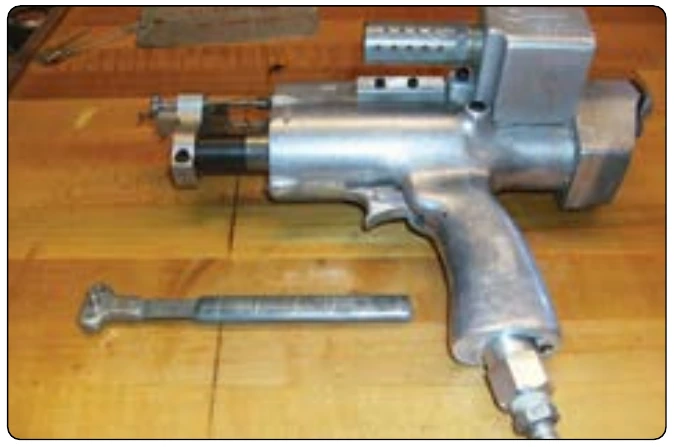
Special drill motors that drill two holes at the same time are used for the installation of nutplates. By drilling two holes at the same time, the distance between the holes is fixed and the holes line up perfectly with the holes in the nutplate. [Figure 4-41]
Drill Press
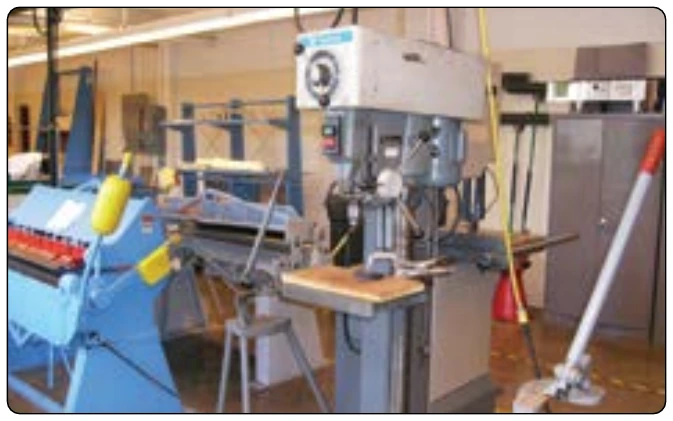
The drill press is a precision machine used for drilling holes that require a high degree of accuracy. It serves as an accurate means of locating and maintaining the direction of a hole that is to be drilled and provides the operator with a feed lever that makes the task of feeding the drill into the work easier. The upright drill press is the most common of the variety of drill presses available. [Figure 4-42]
When using a drill press, the height of the drill press table is adjusted to accommodate the height of the part to be drilled. When the height of the part is greater than the distance between the drill and the table, the table is lowered. When the height of the part is less than the distance between the drill and the table, the table is raised.
After the table is properly adjusted, the part is placed on the table and the drill is brought down to aid in positioning the metal so that the hole to be drilled is directly beneath the point of the drill. The part is then clamped to the drill press table to prevent it from slipping during the drilling operation. Parts not properly clamped may bind on the drill and start spinning, causing serious cuts on the operator’s arms or body, or loss of fingers or hands. Always make sure the part to be drilled is properly clamped to the drill press table before starting the drilling operation.
The degree of accuracy that it is possible to attain when using the drill press depends to a certain extent on the condition of the spindle hole, sleeves, and drill shank. Therefore, special care must be exercised to keep these parts clean and free from nicks, dents, and warpage. Always be sure that the sleeve is securely pressed into the spindle hole. Never insert a broken drill in a sleeve or spindle hole. Be careful never to use the sleeve-clamping vise to remove a drill since this may cause the sleeve to warp.
The drill speed on a drill press is adjustable. Always select the optimum drill speed for the material to be drilled. Technically, the speed of a drill bit means its speed at the circumference, in surface feet per minute (sfm). The recommended speed for drilling aluminum alloy is from 200 to 300 sfm, and for mild steel is 30 to 50 sfm. In practice, this must be converted into rpm for each size drill. Machinist and mechanic handbooks include drill rpm charts or drill rpm may be computed by use of the formula:
Drill Extensions & Adapters
When access to a place where drilling is difficult or impossible with a straight drill motor, various types of drill extensions and adapters are used.
Extension Drill Bits
Extension drill bits are widely used for drilling holes in locations that require reaching through small openings or past projections. These drill bits, which come in 6- to 12-inch lengths, are high speed with spring-tempered shanks. Extension drill bits are ground to a special notched point, which reduces end thrust to a minimum. When using extension drill bits always:
- Select the shortest drill bit that will do the job. It is easier to control.
- Check the drill bit for straightness. A bent drill bit makes an oversized hole and may whip, making it difficult to control.
- Keep the drill bit under control. Extension drills smaller than 1⁄4-inch must be supported by a drill guard made from a piece of tubing or spring to prevent whipping.