Chapter 5
Aircraft Welding
Argon
Argon is a colorless, odorless, tasteless, and non-toxic inert gas. Inert gas cannot combine with other elements. It has a very low chemical reactivity and low thermal conductivity. It is used as a gas shield for the electrode in MIG, TIG, and plasma welding equipment.
Helium
Helium is a colorless, odorless, tasteless, and non-toxic inert gas. Its boiling and melting points are the lowest of the elements and it normally exists only in gas form. It is used as a protective gas shield for many industrial uses including electric arc welding.
Hydrogen
Hydrogen is a colorless, odorless, tasteless, and highly flammable gas. It can be used at a higher pressure than acetylene and is used for underwater welding and cutting. It also can be used for aluminum welding using the oxy-hydrogen process.
Oxygen
Oxygen is a colorless, odorless, and nonflammable gas. It is used in the welding process to increase the combustion rate which increases the flame temperature of flammable gas.
Pressure Regulators
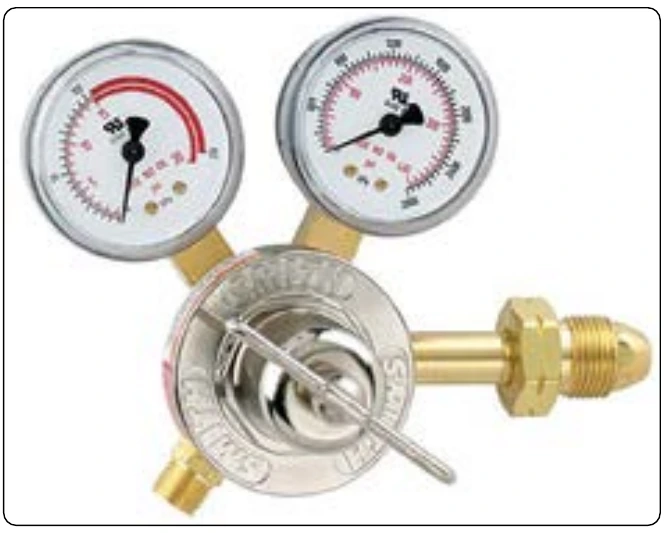
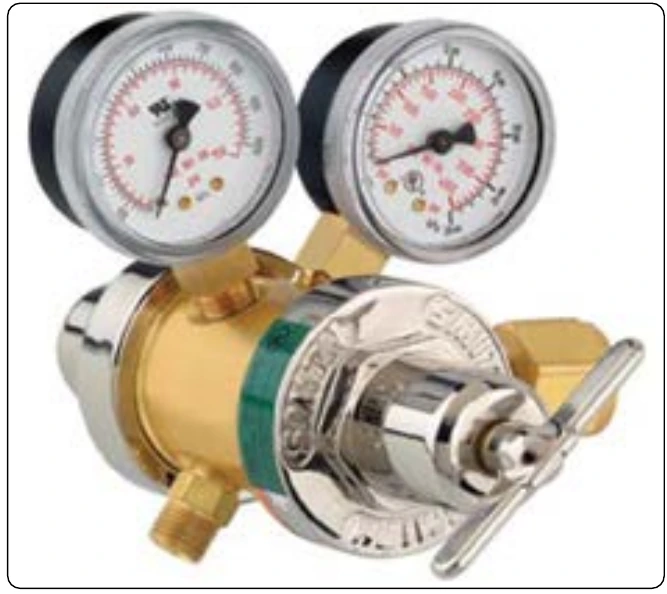
A pressure regulator is attached to a gas cylinder and is used to lower the cylinder pressure to the desired working pressure. Regulators have two gauges, one indicating the pressure in the cylinder and the second showing the working pressure. By turning the adjustment knob in or out, a spring operating a flexible diaphragm opens or closes a valve in the regulator. Turning the knob in causes the flow and pressure to increase; backing it out decreases the flow and pressure.
There are two types of regulators: single stage and two stage. They perform the same function but the two-stage regulator maintains a more constant outlet pressure and flow as the cylinder volume and pressure drops. Two-stage regulators can be identified by a larger, second pressure chamber under the regulator knob. [Figures 5-13 and 5-14]
Welding Hose
A welding hose connects the regulators to the torch. It is typically a double hose joined together during manufacture. The acetylene hose is red and has left hand threads indicated by a groove cut into the connection nut. The oxygen hose is green and has right hand threads indicated by the absence of a groove on the connection nut.
Welding hoses are produced in different sizes from ¼-inch to ½-inch inside diameter (ID). The hose should be marked for light, standard, and heavy duty service plus a grade indicating whether it has an oil- and/or flame-resistant cover. The hose should have the date of manufacture, maximum working pressure of 200 psi, and indicate that it meets specification IP-90 of the Rubber Manufacturers Association and the Compressed Gas Association for rubber welding hoses. Grade-R hose should only be used with acetylene gas. A T-grade hose must be used with propane, MAPP®, and all other fuel gases.
Check Valves & Flashback Arrestors
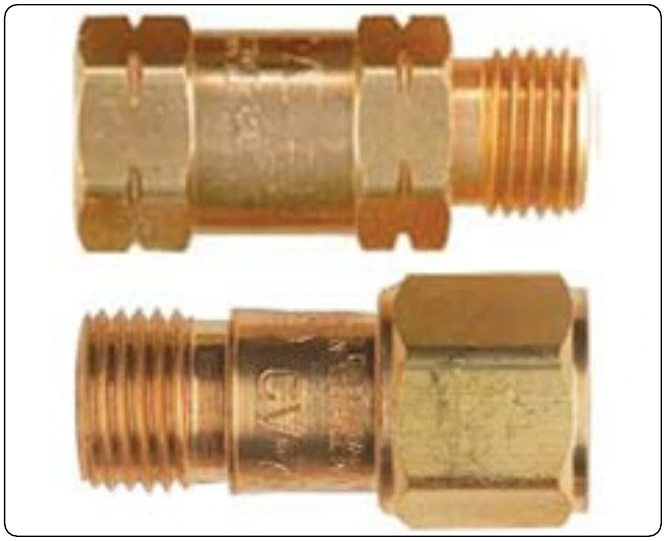
The check valve stops the reverse flow of the gas and can be installed either between the regulator and the hose or the hose and the torch. [Figure 5-15] Excessive overheating of cutting, welding, and heating tips can cause flashback conditions. A flashback can be caused when a tip is overheated and the gas ignites before passing out of the tip. The flame is then burning internally rather than on the outside of the tip and is usually identified by a shrill hissing or squealing noise.
A flashback arrestor installed on each hose prevents a high pressure flame or oxygen-fuel mixture from being pushed back into either cylinder causing an explosion. The flashback arrestors incorporate a check valve that stops the reverse flow of gas and the advancement of a flashback fire. [Figure 5-16]