
Chapter 5
Aircraft Welding
Torches
Equal Pressure Torch
The equal pressure torch is the most commonly used torch for oxy-acetylene welding. It has a mixing chamber and uses acetylene fuel at 1–15 psi. The flame is easy to adjust and there is less chance of flashback with this torch. There are several small lightweight torches of this type that are ideal for aviation welding projects. The Smith Airline™ and the Meco Midget™ torches are small enough to be used in close confined areas, lightweight enough to reduce fatigue during long welding sessions yet, with the appropriate tips, are capable of welding 0.250-inch steel.
Injector Torch
The injector torch uses fuel gas at pressures between just above 0 and 2 psi. This torch is typically used with propane and propylene gas. High-pressure oxygen comes through a small nozzle inside the torch head and pulls the fuel gas along with it via a venturi effect. The low-pressure injector torch is more prone to flashback.
Cutting Torch
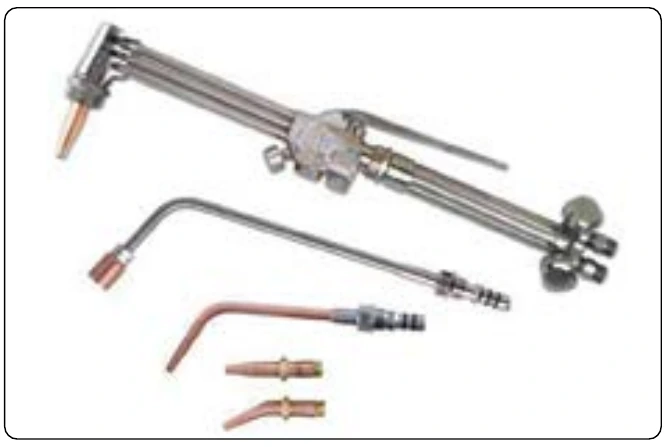
The cutting torch is an attachment added to the torch handle that allows the cutting of metal. The cutting process is fundamentally the rapid burning or oxidizing of the metal in a localized area. The metal is heated to a bright red color (1,400 °F to 1,600 °F), which is the kindling temperature, using only the preheat jets. Then, a jet of high-pressure oxygen released by the lever on the cutting attachment is directed against the heated metal. This oxygen blast combines with the hot metal and forms an intensely hot oxide. The molten oxide is blown down the sides of the cut, heating the metal in its path to the kindling temperature as the torch is moved along the line of the desired cut. The heated metal also burns to an oxide that is blown away on the underside of the piece. [Figure 5-17]
Torch Tips
The torch tip delivers and controls the final flow of gases. It is important that you use the correct tip with the proper gas pressures for the work to be welded satisfactorily. The size of the tip opening—not the temperature—determines the amount of heat applied to the work. If an excessively small tip is used, the heat provided is insufficient to produce penetration to the proper depth. If the tip is too large, the heat is too great, and holes are burned in the metal.
Torch tip sizes are designated by numbers. The manufacturer can provide a chart with recommended sizes for welding specific thicknesses of metal. With use, a torch tip becomes clogged with carbon deposits. If it is allowed to contact the molten pool, particles of slag may clog the tip. This may cause a backfire, which is a momentary backward flow of the gases at the torch tip. A backfire is rarely dangerous, but molten metal may be splattered when the flame pops. Tips should be cleaned with the proper size tip cleaner to avoid enlarging the tip opening.
Welding Eyewear
Protective eyewear for use with oxy-fuel welding outfits is available in several styles and must be worn to protect the welder’s eyes from the bright flame and flying sparks. This eyewear is not for use with arc welding equipment.
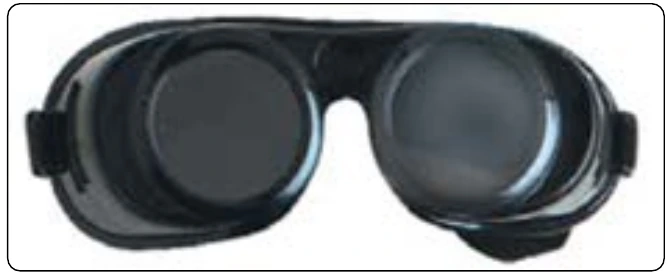
Some of the styles available have individual lenses and include goggles that employ a head piece and/or an elastic head strap to keep them snug around the eyes for protection from the occasional showering spark. [Figure 5-18] Another popular style is the rectangular eye shield that takes a standard 2-inch by 4.25-inch lens. This style is available with an elastic strap but is far more comfortable and better fitting when attached to a proper fitting adjustable headgear. It can be worn over prescription glasses, provides protection from flying sparks, and accepts a variety of standard shade and color lenses. A clear safety glass lens is added in front of the shaded lens to protect it from damage. [Figure 5-19]
It was standard practice in the past to select a lens shade for gas welding based on the brightness of flame emitting from the torch. The darkest shade of lens showing a clear definition of the work was normally the most desirable. However, when flux was used for brazing and welding, the torch heat caused the sodium in the flux to give off a brilliant yellow-orange flare, hiding a clear view of the weld area and causing many eye problems.
Various types of lens and colors were tried for periods of time without much success. It was not until the late 1980s that TM Technologies developed and patented a new green glass designed especially for aluminum oxy-fuel welding. It not only eliminated the sodium orange flare completely, but also provided the necessary protection from ultraviolet, infrared, and blue light, and impact to meet the requirements of the American National Standards Institute (ANSI) Z87-1989 Safety Standards for a special purpose lens. This lens can be used for welding and brazing all metals using an oxy-fuel torch.
Torch Lighters
Torch lighters are called friction lighters or flint strikers. The lighter consists of a file-shaped piece of steel, usually recessed in a cuplike device, and a replaceable flint, which when drawn across the steel produces a shower of sparks to light the fuel gas. An open flame or match should never be used to light a torch, because accumulated gas may envelop the hand and when ignited cause a severe burn. [Figure 5-20]