
Chapter 7
Advanced Composite Materials
Alternate Pressure Application
Shrink Tape
Another method of pressure application for oven cures is the use of shrink wrapping or shrink tape. This method is commonly used with parts that have been filament wound, because some of the same rules for application apply. The tape is wrapped around the completed layup, usually with only a layer of release material between the tape and the layup. Heat is applied to the tape, usually using a heat gun to make the tape shrink, a process that can apply a tremendous amount of pressure to the layup. After shrinking, the part is placed in the oven for cure. High quality parts can be made inexpensively using shrink tape.
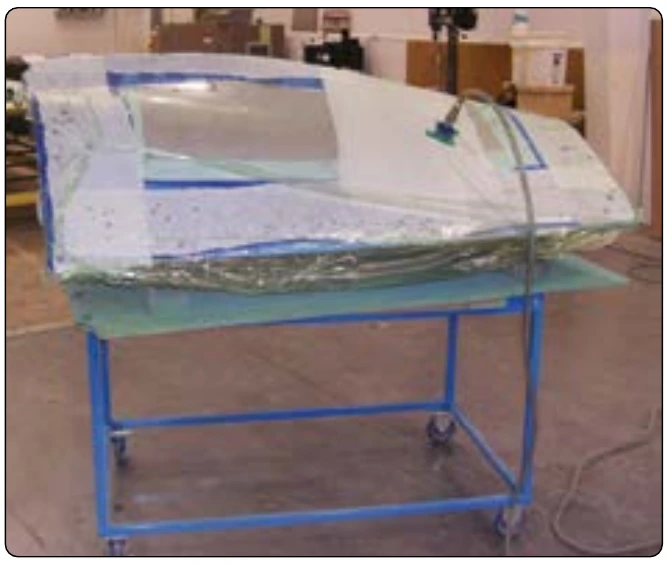
C-Clamps
Parts can also be pressed together with clamps. This technique is used for solid laminate edges of honeycomb panels. Clamps (e.g., C-clamps and spring clamps) are used for pressing together the edges of components and/or repair details. Always use clamps with pressure distribution pads because damage to the part may occur if the clamping force is too high. Spring clamps can be used in applications where resin squeeze-out during cure would require C-clamps to be retightened periodically.
Shotbags & Weights
Shotbags and weights can be used also to provide pressure, but their use is limited due to the low level of pressure imposed.
Curing of Composite Materials
A cure cycle is the time/temperature/pressure cycle used to cure a thermosetting resin system or prepreg. The curing of a repair is as important as the curing of the original part material. Unlike metal repairs in which the materials are premanufactured, composite repairs require the technician to manufacture the material. This includes all storage, processing, and quality control functions. An aircraft repair’s cure cycle starts with material storage. Materials that are stored incorrectly can begin to cure before they are used for a repair. All time and temperature requirements must be met and documented. Consult the aircraft structural repair manual to determine the correct cure cycle for the part that needs to be repaired.
Room Temperature Curing
Room temperature curing is the most advantageous in terms of energy savings and portability. Room temperature cure wet layup repairs do not restore either the strength or the durability of the original 250 °F or 350 °F cure components and are often used for wet layup fiberglass repairs for noncritical components. Room temperature cure repairs can be accelerated by the application of heat. Maximum properties are achieved at 150 °F. A vacuum bag can be used to consolidate the plies and to provide a path for air and volatiles to escape.
Elevated Temperature Curing
All prepreg materials are cured with an elevated temperature cure cycle. Some wet layup repairs use an elevated cure cycle as well to increase repair strength and to speed up the curing process. The curing oven and heat bonder uses a vacuum bag to consolidate the plies and to provide a path for air and volatiles to escape. The autoclave uses vacuum and positive pressure to consolidate the plies and to provide a path for air and volatiles to escape. Most heating devices use a programmable computer control to run the cure cycles. The operator can select from a menu of available cure cycles or write their own program. Thermocouples are placed near the repair, and they provide temperature feedback for the heating device. Typical curing temperature for composite materials is 250 °F or 350 °F. The temperature of large parts that are cured in an oven or autoclave might be different from that of an oven or autoclave during the cure cycle, because they act like a heat sink. The part temperature is most important for a correct cure, so thermocouples are placed on the part to monitor and control part temperature. The oven or autoclave air temperature probe that measures oven or autoclave temperature is not always a reliable device to determine part curing temperature. The oven temperature and the part temperature can be substantially different if the part or tool acts as a heat sink.
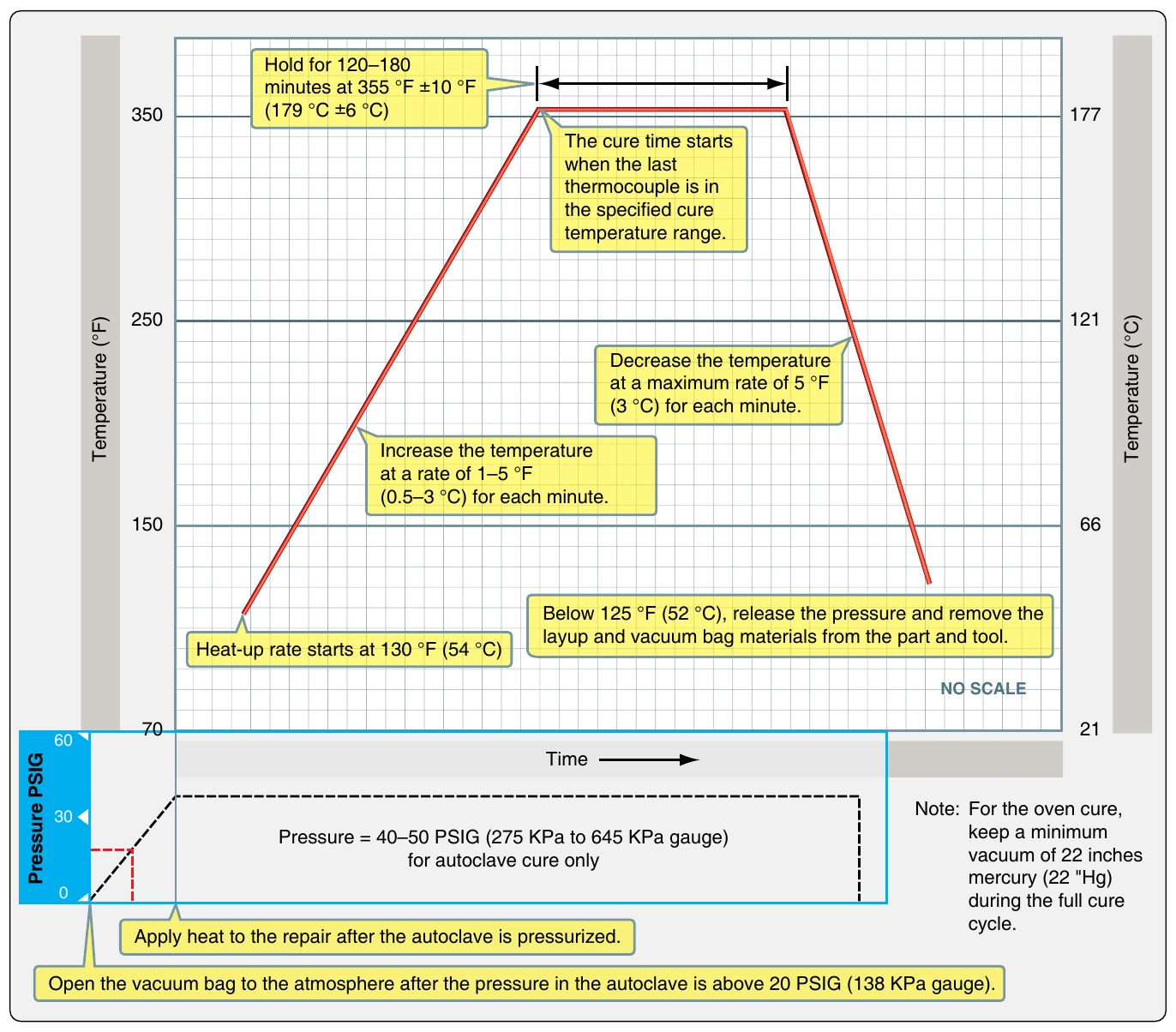
The elevated cure cycle consists of at least three segments:
- Ramp up: The heating device ramps up at a set temperature typically between 3 °F to 5 °F per minute.
- Hold or soak: The heating device maintains the temperature for a predetermined period.
- Cool down: The heating device cools down at a set temperature. Cool down temperatures are typically below 5 °F per minute. When the heating device is below 125 °F, the part can be removed. When an autoclave is used for curing parts, make sure that the pressure in the autoclave is relieved before the door is opened. [Figure 7-53]
The curing process is accomplished by the application of heat and pressure to the laminate. The resin begins to soften and flow as the temperature is increased. At lower temperatures, very little reaction occurs. Any volatile contaminants, such as air and/or water, are drawn out of the laminate with vacuum during this time. The laminate is compacted by applying pressure, usually vacuum (atmospheric pressure); autoclaves apply additional pressure, typically 50–100 psi. As the temperature approaches the final cure temperature, the rate of reaction greatly increases, and the resin begins to gel and harden. The hold at the final cure lets the resin finish curing and attain the desired structural properties.