
Chapter 7
Advanced Composite Materials
Composite Honeycomb Sandwich Repairs
A large proportion of current aerospace composite components are light sandwich structures that are susceptible to damage and are easily damaged. Because sandwich structure is a bonded construction and the face sheets are thin, damage to sandwich structure is usually repaired by bonding. Repairs to sandwich honeycomb structure use similar techniques for the most common types of face sheet materials, such as fiberglass, carbon, and Kevlar®. Kevlar® is often repaired with fiberglass. [Figure 7-54]
Damage Classification
A temporary repair meets the strength requirements, but is limited by time or flight cycles. At the end of the repair’s life, restores the required strength to the component. However, this repair does not restore the required durability to the component. Therefore, it has a different inspection interval and/or method. A permanent repair is a repair that restores the required strength and durability to the component. The repair has the same inspection method and interval as the original component.
Sandwich Structures
Minor Core Damage (Filler & Potting Repairs)
A potted repair can be used to repair damage to a sandwich honeycomb structure that is smaller than 0.5 inch. The honeycomb material could be left in place or could be removed and is filled up with a potting compound to restore some strength. Potted repairs do not restore the full strength of the part.
Potting compounds are most often epoxy resins filled with hollow glass, phenolic or plastic microballoons, cotton, flox, or other materials. The potting compound can also be used as filler for cosmetic repairs to edges and skin panels. Potting compounds are also used in sandwich honeycomb panels as hard points for bolts and screws. The potting compound is heavier than the original core and this could affect flight control balance. The weight of the repair must be calculated and compared with flight control weight and balance limits set out in the SRM.
Damage Requiring Core Replacement & Repair to One or Both Faceplates
Step 1: Inspect the Damage
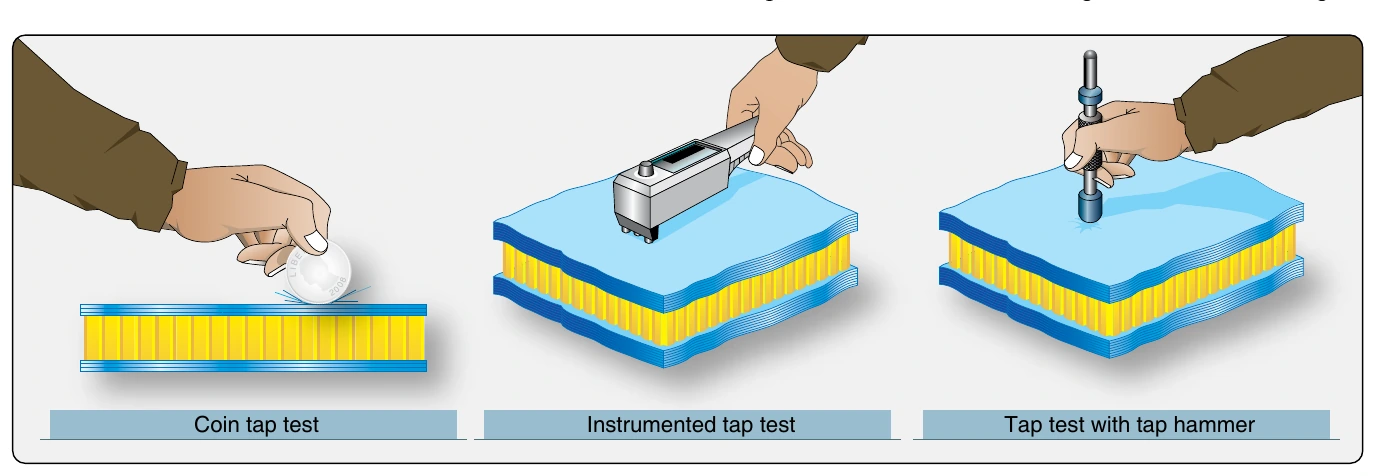
Thin laminates can be visually inspected and tap tested to map out the damage. [Figure 7-55] Thicker laminates need more in-depth NDI methods, such as ultrasonic inspection. Check in the vicinity of the damage for entry of water, oil, fuel, dirt, or other foreign matter. Water can be detected with X-ray, back light, or a moisture detector.
Step 2: Remove Water From Damaged Area
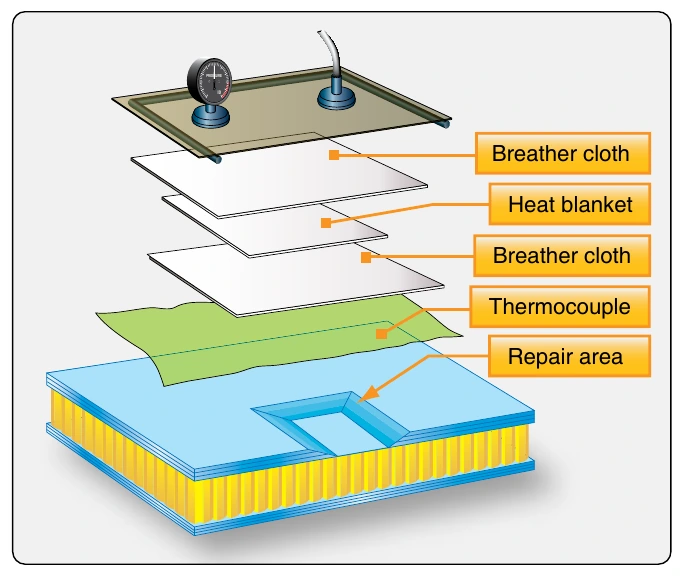
Water needs to be removed from the core before the part is repaired. [Figure 7-56] If the water is not removed, it boils during the elevated temperature cure cycle and the face sheets blow off the core, resulting in more damage. Water in the honeycomb core could also freeze at the low temperatures that exist at high altitudes, which could result in disbonding of the face sheets.
Step 3: Remove the Damage
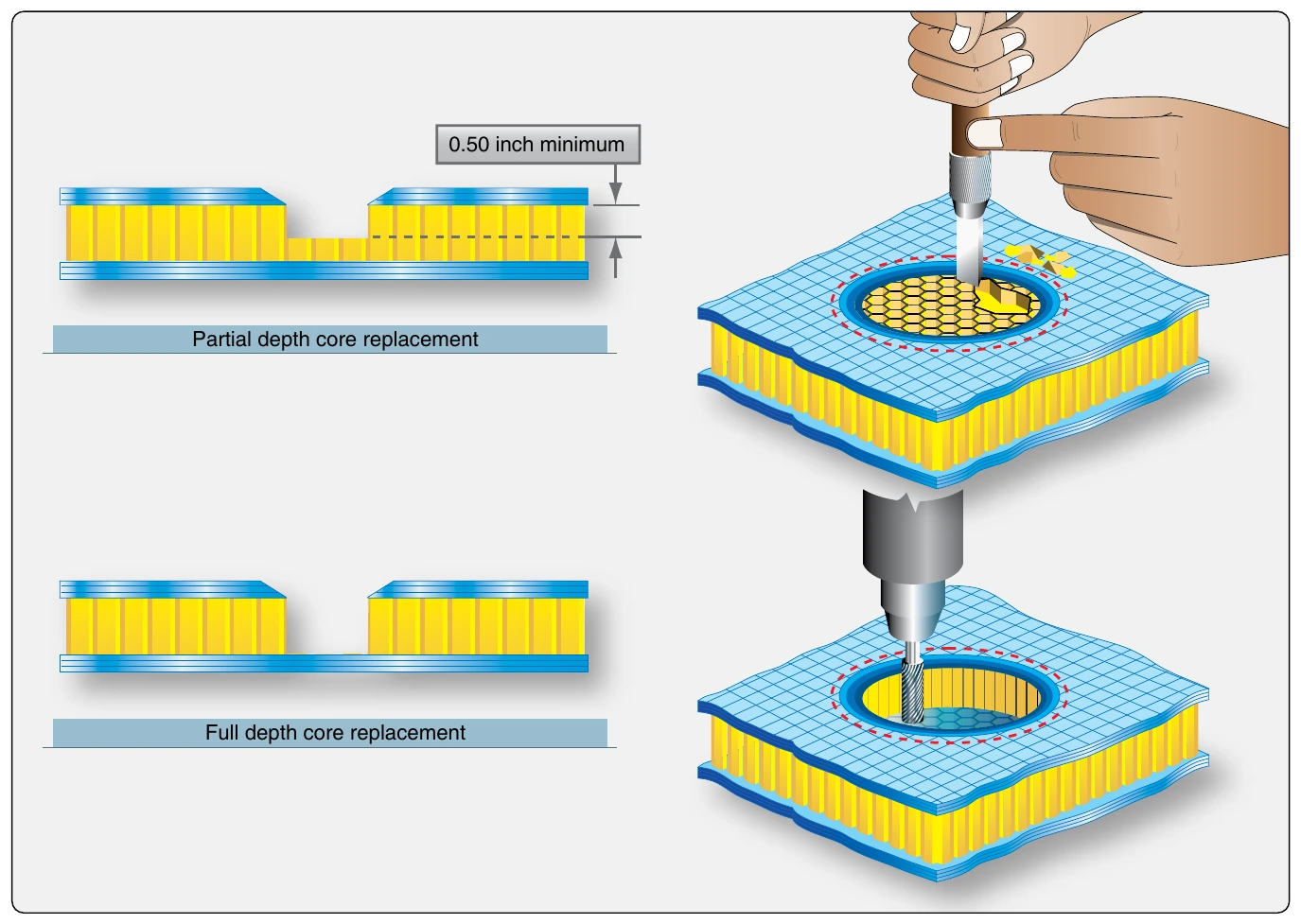
Trim out the damage to the face sheet to a smooth shape with rounded corners, or a circular or oval shape. Do not damage the undamaged plies, core, or surrounding material. If the core is damaged as well, remove the core by trimming to the same outline as the skin. [Figure 7-57]