Chapter 9
Aircraft Electrical System
To find total current:
Remember that inductive and capacitive reactances can cause a phase shift between voltage and current. In this example, inductive reactance is larger than capacitive reactance, so the voltage leads current.
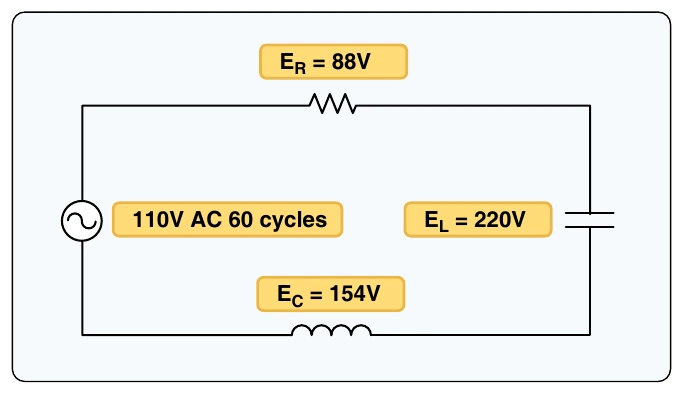
It should be noted that since inductive reactance, capacitive reactance, and resistance affect each other at right angles, the voltage drops of any series AC circuit should be added using vector addition. Figure 9-28 shows the voltage drops over the series AC circuit described in example 3 above.
To calculate the individual voltage drops, simply use the equations:
To determine the total applied voltage for the circuit, each individual voltage drop must be added using vector addition.
Parallel AC Circuits
When solving parallel AC circuits, one must also use a derivative of the Pythagorean Theorem. The equation for finding impedance in an AC circuit is as follows:
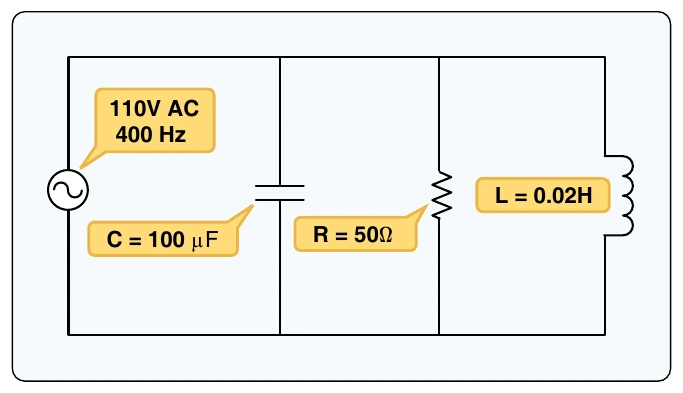
To determine the total impedance of the parallel circuit shown in Figure 9-29, one would first determine the capacitive and inductive reactances. (Remember to convert microfarads to farads.)
Next, the impedance can be found: