
Chapter 9
Aircraft Electrical System
To find the capacitive reactance, the following equation:
First, the capacitance, 80 μf, is changed to farads by dividing 80 by 1,000,000, since 1 million microfarads is equal to 1 farad. This quotient equals 0.000080 farad. This is substituted in the equation:
Impedance
The total opposition to current flow in an AC circuit is known as impedance and is represented by the letter Z. The combined effects of resistance, inductive reactance, and capacitive reactance make up impedance (the total opposition to current flow in an AC circuit). In order to accurately calculate voltage and current in AC circuits, the effect of inductance and capacitance along with resistance must be considered. Impedance is measured in ohms.
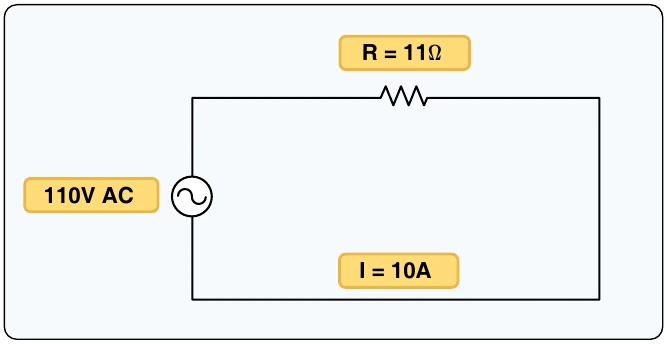
The rules and equations for DC circuits apply to AC circuits only when that circuit contains resistance alone and no inductance or capacitance. In both series and parallel circuits, if an AC circuit consists of resistance only, the value of the impedance is the same as the resistance, and Ohm’s Law
AC is applied, the following example is solved:
If there are two resistance values in parallel connected to an AC voltage, as seen in Figure 9-23, impedance is equal to the total resistance of the circuit. Once again, the calculations would be handled the same as if it were a DC circuit and the following would apply:
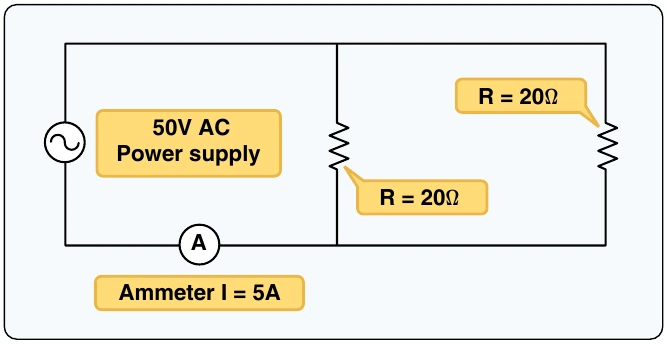
To determine the current flow in the circuit use the equation:
Impedance is the total opposition to current flow in an AC circuit. If a circuit has inductance or capacitance, one must take into consideration resistance (R), inductive reactance (XL), and/or capacitive reactance (XC) to determine impedance (Z). In this case, Z does not equal RT. Resistance and reactance (inductive or capacitive) cannot be added directly, but they can be considered as two forces acting at right angles to each other. Thus, the relation between resistance, reactance, and impedance may be illustrated by a right triangle. [Figure 9-24] Since these quantities may be related to the sides of a right triangle, the formula for finding the impedance can be found using the Pythagorean Theorem. It states that the square of the hypotenuse is equal to the sum of the squares of the other two sides. Thus, the value of any side of a right triangle can be found if the other two sides are known.
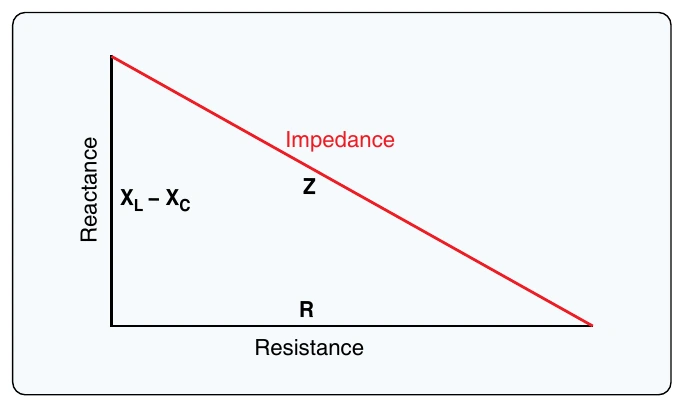
In practical terms, if a series AC circuit contains resistance and inductance, as shown in Figure 9-25, the relation between the sides can be stated as: