
Chapter 8
Cleaning & Corrosion Control
Treatment of Wrought Magnesium Sheet & Forgings
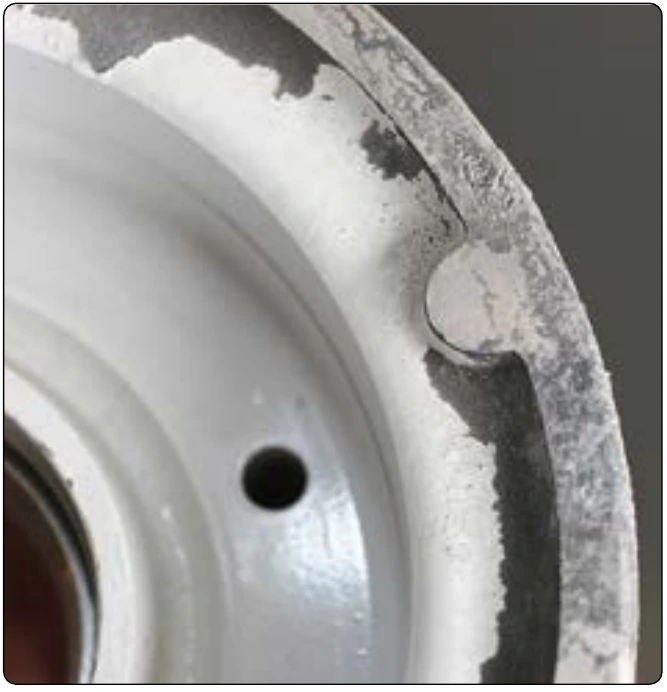
Magnesium skin corrosion usually occurs around edges of skin panels, underneath washers, or in areas physically damaged by shearing, drilling, abrasion, or impact. If the skin section can be removed easily, do so to assure complete inhibition and treatment. If insulating washers are involved, loosen screws sufficiently to permit brush treatment of the magnesium under the insulating washer. Complete mechanical removal of corrosion products is to be practiced insofar as practicable. Limit such mechanical cleaning to the use of stiff, hog bristle brushes and similar nonmetallic cleaning tools (including nonwoven abrasive pads), particularly if treatment is to be performed under field conditions. Like aluminum, under no circumstances are steel or aluminum tools; steel, bronze, or aluminum wool; or other cleaning abrasive pads used on different metal surfaces to be used in cleaning magnesium. Any entrapment of particles from steel wire brushes or steel tools, or contamination of treated surfaces by dirty abrasives, can cause more trouble than the initial corrosive attack.
Corroded magnesium may generally be treated as follows:
- Clean and strip the paint from the area to be treated. Paint stripping procedures were discussed earlier in this chapter and are also addressed in FAA AC 43.13-1, Acceptable Methods, Techniques, and Practices— Aircraft Inspection and Repair.
- Use a stiff, hog-bristle brush or nonwoven abrasive pad to break loose and remove as much of the corrosion products as practicable. Steel wire brushes, carborundum abrasives, or steel cutting tools must not be used.
- Treat the corroded area liberally with a chromic acid solution that sulfuric acid has been added to. Work the solution into pits and crevices by brushing the area while still wet with chromic acid, again using a nonmetallic brush.
- Allow the chromic acid to remain in place for 5 to 20 minutes before wiping up the excess with a clean, damp cloth. Do not allow the excess solution to dry and remain on the surface, as paint lifting is caused by such deposits.
- As soon as the surfaces are dry, restore the original protective paint.
Treatment of Installed Magnesium Castings
Magnesium castings, in general, are more porous and prone to penetrating attack than wrought magnesium skins. For all practical purposes, however, treatment is the same for all magnesium areas. Engine cases, bellcranks, fittings, numerous covers, plates, and handles are the most common magnesium castings.
When attack occurs on a casting, the earliest practicable treatment is required if dangerous corrosive penetration is to be avoided. In fact, engine cases submerged in saltwater overnight can be completely penetrated. If it is at all practicable, separate parting surfaces to effectively treat the existing attack and prevent its further progress. The same general treatment sequence in the preceding paragraph for magnesium skin is to be followed.
If extensive removal of corrosion products from a structural casting is involved, a decision from the manufacturer may be necessary to evaluate the adequacy of structural strength remaining. Specific structural repair manuals usually include dimensional tolerance limits for critical structural members and must be referred to if any question of safety is involved.
Treatment of Titanium & Titanium Alloys
Attack on titanium surfaces is generally difficult to detect. Titanium is, by nature, highly corrosion resistant, but it may show deterioration from the presence of salt deposits and metal impurities, particularly at high temperatures. Therefore, the use of steel wool, iron scrapers, or steel brushes for cleaning or for the removal of corrosion from titanium parts is prohibited.
If titanium surfaces require cleaning, hand polishing with aluminum polish or a mild abrasive is permissible if fiber brushes only are used and if the surface is treated following cleaning with a suitable solution of sodium dichromate. Wipe the treated surface with dry cloths to remove excess solution, but do not use a water rinse.
Protection of Dissimilar Metal Contacts
Certain metals are subject to corrosion when placed in contact with other metals. This is commonly referred to as electrolytic or dissimilar metals corrosion. Contact of different bare metals creates an electrolytic action when moisture is present. If this moisture is salt water, the electrolytic action is accelerated. The result of dissimilar metal contact is oxidation (decomposition) of one or both metals. The chart shown in Figure 8-30 lists the metal combinations requiring a protective separator. The separating materials may be metal primer, aluminum tape, washers, grease, or sealant, depending on the metals involved.
Contacts Not Involving Magnesium
All dissimilar joints not involving magnesium are protected by the application of a minimum of two coats of zinc chromate or, preferably, epoxy primer in addition to normal primer requirements. Primer is applied by brush or spray and allowed to air dry 6 hours between coats.
Contacts Involving Magnesium
To prevent corrosion between dissimilar metal joints in which magnesium alloy is involved, each surface is insulated as follows:
At least two coats of zinc chromate or, preferably, epoxy primer are applied to each surface. Next, a layer of pressure sensitive vinyl tape 0.003" thick is applied smoothly and firmly enough to prevent air bubbles and wrinkles. To avoid creep back, the tape is not stretched during application. When the thickness of the tape interferes with the assembly of parts, where relative motion exists between parts or when service temperatures above 250 °F are anticipated, the use of tape is eliminated and extra coats (minimum of three) of primer are applied.