
Chapter 8
Cleaning & Corrosion Control
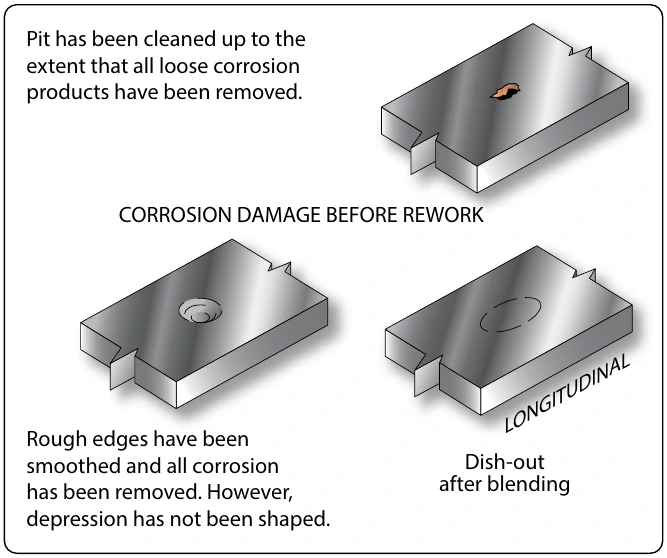
All depressions resulting from corrosion rework must be faired or blended with the surrounding surface. Fairing can be accomplished as follows:
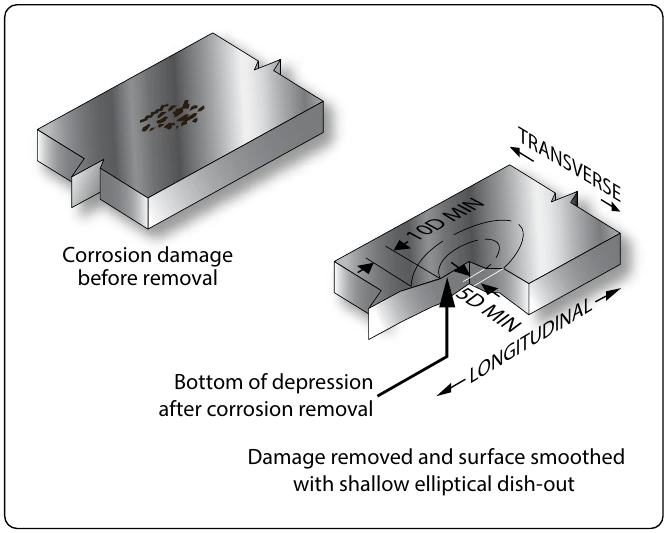
- Remove rough edges and all corrosion from the damaged area. All dish-outs must be elliptically shaped with the major axis running spanwise on wings and horizontal stabilizers, longitudinally on fuselages, and vertically on vertical stabilizers.
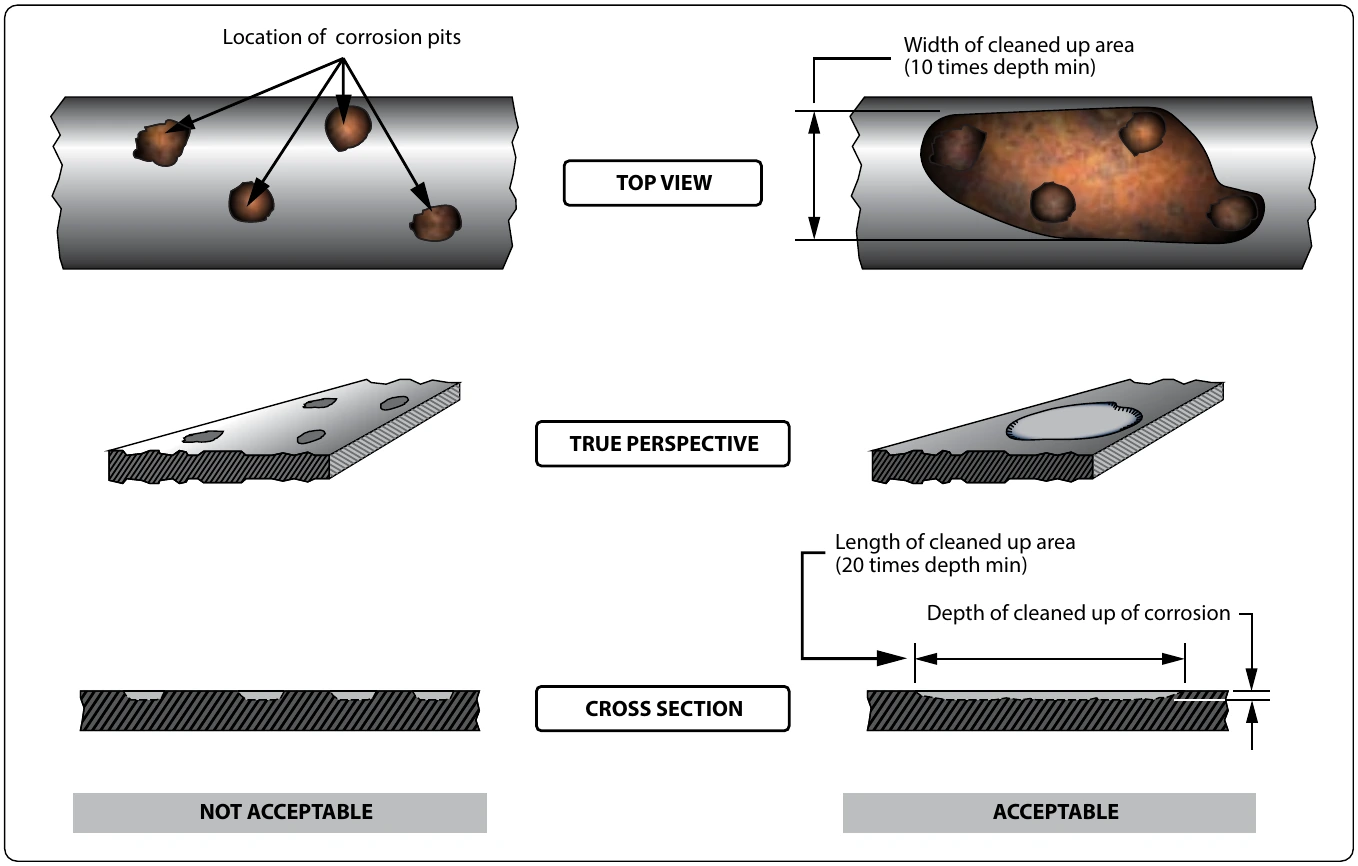
- In critical and highly stressed areas, all pits remaining after the removal of corrosion products must be blended out to prevent stress risers that may cause stress corrosion cracking. [Figure 8-23] On a non-critical structure, it is not necessary to blend out pits remaining after removal of corrosion products by abrasive blasting, since this results in unnecessary metal removal.
Rework depressions by forming smoothly blended dish-outs, using a ratio of 20:1, length to depth. [Figure 8-24] In areas having closely-spaced, multiple pits, intervening material must be removed to minimize surface irregularity or waviness. [Figure 8-25] Steel nut-plates and steel fasteners are to be removed before blending corrosion out of aluminum structure. Steel or copper particles embedded in aluminum can become a point of future corrosion. All corrosion products must be removed during blending to prevent reoccurrence of corrosion.
Corrosion of Ferrous Metals
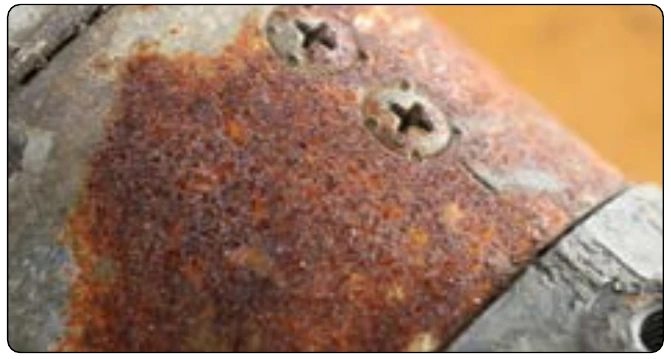
One of the most familiar types of corrosion is ferrous oxide (rust), generally resulting from atmospheric oxidation of steel surfaces. Some metal-oxides protect the underlying base metal, but rust is not a protective coating in any sense of the word. Its presence actually promotes additional attack by attracting moisture from the air and acting as a catalyst for additional corrosion. If complete control of the corrosive attack is to be realized, all rust must be removed from steel surfaces.
Rust first appears on bolt heads, hold-down nuts, or other unprotected aircraft hardware. [Figure 8-26] Its presence in these areas is generally not dangerous and has no immediate effect on the structural strength of any major components. The residue from the rust may also contaminate other ferrous components, promoting corrosion of those parts. The rust is indicative of a need for maintenance and of possible corrosive attack in more critical areas. It is also a factor in the general appearance of the equipment. When paint failures occur or mechanical damage exposes highly-stressed steel surfaces to the atmosphere, even the smallest amount of rusting is potentially dangerous in these areas and must be removed and controlled. Rust removal from structural components, followed by an inspection and damage assessment, must be done as soon as feasible. [Figure 8-27]
Mechanical Removal of Iron Rust
The most practicable means of controlling the corrosion of steel is the complete removal of corrosion products by mechanical means and restoring corrosion preventive coatings. Except on highly-stressed steel surfaces, the use of abrasive papers and compounds, small power buffers and buffing compounds, hand wire brushing, or steel wool are all acceptable cleanup procedures. However, it should be recognized that in any such use of abrasives, residual rust usually remains in the bottom of small pits and other crevices. It is practically impossible to remove all corrosion products by abrasive or polishing methods alone. As a result, once a part cleaned in such a manner has rusted, it usually corrodes again more easily than it did the first time.
The introduction of variations of the nonwoven abrasive pad has also increased the options available for the removal of surface rust. [Figure 8-28] Flap wheels, pads intended for use with rotary or oscillating power tools, and hand-held nonwoven abrasive pads all can be used alone or with light oils to remove corrosion from ferrous components.
Chemical Removal of Rust
As environmental concerns have been addressed in recent years, interest in noncaustic chemical rust removal has increased. A variety of commercial products that actively remove the iron oxide without chemically etching the base metal are available and can be considered for use. If at all possible, the steel part is removed from the airframe for treatment, as it can be nearly impossible to remove all residue. The use of any caustic rust removal product requires the isolation of the part from any nonferrous metals during treatment and probably inspection for proper dimensions.
phosphates and other protective coatings. Other commercial preparations are effective rust converters where tolerances are not critical and where thorough rinsing and neutralizing of residual acid is possible. These situations are generally not applicable to assembled aircraft, and the use of chemical occur when such materials are used under field conditions, outweigh any advantages to be gained from their use.
Removal of Corrosion from Highly Stressed Steel Parts
Any corrosion on the surface of a highly-stressed steel part is potentially dangerous, and the careful removal of corrosion products is required. Surface scratches or change in surface structure from overheating can also cause sudden failure of these parts. Corrosion products must be removed by careful processing, using mild abrasive papers, such as rouge or fine grit aluminum oxide or fine buffing compounds on cloth buffing wheels. Nonwoven abrasive pads can also be used. It is essential that steel surfaces not be overheated during buffing. After careful removal of surface corrosion, reapply protective paint finishes immediately. The use of chemical corrosion removers is prohibited without engineering authorization, because high-strength steel parts are subject to hydrogen embrittlement.
Corrosion of Aluminum & Aluminum Alloys
Aluminum and aluminum alloys are the most widely used material for aircraft construction. Aluminum appears high in the electro-chemical series of elements and corrodes very easily. However, the formation of a tightly-adhering oxide film offers increased resistance under most corrosive conditions. Most metals in contact with aluminum form couples that undergo galvanic corrosion attack. The alloys of aluminum are subject to pitting, intergranular corrosion, and intergranular stress corrosion cracking. In some cases, the corrosion products of metal in contact with aluminum are corrosive to aluminum. Therefore, aluminum and its alloys must be cleaned and protected.