
Chapter 9
Fluid Lines & Fittings
Flexible rubber hose consists of a seamless synthetic rubber inner tube covered with layers of cotton braid and wire braid and an outer layer of rubber-impregnated cotton braid. This type of hose is suitable for use in fuel, oil, coolant, and hydraulic systems. The types of hose are normally classified by the amount of pressure they are designed to withstand under normal operating conditions: low, medium, and high.
- Low pressure—below 250 psi. Fabric braid reinforcement.
- Medium pressure—up to 3,000 psi. One wire braid reinforcement. Smaller sizes carry up to 3,000 psi. Larger sizes carry pressure up to 1,500 psi.
- High pressure—all sizes up to 3,000 psi operating pressures.
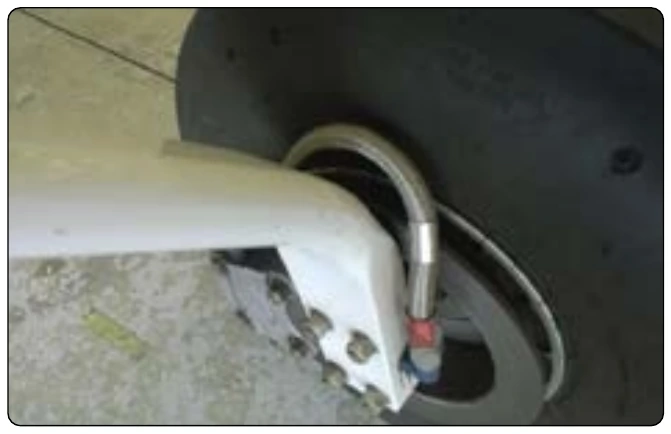
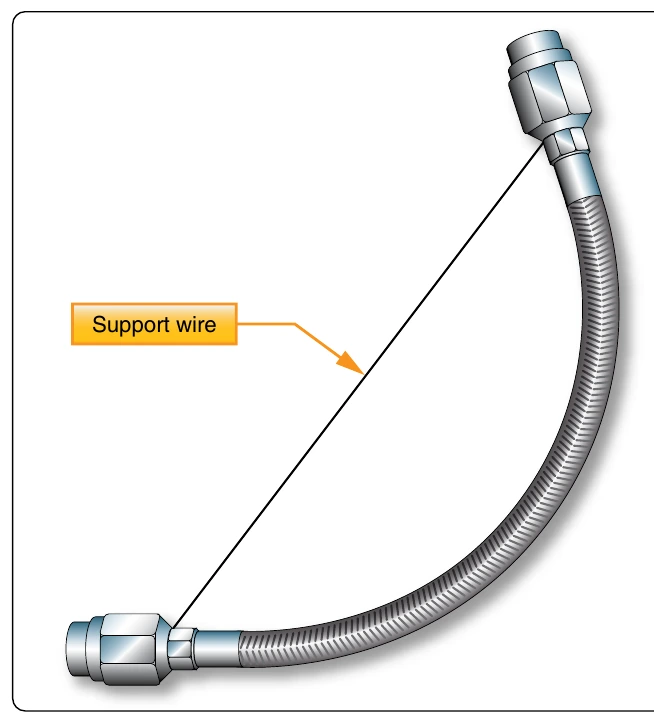
Flexible hoses used for brake systems have sometimes a stainless steel wire braid installed over the hose to protect the hose from damage. [Figure 9-32]
Hose Identification
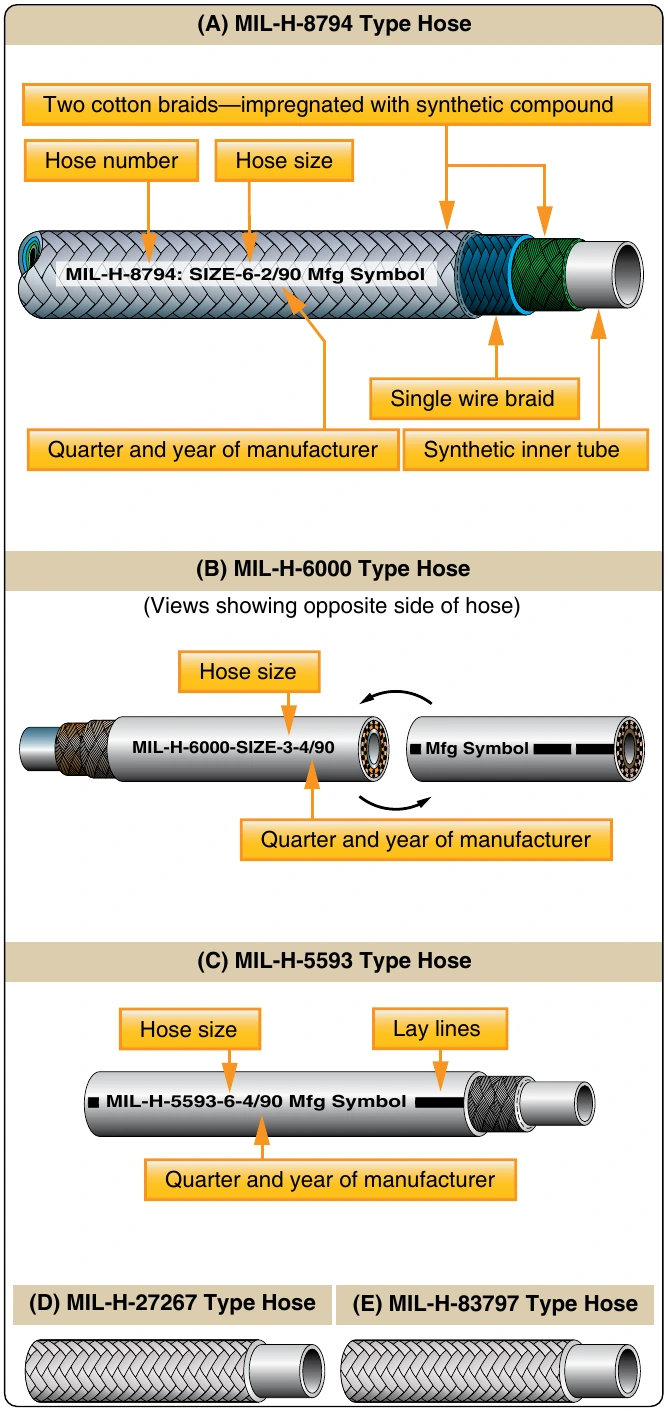
Lay lines and identification markings consisting of lines, letters, and numbers are printed on the hose. [Figure 9-33] Most hydraulic hose is marked to identify its type, the quarter and year of manufacture, and a 5-digit code identifying the manufacturer. These markings are in contrasting colored letters and numerals that indicate the specifications or a recommended substitute. Hose suitable for use with phosphate ester base hydraulic fluid is marked Skydrol™ use. In some instances, several types of hose may be suitable for the same use. Therefore, to make the correct hose selection, always refer to the applicable aircraft maintenance or parts manual.
Teflon™ is the DuPont trade name for tetrafluoroethylene resin. It has a broad operating temperature range (−65 °F to +450 °F). It is compatible with nearly every substance or agent used. It offers little resistance to flow; sticky, viscous materials do not adhere to it. It has less volumetric expansion than rubber, and the shelf and service life is practically limitless. Teflon™ hose is flexible and designed to meet the requirements of higher operating temperatures and pressures in present aircraft systems. Generally, it may be used in the same manner as rubber hose. Teflon™ hose is processed and extruded into tube shape to a desired size. It is covered with stainless steel wire, which is braided over the tube for strength and protection. Teflon™ hose is unaffected by any known fuel, petroleum, or synthetic base oils, alcohol, coolants, or solvents commonly used in aircraft. Teflon™ hose has the distinct advantages of a practically unlimited storage time, greater operating temperature range, and broad usage (hydraulic, fuel, oil, coolant, water, alcohol, and pneumatic systems). Medium-pressure Teflon™ hose assemblies are sometimes preformed to clear obstructions and to make connections using the shortest possible hose length. Since preforming permits tighter bends that eliminate the need for [Figure 9-34]
Flexible Hose Inspection
Check the hose and hose assemblies for deterioration at each inspection period. Leakage, separation of the cover or braid from the inner tube, cracks, hardening, lack of flexibility, or excessive “cold flow” are apparent signs of deterioration and reason for replacement. The term “cold flow” describes the deep, permanent impressions in the hose produced by the pressure of hose clamps or supports.
When failure occurs in a flexible hose equipped with swaged end fittings, the entire assembly must be replaced. Obtain a new hose assembly of the correct size and length, complete with factory installed end fittings. When failure occurs in hose
Fabrication & Replacement of Flexible Hose
To make a hose assembly, select the proper size hose and end fitting. [Figure 9-35] MS-type end fittings for flexible hose are detachable and may be reused if determined to be serviceable. The inside diameter of the fitting is the same as the inside diameter of the hose to which it is attached. [Figure 9-36] applying pressure to the inside of the hose assembly. The proof-test medium may be a liquid or gas. For example, hydraulic, fuel, and oil lines are generally tested using hydraulic oil or water, whereas air or instrument lines are tested with dry, oil-free air or nitrogen. When testing with a liquid, all trapped air is bled from the assembly prior to tightening the cap or plug. Hose tests, using a gas, are conducted underwater. In all cases, follow the hose manufacturer’s instructions for proof-test pressure and fluid to be used when testing a specific hose assembly. [Figure 9-37]
When a flexible hose has been repaired or overhauled using existing hardware and new hose material, and before the hose is installed on the aircraft, it is recommended that the hose be tested to at least 1.5 system pressure. A hydraulic hose burst test stand is used for testing flexible hose. [Figure 9-38] A new hose can be operationally checked after it is installed in the aircraft using system pressure.
Size Designations
Hose is also designated by a dash number according to its size. The dash number is stenciled on the side of the hose and indicates the size tubing with which the hose is compatible. It does not denote inside or outside diameter. When the dash number of the hose corresponds with the dash number of the tubing, the proper size hose is being used. [Figure 9-33] detachable fittings, or they may be used with beads and hose clamps. Hoses equipped with swaged fittings are ordered by correct length from the manufacturer and ordinarily cannot be assembled by the mechanic. They are swaged and tested at the factory and are equipped with standard fittings. The detachable fittings used on flexible hoses may be detached and reused if they are not damaged; otherwise, new fittings must be used. [Figure 9-39]